A scone-fuelled mission

It’s fun to have a mission.

I’ve been to the Tate Britain many times before but this was the first time I had a mission – I was looking for artworks that had representations of home in them.

Often I wander around museums and don’t really feel like I’m engaging with them. I did a short ethnography course a million years ago and the activity I undertook was watching others interacting with an artwork. Sitting there for an afternoon I felt quite exposed because, although I’d picked a quite well known and large piece of art to watch the watchers, most people passed it by very quickly indeed. My sitting there for so long felt very out of place compared to how long others were interacting with the artwork.

As someone who’s never learned ‘how to’ interpret art, I don’t feel like I come to it with a very wide vocabulary to understand what I’m seeing. That’s partly why I’m so interested in including reviewing different cultural materials in my PhD – it’s a way for me to learn some skills and approaches to understanding and interrogating artwork.

I love going to museums and galleries and enjoy exploring, so being able to get more ways to understand pieces of art and find ways to interact with them in a more meaningful way feels like such an enriching thing to be able to do. The fact that it’s in the service of something that feels useful in terms of answering the questions of my wider PhD then means I can allow myself to enjoy it without the more puritanical streak in me freaking out.

I also got to have some delicious tea and a lovely scone with an absolutely stonking amount of clotted cream and jam to refresh me part-way through the endeavour. If anyone had told me this is what working on the weekend could be like I think past me would find it as hard as current me to fathom this could be the case.

In that context then, I really enjoyed having that sense of purpose – being able to make my way around the exhibition with a hook to see what I could find. I also passed on my mission to the posse I was with which added to the fun, for me at least – I didn’t do a feedback poll to see how the others felt about it.

I had expected to be able to find more things along the way than I did though. Lots of pieces either didn’t seem to relate to the home or didn’t show people in that context.

Here are a few of the ones I did find along the way.

Walter Sickert, Ennui, 1914

A fascinating piece, with such a story within it of the relationship between the two people. Virginia Woolf wrote an essay about Sickert, and particularly this piece, as a response. Albeit Woolf was writing in response to another version of the painting done by Sickert and held at the Ashmolean Museum – that one has much more vibrant colours and decor but the people within it are unchanged. Stuck and bored whatever their surroundings.

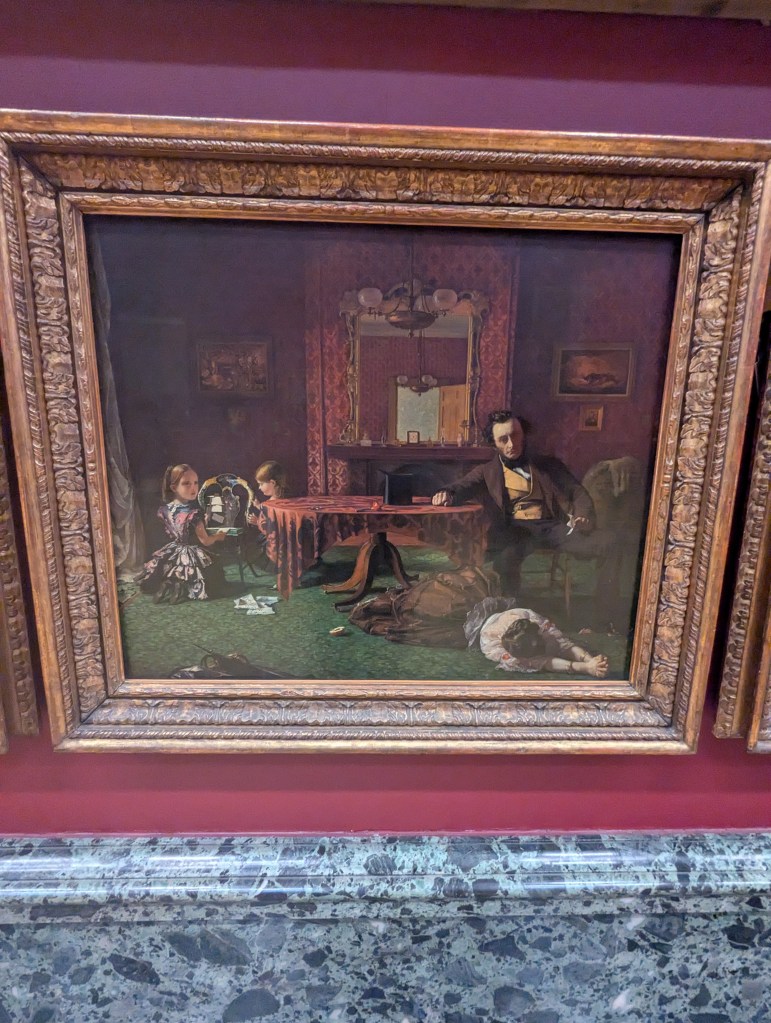
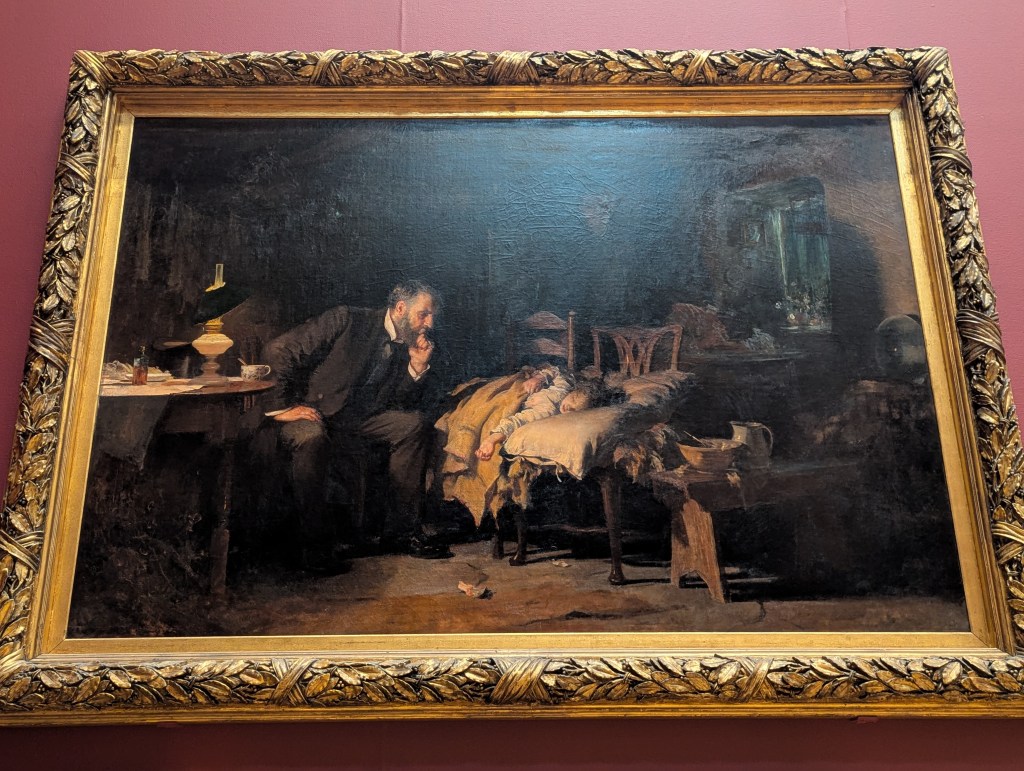
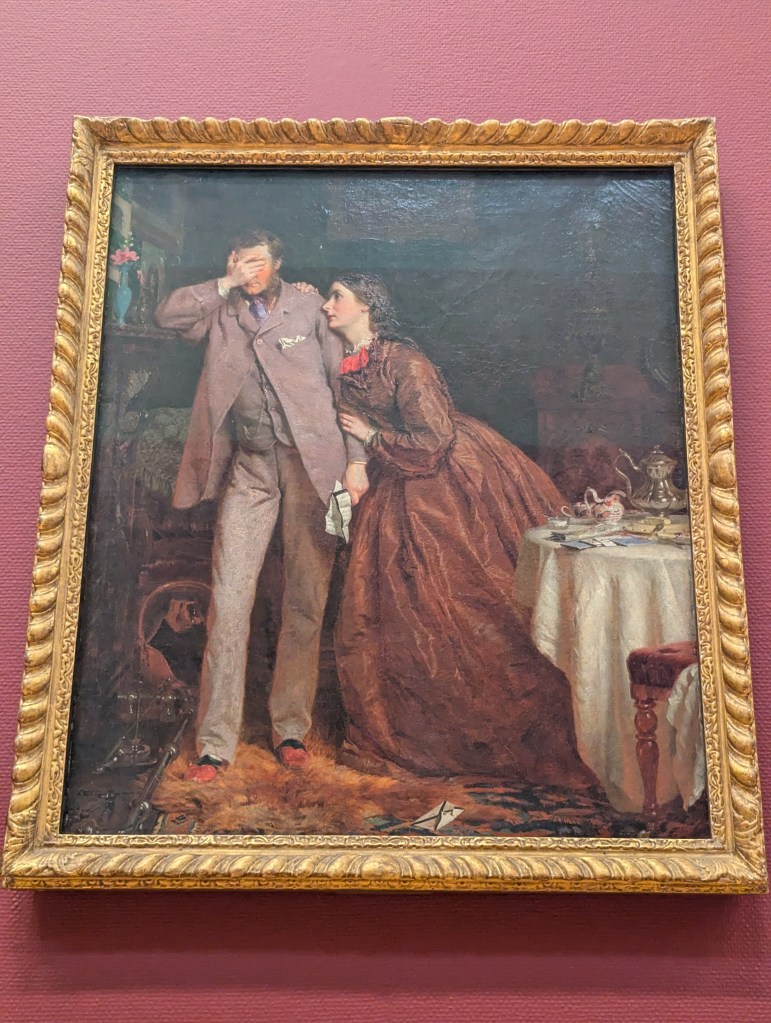
That sense of a story in the paintings comes through much more strongly in those pieces where there are multiple people in. From a Dr looking after a sick child, to men distraught – sometimes supported by their wife as in Hick’s work, at other times, as in Egg’s the prostrate woman is apparently the cause. Of course that also makes it harder to see the interiors though…

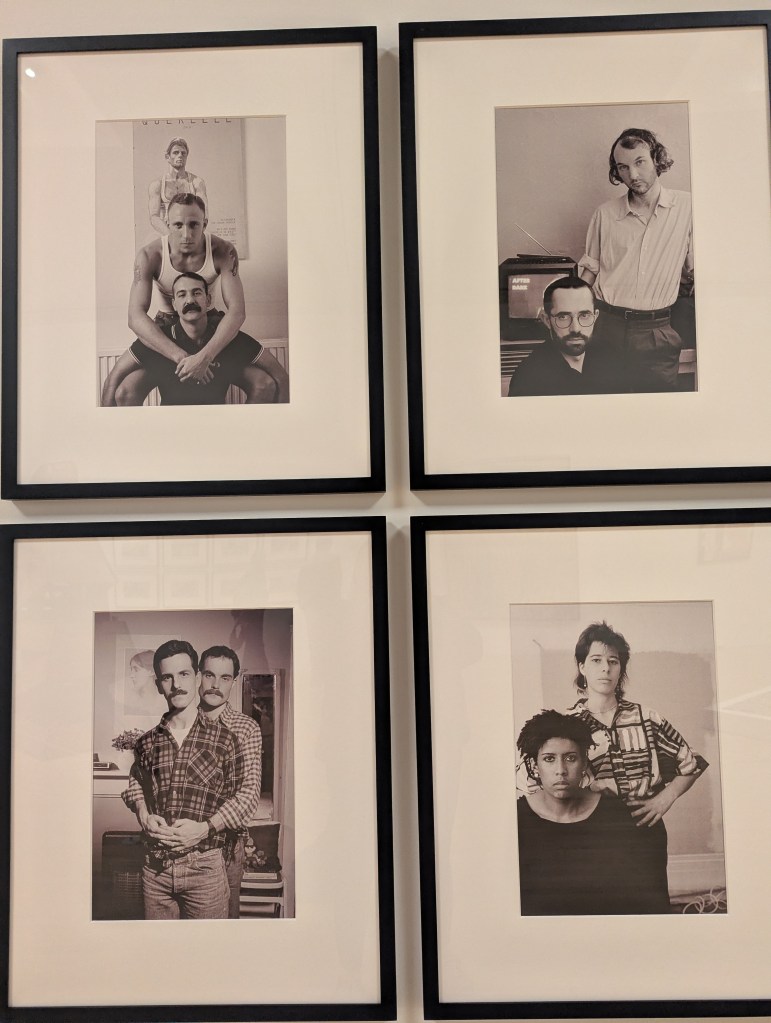
Woolf makes another appearance in the home of one couple in Gupta’s series showing homosexual couples at home. The photos were taken at a time in the 1980s when homosexuality was being portrayed as deviant whilst these photos present them as ordinary rather than other.
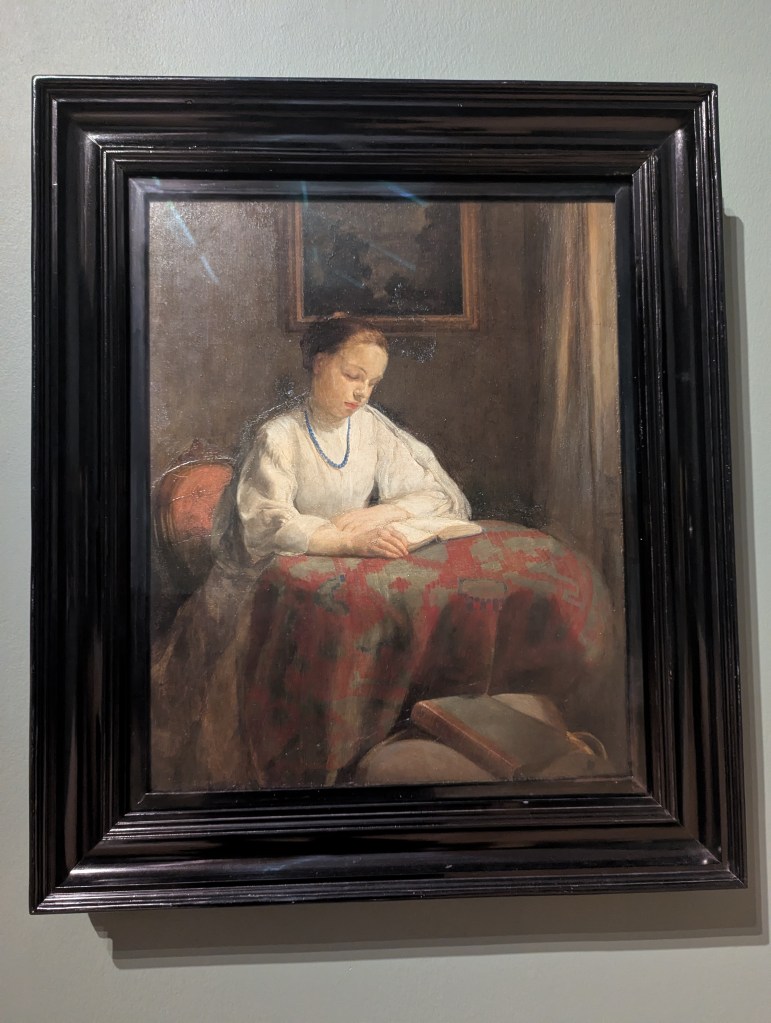
All of the paintings have a story to tell but from this collection of paintings at least, it’s a gentler story in those with just one person in. Peace, quiet and reflection in the scenes but, apart from McEvoy’s painting the interiors themselves are vibrant and busy – full of colour and objects.
More wandering and exploring, a beautiful richly coloured and empty view of the room where Shakespeare was apparently born; a side-quest visit to see the Henry Moore’s because I can still enjoy the stark, sensual beauty of them whilst working hard.

Then, as we left the building, we were met by Chris Ofili’s colourful, elegiac piece in memory of those who died in the Grenfell Tower fire. A totally different piece. The scale monumental compared to the smaller pieces I’d seen. Richly coloured and far removed from the gentle, quiet reflections. As with some of the other pieces, telling a story about when things have gone wrong, failings and harm. This time, at a societal level rather than between two people. The painting itself has a dreamlike quality about a nightmarish situation.
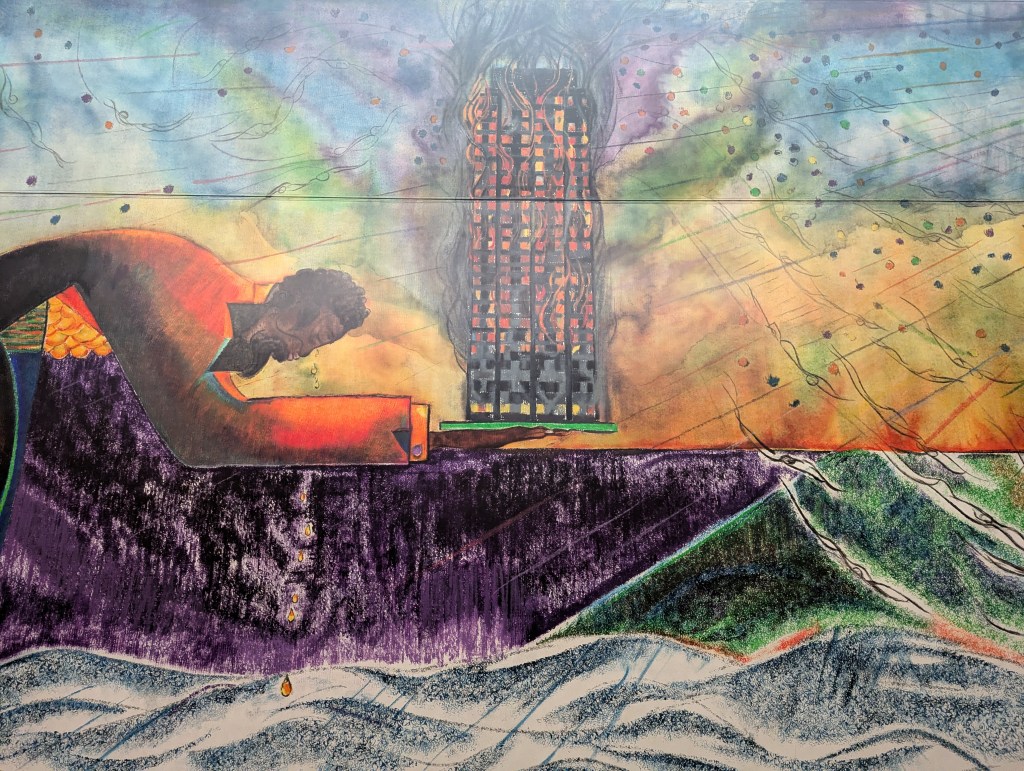
Chris Ofili, Requiem, 2023

Only a few pieces of art found on my visit but that small selection shows just how varied homes and home-making and un-making can be, how fundamental they are to our lives and wellbeing.

The RoI of paint

Luring you in with my jargon chat there. Not here to talk about the French king of paint. RoI is what the cool kids use to talk about a return on investment.

In economics world, where we are rational actors, the talk is about return on investment. If an organisation or an individual invests £x, how long will it take them to see a return on that? Investing £x means maintenance or running costs will be x% lower and therefore you can calculate how long it will take to generate savings which add up to original investment. Aka your return on investment.

All sounds really straightforward and scientific. Hard crunchy numbers which are inarguable. Intentionally so I think. Constructing approaches which reinforce the impression that this is an objective approach in a world which seems to think objectivity is good thing. As Christie, Smith and Munro (2008) reflect, detachment, objectivity and scepticism are simply forms of emotion work which have been privileged within accounts of the scientific method, and I would argue more broadly too.

Yet how those numbers get developed, who is in control of defining what does or doesn’t weigh on the scales is also fundamental. In another lifetime I was trying to develop a project using the feed-in tariff – a governmental mechanism to provide an above-market price for renewable energy generated. When the feed-in tariff was first introduced the rates were really high, such that it would only take about 10 years to break even on the tariff, with another 15 years of income given the feed-in tariff lasted for 25 years. This was far and away a better deal than lots of other investment opportunities. It was so good that we didn’t even try to claim bill savings from the energy generated because there were a lot of variables in consumption patterns and we didn’t have sufficient confidence in the indicative numbers we generated.

It wasn’t our first rodeo doing this kind of project so we felt confident that we had covered the different elements to build up the cost profile that people would expect. Over time in discussion with senior decision makers, we were asked to add all kinds of costs in which were normally outside the scope of costs for this kind of decision. More and more costs got added on and the numbers that popped out the other end of the evaluation got worse and worse. We looked to offset this by adding in projected cost savings on energy but eventually the model broke. It became clear that they just didn’t want to do the project, so they kept going until the RoI looked so bad that people said there was no way they could support the project. They ‘weren’t sure’ about the technology but could turn it in to numbers that looked empirical, feel like they were doing their job properly and meant they didn’t need to engage with their lack of knowledge.

Yet there are many items we spend money on where even attempting that kind of calculation doesn’t make sense. Paint for instance. Or a vase. Maybe it’s easier with paint. We can at least try and make a guess at whether one kind of paint might last compared to a cheaper one. That’s not entirely straightforward though either. What does it mean for paint to last? Never gets any marks on it at all? To bounce back after marks have been attempted to get cleaned off? Or something more ephemeral – it lasts longer because we really like the colour and it fits with the place and how we want it to be? Continually works as we look to shift things around in terms of the look of the place?

We can do some research to get feedback on how long paint ‘lasts’ but is that a meaningful metric for how people actually make decisions? For many people, the premium for some paints like Farrow & Ball is worth it because of the vibe the paint has. It makes people feel they are buying some of that lifestyle which the relative difference in costs compared to cheaper paint allows, in a way the cost differential between their home and one more in keeping with the atmos isn’t.

Of course, paint is much cheaper than lots of other things people can do to their homes. So transformative as well. A tin of paint, a few hours and a totally different space. Hard to think of something which can make as much of a difference as quickly. In terms of bang for your beautifully coloured buck it scores highly. When people move into a new place there can often be talk about wanting to make the place their own (Cook, 2021). Paint is such a strong way to do that, literally getting attached to the place. The act and practice of making the place your home.

It’s therefore unsurprising that people will be prepared to spend a bit more on paint and might not think about the RoI, compared to more expensive things like heat pumps or solar PV. In both cases the question might be around whether they can afford it or not, it’s just that in the latter case the upfront cost is much higher and therefore it might not be possible to satisfy the want.

For many people, they’ve already got a heating system which works. Making the change to a heat pump or getting solar doesn’t solve a problem or give them an opportunity. It will make their home slightly differently warm. It might bring with it indeterminate concerns about running costs or how it works. It’s a lot of cost, in a world where choosing the heat pump or solar likely means choosing not to do lots of other things. Of course there are an increasing number of people for whom it isn’t a choice in the first place but for those who have enough in the bank or can borrow, it is a choice and one it can be hard to justify.

Of course we’re talking about costs which are orders of magnitude different but does that mean the thought processes which lead to the choice are totally different?