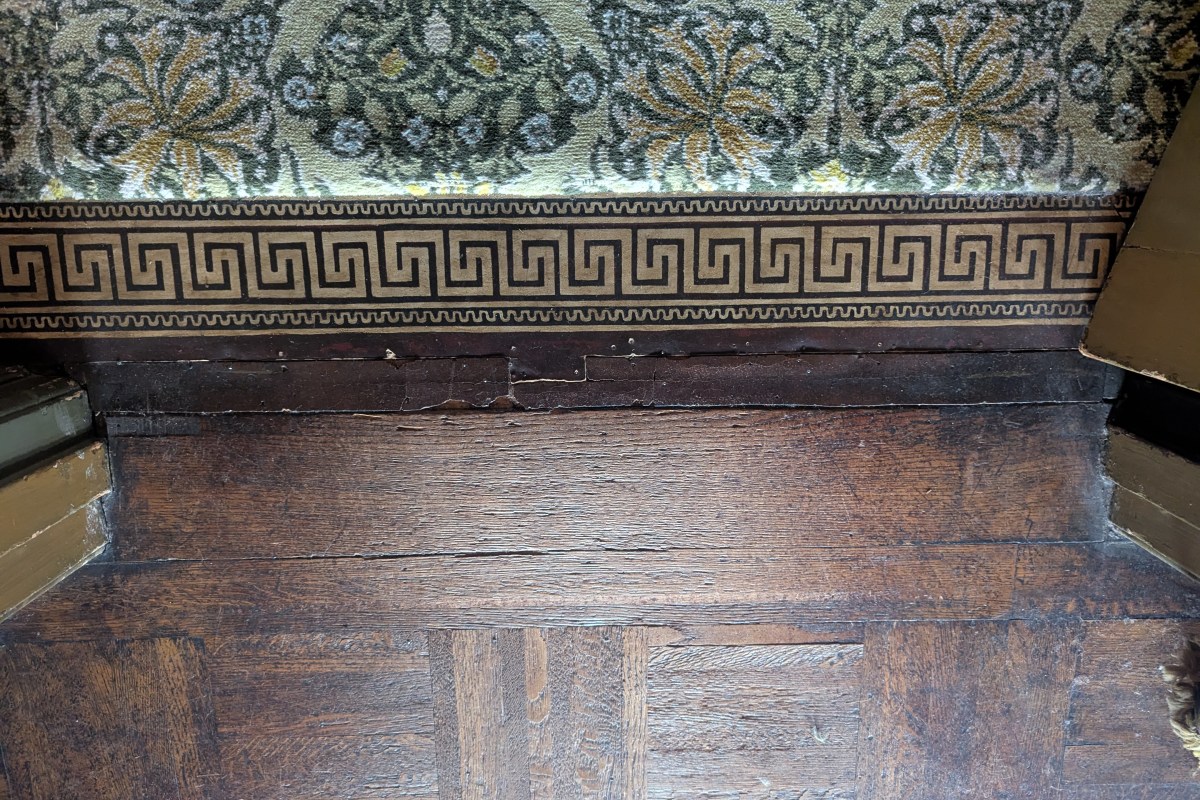
My latest study visit took me to Sambourne House, the family home of Linley Sambourne, the artist and Chief Cartoonist for Punch magazine that has been preserved almost untouched. The space has become a show home but still feels very lived in. It gives an insight into Victorian life and particularly for that of a family with an artistic disposition. The house shows how homes can absorb the influences and advances of the time, and yet still allow people to express their own tastes.
The house reflects the ‘House Beautiful’ aesthetic of the time – this saw a reaction to mass produced products, favouring the handmade and recognising the value of furniture and furnishings as artworks. The style tends to include lots of natural motifs and more muted colours – which can be seen throughout the house in the colours and designs, including William Morris wallpapers.
However, the house also reflects how people can take aspects of the current styles and adjust them to their own tastes. Another aspect of this style is a restrained, pared back approach and that is most definitely not the case in the Sambourne’s house. As the picture of the living room below shows, it is a space that is very full of things indeed.
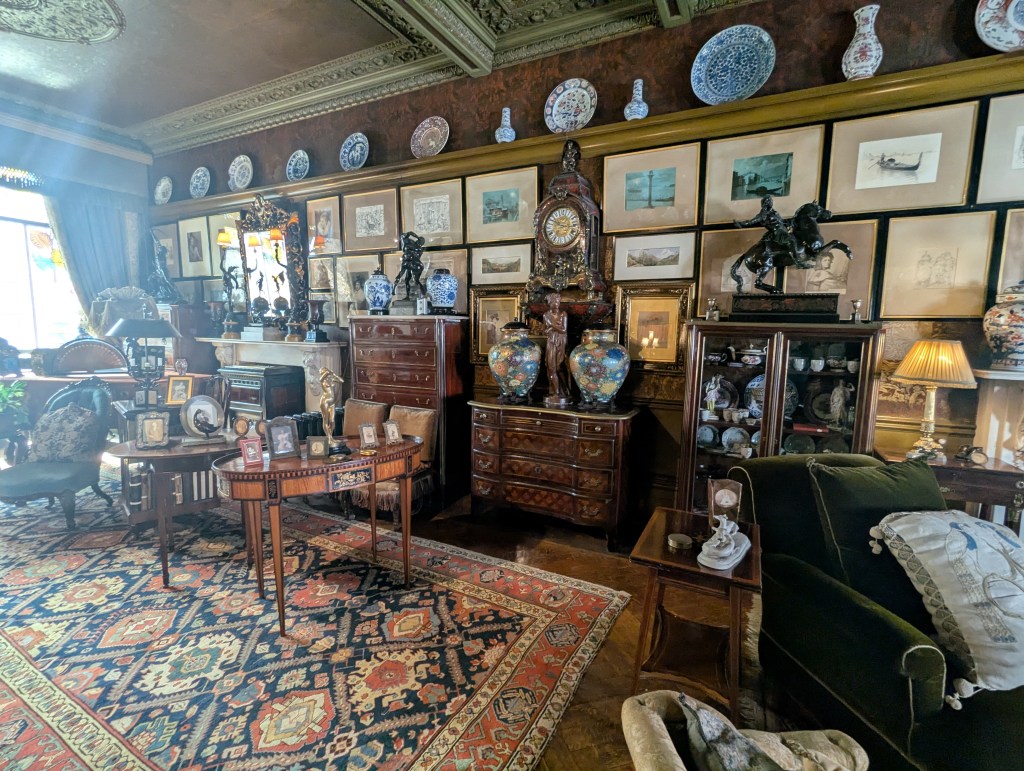
As the picture above also shows, there are lots of elements of the interior which are connected to the exterior. Chinoiserie and pictures from and of the wider world – from their travels and also to reflect their connections to and placing themselves in relation to the world. Rugs and vases from around the world too – showing how homes are not just individual spaces but are connected to other places and people and that people intentionally seek out those connections. Influences and designs, a way of showing off both your taste and sense of self, allowing you to be somewhat out in the world even when at home, and signalling to others that you are cosmopolitan and connected.
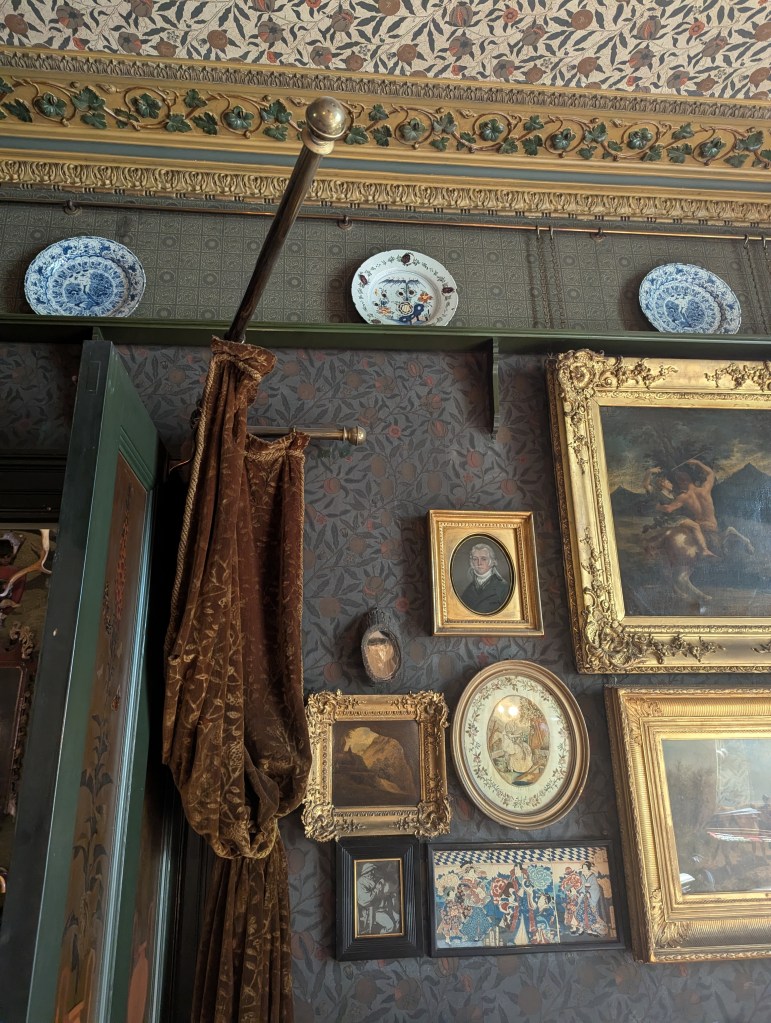
There was a strong sense of comfort about the place, with lots of places for people to sit, rich and warm fabrics and materials covering all of the surfaces, and fireplaces in the rooms and even in the hall. I was very intrigued to find a curtain over the doorway in one of the rooms – part of it was on a pole that comes out so you can open the door without getting the curtain tangled up with the door. I had never seen that technology before but it makes such sense.
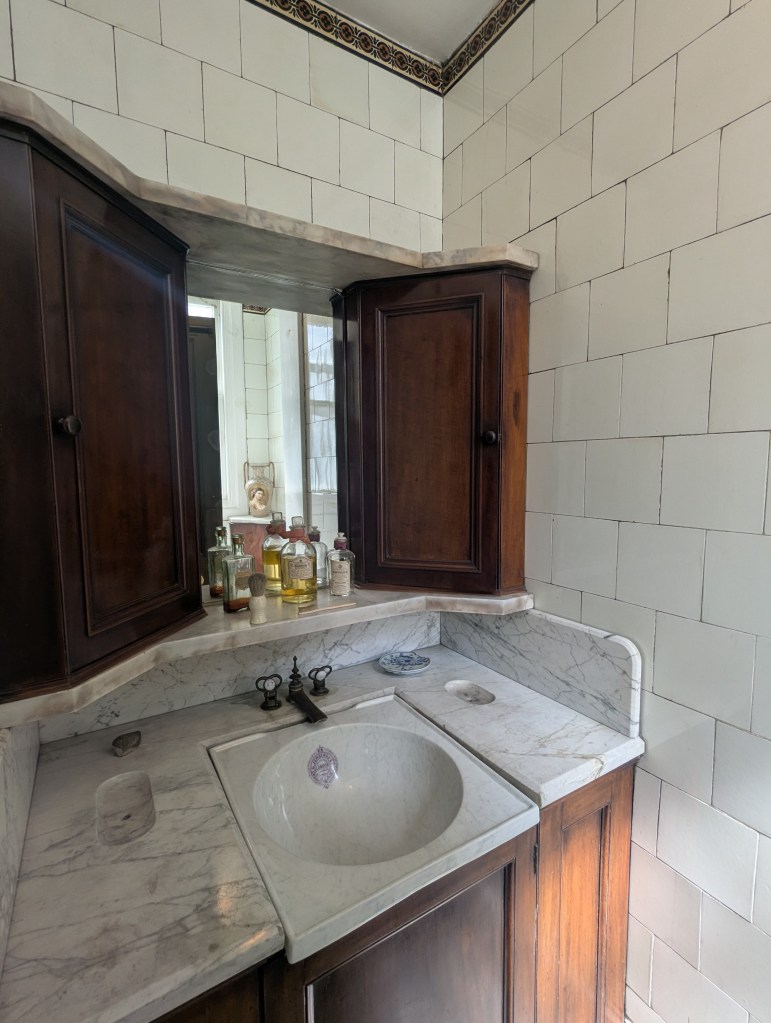
Another sign of the modernity of the house was that it has a downstairs cloakroom toilet as well as a separate bathroom with a toilet. This increased prevalence of toilets was something that was starting to come forward in Victorian times, following The Great Exhibition of 1851 at Crystal Palace. There the expression ‘to spend a penny’ came into being, as people could spend a penny to trial the first paid public toilets. This helped increased expectations about the availability of toilets, and the privacy of having a separate space for them.
The downstairs cloakroom is so modern that the sink is a technology innovation – to empty it you would have to tilt it to let the water run out of. These sinks allowed people to have access to running water and enabled them to wash their hands without needing to have the pipework plumbed in. This made it much more accessible for people to have installed, it also got around the issue which arose where plumbing systems initially were quite smelly – rendering them less attractive for people from that perspective. I wasn’t able to get in to the room to have a look but typically these sinks would empty into a bucket which would be cleared away – by the servants.
While the rest of the house is very highly decorated, the cloakroom has the white tiling that Barbara Penner talks about in her book which have come from a medical context – where the white tiles are designed to show how clean the place is, or make it easy to tell if and where it isn’t.
After Linley and his wife Marion died the house was left to their son Roy, who kept the house largely unchanged. When he died in 1946 the house was left to his sister Maud. Maud already had a large London residence, and so the house became a time capsule, mostly unoccupied and unchanged. Maud’s daughter Anne became fascinated by the place, leading to her setting up the Victorian Society and the continued preservation of the house.
I was interested by Roy Sambourne – choosing to live in the house and preserve it largely unchanged from when his parents had lived there. It seemed like an odd choice, to consciously choose to preserve somewhere, particularly somewhere that wasn’t a ‘stately’ home or one belonging to particularly famous people. I wondered how much it was a conscious choice or if it was something that reflected more a lack of decisions and action to make changes
As I found out more about Roy it came to make a bit more sense. From what I’ve been able to gather, he never really found his way in life. His mother Marion Sambourne wrote that “she was worried that her son had inherited none of the ambition and capacity for sustained hard work which had made his father so successful”. Roy’s biographer Shirley Nicholson writes in her book ‘An Edwardian Bachelor’ that “All Roy ever wanted to do was have a good time with the minimum amount of effort. This may not be an unusual attitude among the young, but Roy was never to grow out of it; Life carried him along, while he made no effort to shape its course”. When I read that, it became easier to see how he might choose to live in the house and not make any particular changes to it – beyond apparently getting the woodwork in his bedroom changed from red to white – while still leaving a space that didn’t feel very minimalist, as the picture of his room below shows.
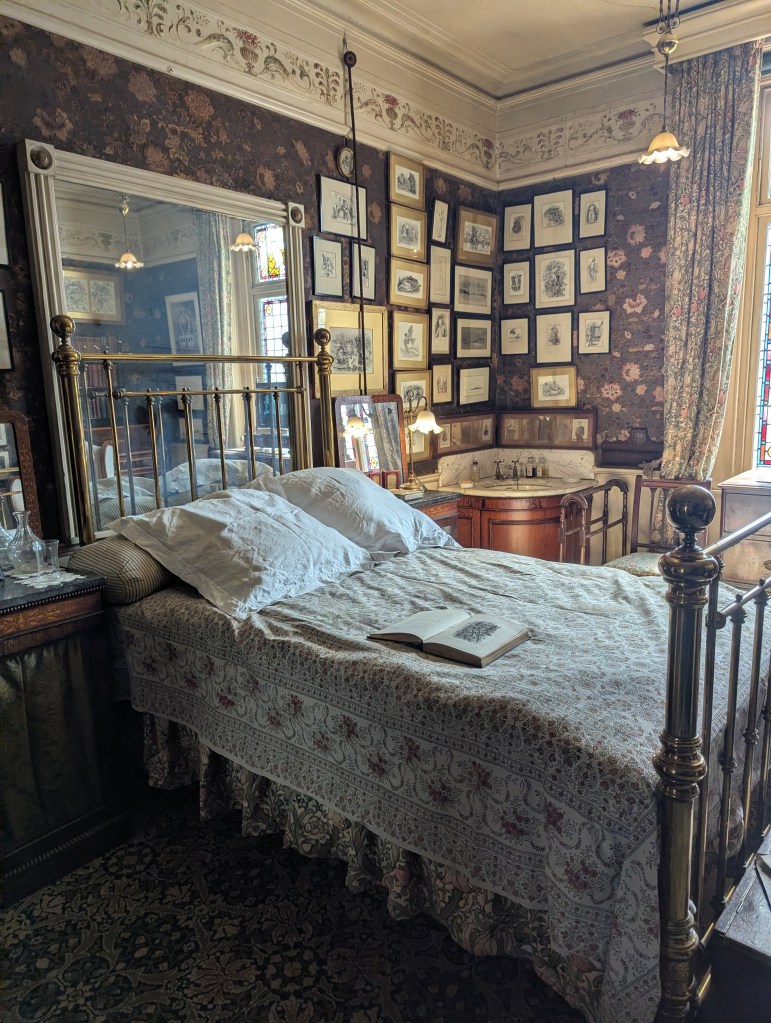
A time capsule that developed from a comfortable family home into a place that shows how people lived then. It felt quite different to the more restrained designs that can typify the modern Victorian aesthetic. For a place that hasn’t been lived in since the late 1940s it nonetheless felt like a real home, and one that people obviously tried to make comfortable and reflective of their tastes. An old fashioned feeling space now but one that was clearly quite modern in lots of ways then.

