A time capsule

My latest study visit took me to Sambourne House, the family home of Linley Sambourne, the artist and Chief Cartoonist for Punch magazine that has been preserved almost untouched. The space has become a show home but still feels very lived in. It gives an insight into Victorian life and particularly for that of a family with an artistic disposition. The house shows how homes can absorb the influences and advances of the time, and yet still allow people to express their own tastes.

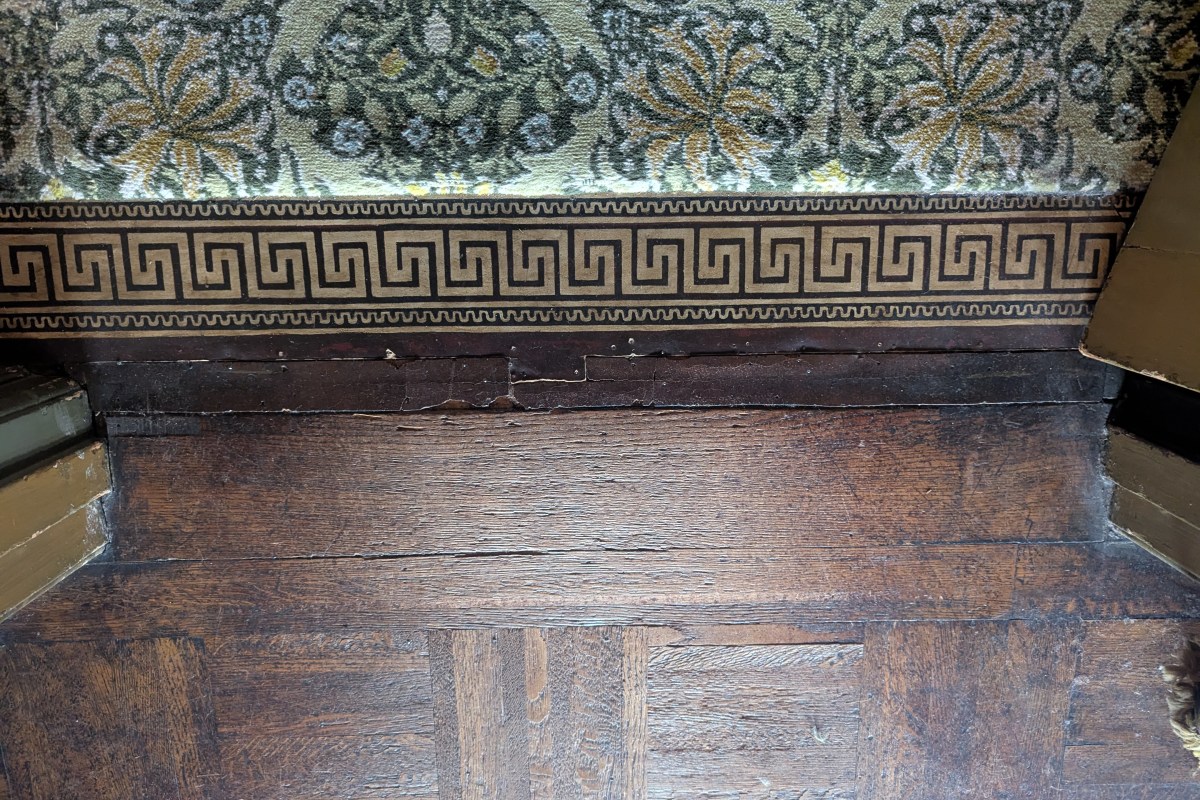
The house reflects the ‘House Beautiful’ aesthetic of the time – this saw a reaction to mass produced products, favouring the handmade and recognising the value of furniture and furnishings as artworks. The style tends to include lots of natural motifs and more muted colours – which can be seen throughout the house in the colours and designs, including William Morris wallpapers.

However, the house also reflects how people can take aspects of the current styles and adjust them to their own tastes. Another aspect of this style is a restrained, pared back approach and that is most definitely not the case in the Sambourne’s house. As the picture of the living room below shows, it is a space that is very full of things indeed.
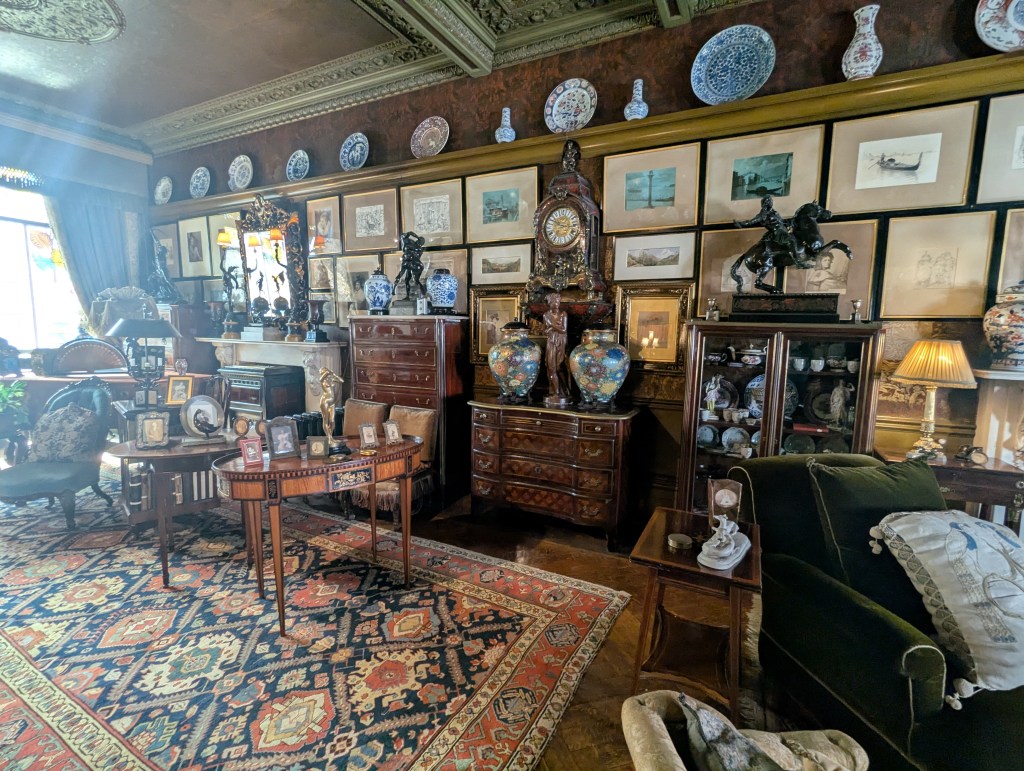
As the picture above also shows, there are lots of elements of the interior which are connected to the exterior. Chinoiserie and pictures from and of the wider world – from their travels and also to reflect their connections to and placing themselves in relation to the world. Rugs and vases from around the world too – showing how homes are not just individual spaces but are connected to other places and people and that people intentionally seek out those connections. Influences and designs, a way of showing off both your taste and sense of self, allowing you to be somewhat out in the world even when at home, and signalling to others that you are cosmopolitan and connected.

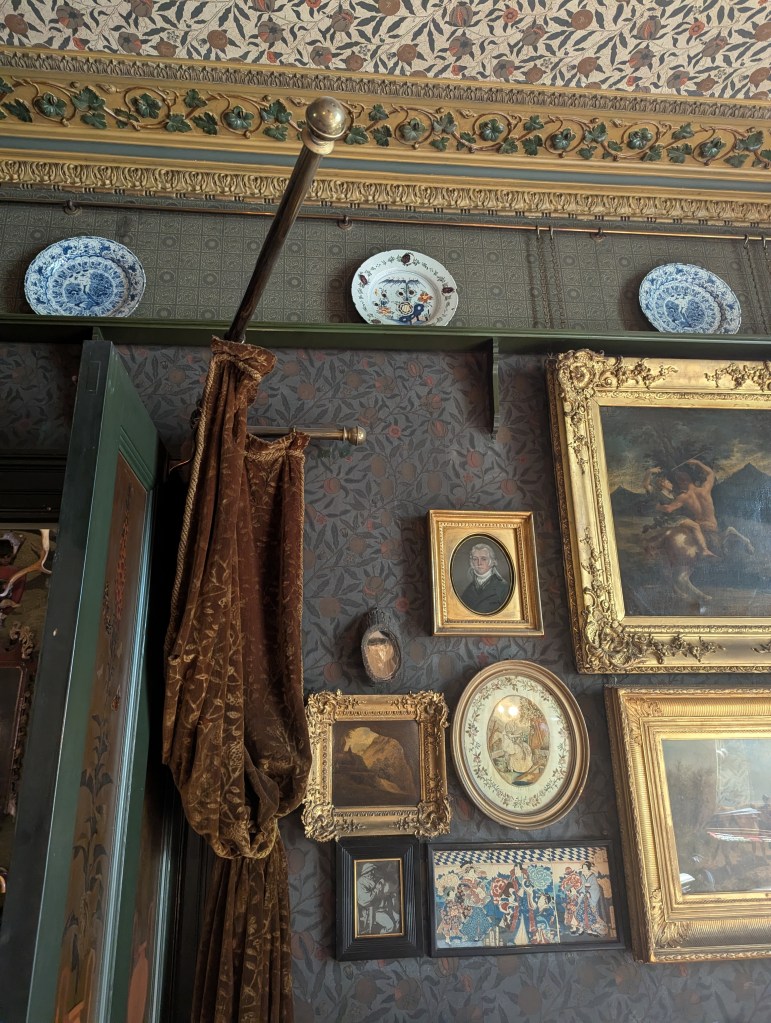
There was a strong sense of comfort about the place, with lots of places for people to sit, rich and warm fabrics and materials covering all of the surfaces, and fireplaces in the rooms and even in the hall. I was very intrigued to find a curtain over the doorway in one of the rooms – part of it was on a pole that comes out so you can open the door without getting the curtain tangled up with the door. I had never seen that technology before but it makes such sense.
Another sign of the modernity of the house was that it has a downstairs cloakroom toilet as well as a separate bathroom with a toilet. This increased prevalence of toilets was something that was starting to come forward in Victorian times, following The Great Exhibition of 1851 at Crystal Palace. There the expression ‘to spend a penny’ came into being, as people could spend a penny to trial the first paid public toilets. This helped increased expectations about the availability of toilets, and the privacy of having a separate space for them.

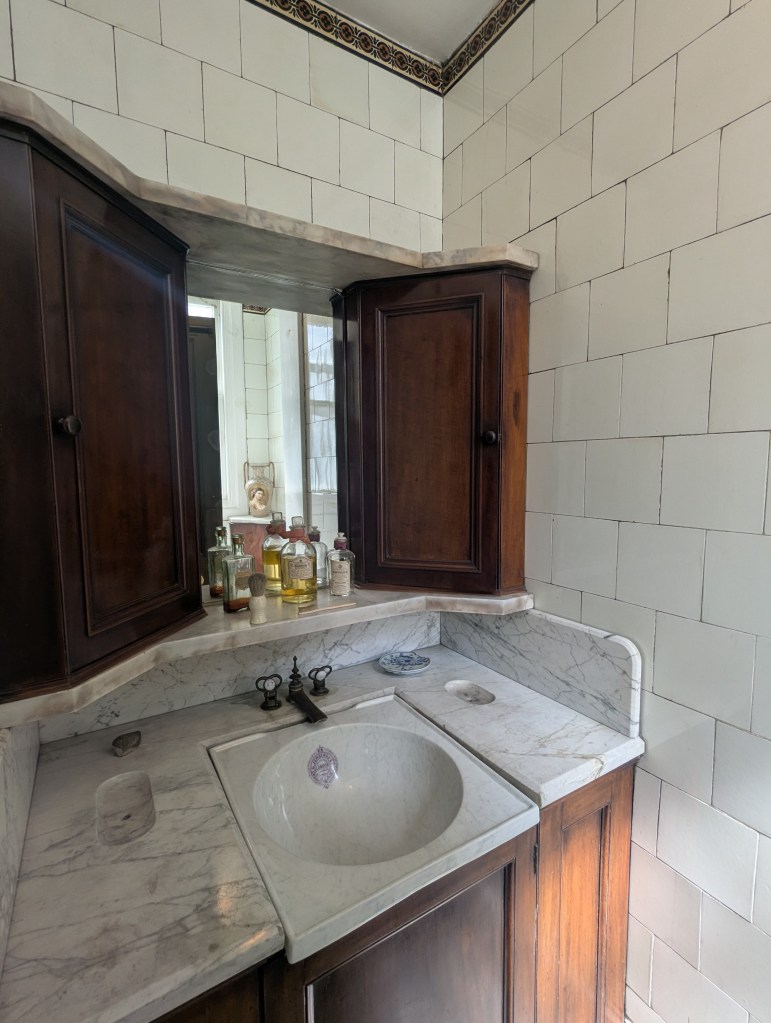
The downstairs cloakroom is so modern that the sink is a technology innovation – to empty it you would have to tilt it to let the water run out of. These sinks allowed people to have access to running water and enabled them to wash their hands without needing to have the pipework plumbed in. This made it much more accessible for people to have installed, it also got around the issue which arose where plumbing systems initially were quite smelly – rendering them less attractive for people from that perspective. I wasn’t able to get in to the room to have a look but typically these sinks would empty into a bucket which would be cleared away – by the servants.

While the rest of the house is very highly decorated, the cloakroom has the white tiling that Barbara Penner talks about in her book which have come from a medical context – where the white tiles are designed to show how clean the place is, or make it easy to tell if and where it isn’t.
After Linley and his wife Marion died the house was left to their son Roy, who kept the house largely unchanged. When he died in 1946 the house was left to his sister Maud. Maud already had a large London residence, and so the house became a time capsule, mostly unoccupied and unchanged. Maud’s daughter Anne became fascinated by the place, leading to her setting up the Victorian Society and the continued preservation of the house.

I was interested by Roy Sambourne – choosing to live in the house and preserve it largely unchanged from when his parents had lived there. It seemed like an odd choice, to consciously choose to preserve somewhere, particularly somewhere that wasn’t a ‘stately’ home or one belonging to particularly famous people. I wondered how much it was a conscious choice or if it was something that reflected more a lack of decisions and action to make changes

As I found out more about Roy it came to make a bit more sense. From what I’ve been able to gather, he never really found his way in life. His mother Marion Sambourne wrote that “she was worried that her son had inherited none of the ambition and capacity for sustained hard work which had made his father so successful”. Roy’s biographer Shirley Nicholson writes in her book ‘An Edwardian Bachelor’ that “All Roy ever wanted to do was have a good time with the minimum amount of effort. This may not be an unusual attitude among the young, but Roy was never to grow out of it; Life carried him along, while he made no effort to shape its course”. When I read that, it became easier to see how he might choose to live in the house and not make any particular changes to it – beyond apparently getting the woodwork in his bedroom changed from red to white – while still leaving a space that didn’t feel very minimalist, as the picture of his room below shows.
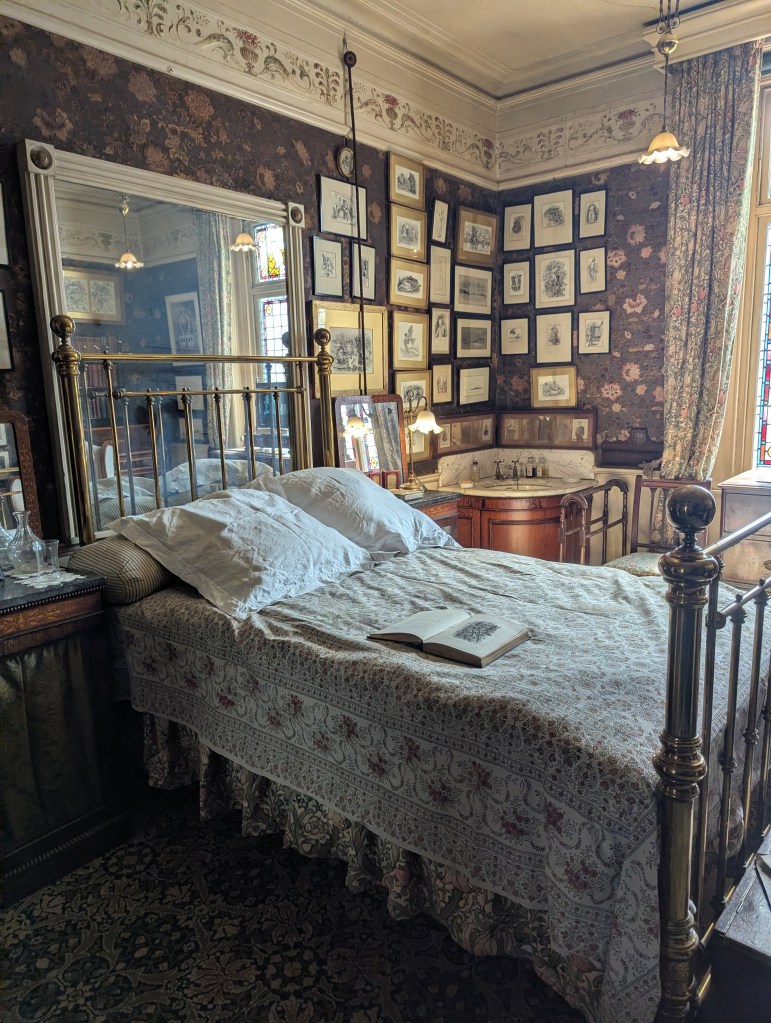
A time capsule that developed from a comfortable family home into a place that shows how people lived then. It felt quite different to the more restrained designs that can typify the modern Victorian aesthetic. For a place that hasn’t been lived in since the late 1940s it nonetheless felt like a real home, and one that people obviously tried to make comfortable and reflective of their tastes. An old fashioned feeling space now but one that was clearly quite modern in lots of ways then.
Back to the future

Visiting archives is a way to physically connect with the past, so I am keen to do so as a way to explore the stories that shape how we understand homes, communities, and change over time. As soon as I stepped into the Southwark Archives I realised that of course this is what an archives should smell like. That slightly dry, dusty but richly inviting smell. Absolutely ideal.

From that on-point smell, my visit to an archives only got better. As a first-time visitor to an archives, and going in an exploratory way to get a sense of the lay of the land, I didn’t have much of a sense of what I’d find, how it would all work.

The amazing archivist that I’d e-mailed before I arrived had, on the basis of a very broad set of parameters, collected together some information for me and it was all laid out ready when I arrived. I just delved right in, looking to see what piqued my interest, or felt like it related to my PhD.

The generosity of this work, people working to preserve parts of the past and help others make sense of it just blew me away. Watching one of the archivists respectfully and patiently respond to a million questions from a couple of people who had booked a visit. Finding and helping, making resources available and helping people who are coming to the archives with all kinds of interests and questions. The act of archiving, as they acknowledged themselves when talking about the changing norms in society, is obviously an act of choosing what is important, what should be kept, that says something about the time, place and people – even if those views reflect a worldview that most of us would now no longer agree with.

It was so incredible to actually physically hold documents going back over 100 years. Although virtual things are great and give us access to so much information easily, that sense of literally holding parts of history in my hands had me feeling quite emotional at times. The more so because most of what I looked at was the stuff of everyday life – brochures, flyers, news stories and reports. Often it’s the so-called ‘extraordinary’ moments that get recorded – moments in which most people are observers rather than participants, such as sporting events, the details of rich peoples lives. It was really lovely to see a richer reflection and recognition of people’s lives beyond that small slice of it.

Even though I felt like I was in hunter gathering mode, rather than really processing what I was seeing, there were still some themes which came through:

  • the care people put into looking after each other – the different schemes and plans to look after each other, to try and find ways to help people live healthier, better lives
  • an increasingly common mismatch between the amount of funding needed to look after, let alone improve social housing and what has been made available
  • restrictions on how people can live in homes they don’t own, regulations from an 1897 publication, much of which would still feel familiar today
  • different manifestations of the tensions between people and other creatures. Lots of news stories about rats, ants, mice, cockroaches and other insects and animals that are trying to make themselves at home

There were also some fascinating gems, including:

  • a sense of the changing expectations of homes coming through in a drawing from a 1928 publication. This proudly showed a lovely home that had a properly plumbed in bath in the kitchen. This would now be considered unacceptable but was then considered quite an upgrade
  • photo’s and stories from people giving glimpses into the different ways people navigate the world and place their home within it – from the landmarks around the place a registered blind person uses to orientate himself, to transient spaces briefly becoming homes for homeless people
  • Montagu H. Cox, the Clerk of the Council, wrote in January 1928 about ‘the housing problem’ in a way which felt both humble and yet purposeful – ‘These are striking figures (numbers of homes built), but it must not be supposed that the housing problem is already solved. Slums have not yet been wholly swept away, nor have houses yet been provided for all who need them. Moreover, the housing standards of to-day will not necessarily be those of to-morrow, and some areas not at present classed as slums are certain in course of time to come within this category. Nevertheless, much has been accomplished, the lines of future progress are more clearly discernible, and the time has been brought appreciably nearer when it may be possible to say that the solution of one of the most difficult and serious social problems of the age is at last within sight’. Much in there which would still hold true – from housing standards changing to homes and areas changing in character. That sense of a solution, written in a beautifully printed and bound book, looking positively to the future felt tonally very different to much of the public discourse we see and hear now about what’s possible.

My favourite find though was in the seemingly unlikely place of a 1939 brochure by the Borough of Bermondsey Electricity Committee. You’d be forgiven for thinking this might be an offering as dry and dusty as the air in archives but you would be wrong – richness indeed in that brochure, as in the archival air. Here’s a small sample from ‘The magic of electricity’:

‘Once upon a time, a little girl named Alice discovered a Wonderland where philosophic caterpillars smoked hookahs, and lobsters danced quadrilles, while the Mock Turtle sobbed without ceasing – a queer quarrelsome Wonderland of muddled magic. There was a lovely garden in this Wonderland, but Alice could not find the way into it until the middle of the story, when a golden key unlocked the door the led to the bright flower-beds and cool fountains.

Housewives who use the old-fashioned methods of lighting, heating, cooking and cleaning are just in Alice’s shoes. They are surrounded by a quarrelsome Wonderland of smoky fires, inadequate lighting, dirt that needs continual clearing away, and unending labour over the simplest tasks. They have not discovered the key that gives access to the lovely garden of Leisure – the golden key that is clearly marked “Electricity”.

With this little book, the Electricity Committee presents every modern Alice who lives in Bermondsey with the key.’

Key’s indeed to be found, in that brochure and the rest of the archives. An absolute privilege to be able to explore them, my first visit but hopefully not my last to that kind of ‘quarrelsome Wonderland’.

Walked the homes

Do Ho Suh’s exhibition at the Tate is so titled because traditional Korean buildings known as a hanok can be disassembled and reassembled elsewhere, a process of ‘walking the house’.

It was wonderful to be immersed in someone expressing different aspects of the home. From the physical aspects to the emotional and temporal. Seeing them all overlaid together, as they are for people most of the time but which feels rare to see in artworks. Homes can often be featured in art but rarely as the main event, more commonly as a backdrop or fleeting glimpse. Something that tells us about someone but isn’t usually the main focus of the piece.

Public/private split

Homes are usually thought of as private spaces, or at least they have increasingly been for the last few hundred years. People lived together in much more communal set-ups. Sharing rooms, beds and homes. Things that we would now consider private, like using the toilet or having sex, were much more public activities then. It’s apparently why swear words were related to religion up until a few hundred years ago – that was a transgressive thing to talk about, whereas swear words now are more about sex and toilet things because they have become private matters, things to be ashamed or embarrassed about.

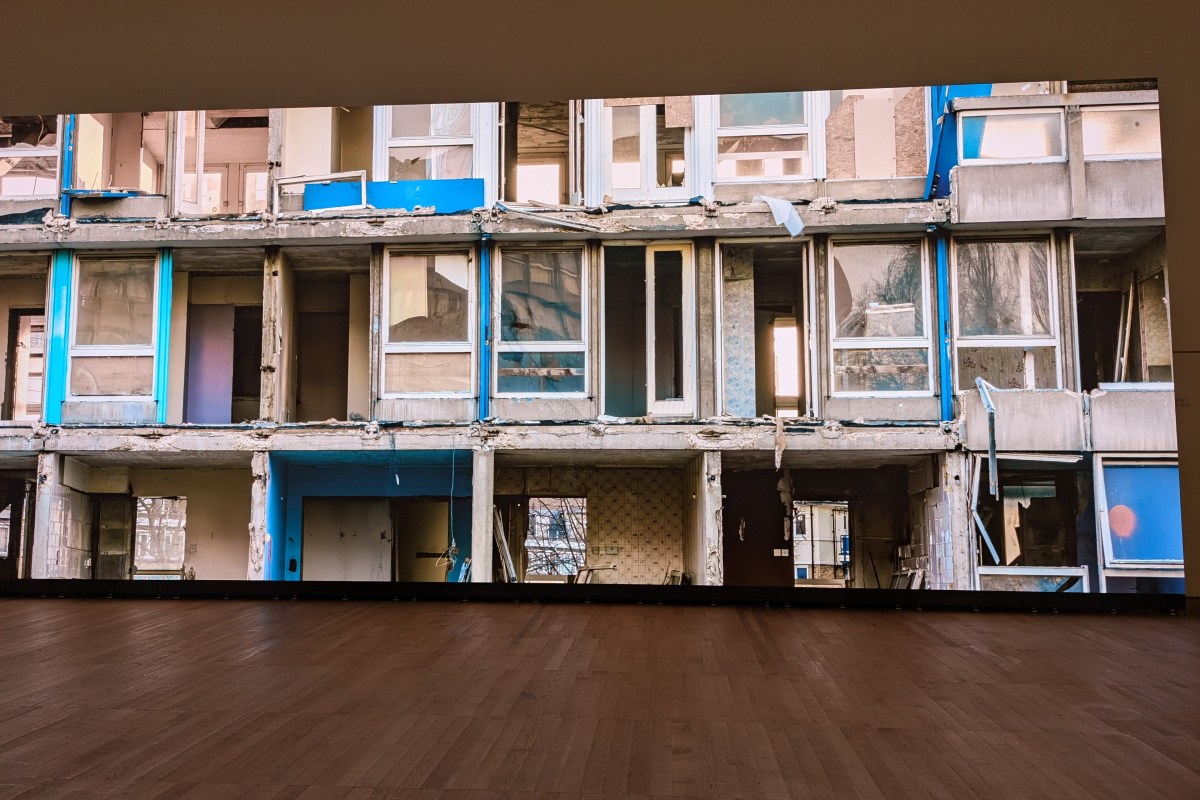
Here, Suh upends that, making the private public. He has houses within houses, parts of homes which have become public spaces as they are demolished. A childhood home rubbed down and rebuilt within the gallery. Every part of the exterior traced onto paper, lines and designs, to capture the look and feel of the place. Films showing homes exposed to the public as they are demolished, private walls becoming briefly public before they disappear.

Homes in this telling are not just becoming public because we get to see the private light switches and fire hydrants of previous homes but, in sharing his artistic response to his home, he’s also helping us move from the specific to the universal. In showing us where he’s lived in a way which invites us in, creates some intimacy, he’s also inviting people to think about their own home. Helping us bring our own homes into that gallery, comparing ours with his, reflecting back on our own, seeing how others live.

Gender and homes

Homes have traditionally become a place that’s associated with women rather than men, as many, including Bowlby, Gregory and McKie have reflected. Following the split between public and private spaces, men became more associated with public spaces and women with private spaces. Perhaps if the exhibition had been by a woman rather than a man, it might have resonated slightly differently. A sense of women working within the parameters they are typically afforded. Whereas having a man make art from it, and see it as something which is worthy of making art with and from, is another way of helping to show and shift that division.

Modernity and homes

Putnam identified two successive transformations of contemporary living from traditional 19th Century models of home. The first was the emergence of the modern home between about 1920-1950 when domestic spaces were designed around the technical core of sewers, water, gas and power cables. A time when these innovations were new for most people and somewhat astonishing, or perhaps a little terrifying too. The second shift he identifies is around the 1960s, when the technical, economic and political structures of modernity became part of the background of modern home life. At that point, as what he describes as ‘the material life supports of modernity are taken for granted’, the cables and sewers and suchlike fade into the background and the home becomes a space in which people personalise their space and negotiate with each other about how it looks.

In that context it was fun to see cables, wires and light fittings represented. Those life supports, especially things like cables, don’t tend to be shown and have disappeared into a sense of what normal homes look like. Often in lifestyle magazines cables and wires get edited out of pictures, as though the items they are powering magically work without showing the plugs. That it’s not cool or aspirational to need to connect in to power sockets.

Suh shows the different aspects of the home which would normally be hidden, peeling away layers of life. Simultaneously showing the modernity of the home which is taken for granted by those who have grown up with it, and also going back to the pre-modern home where it’s not taken for granted and is instead something to marvel at. Bringing them to the fore again allows for the magic and importance of them to be seen and recognised.

Making homes our own

When people move into a place they often try and remove traces of previous occupants to ‘make it their own’. Suh shows there are many ways to make a home our own.  He had to get permission from some of the landlords to make the art,  a way of taking ownership of the home – it’s his art when it’s out in the world, even if it wasn’t and isn’t ‘his’ home.

In one of the pieces, he layers up aspects of different homes – light switches and plugs, light fittings and door handles. It gave me a time-travelling sense of all of the people who would have used those light switches and door handles. The different hands that had used them, the lives they have supported. As we become more separate in our homes, with much less communal living, more people living by themselves, and even within homes as we have separate spaces, overlaying parts from multiple homes gave a more communal sense of home.

Memory and meaning

For some, home is a place of practices and habits, for others it’s a place that holds memory and meaning. The pieces by Suh blur those boundaries. The practice of making art, the holding on to places and details which act as anchors for both practices within the home and also memories.

The pieces are a way of preserving the past but also, for him as an artist, of making the future – exhibitions and work, building a body of work and meaning. Tracing the contours of the building, with his childhood home literally rubbing every part of the outside of the building, capturing the details on fabric which then gets remade into a simulacrum of his home – but not a place you could actually live within. A memory of the memory. A memory that looks like the memory, in the same way a story that gets told and retold can become a memory of the story, rather than a memory of the memory.

As Brickell reflects, home isn’t just a place where history ends up but where history emerges from and, quoting Caluya, the home exhibits ‘a certain plastic tendency that enables its boundaries to expand and shrink’. This work does that too, delicately and painstakingly tracing the boundaries of the homes but with an intention for those very boundaries to go further out into the world.

The exhibition space itself felt like things were quite crushed together and could have done with some more space to breathe. Nonetheless, providing room for people to see homes as worthy of being considered art, and not just glamorous homes but the life support parts, created a space for thinking about homes that we can take from the gallery into the world and back home again.

Bedding down

Beds have come to seem so normal but for most people in time and space, the kinds of mattresses we think of as standard in the UK just aren’t. Sleeping on bare earth – or at least, earth covered with grass and herbs to provide some kind of matting for people to walk around and sleep on. Hammocks and boxes, benches and coffin-like beds. Mattresses made of linen, feathers or straw, beds have been through lots of iterations.

My bed, I’m so happy and lucky to say, is very much not like sleeping on bare earth. It is so comfortable and either explicitly or implicitly I register that each time I get in. A daily joy and privilege. It’s quite firm but not too firm. There’s some give in it but it doesn’t feel squashed or like I’m suffocating or being swallowed up by the bed.

Yet I wonder what it would feel like for people who are used to sleeping on rolled up plant materials if they were to magically be able to try out my bed. Whether they would lie down on it and be blown away by the comfort levels, see their own situation differently. Wish for something else. Or whether it would just feel too uncomfortable. Too much. Or perhaps too little. Missing that connection with the ground. Feeling a bit unmoored from their life and homesick for something that felt more natural, rather than being on some complicated set-up.

Shove suggests that so much of what we experience as comfort is set by wider expectations. With the availability of technologies which allow us to control the temperature in rooms and buildings more easily there was a need for designers to have an understanding of what temperature range they should be aiming for. This has led to the development of a norm around temperatures in buildings which then creates a feedback loop, or ratchet as Shove describes it, which leads to increases in usage more widely. Somewhat terrifyingly, Walker, Simcock and Day found the temperatures people prefer in their bedrooms are generally lower than the 18 degrees recommended by the energy sector. This guidance can help to reset expectations and could lead to further increases in energy consumption.

So perhaps those mythical time travellers who get to test my bed might not like it if they just gave it a one-time try. Their expectations would still be with their own beds and perhaps mine wouldn’t feel right for them.

A really big shift, perhaps bigger than the actual bed technology, is the one from sleeping being a more communal activity to sleep as something private. There is a wider move to more privacy at home, and beds are just part of that. Until around the Victorian times in the UK, sleep was a much more shared experience. It used to be common for all the members of a household to bed down together. Halls were multi-purpose rooms where people would eat, work, hang out and sleep. Servants and masters, young and old sharing beds or a room. Hard to imagine that being the norm for most people in space and time, yet there was considered to be an intimacy to sharing that space. For many members of the nobility, inviting people into their bedchamber was considered to be offering or getting a huge privilege. A much more communal existence than most people have now.

This shift by the Victorians was driven partly by increased concerns around the moral implications of people sharing beds, and partly because of hygiene considerations. There became more awareness of how infectious diseases could be spread, and therefore more of a drive for people to have their own space to try and reduce that risk.

That seems impossible for most of us to imagine. A tangible way in which people from previous generations lived lives that are very different to our own.

Of course, there are now hundreds of thousands of people around the country, one of the richest in the world, for whom imagining that is easy because it is their reality today too. Families or groups of individuals sharing one room. That room becoming like the Hall of old – with one room also becoming the living, working and eating space. Sometimes the room they have to use for cooking too. Living rooms in rental places increasingly getting used as living rooms, either by the people renting having to make that decision to be able to afford the space, or landlords making that decision for people.

As with other changing expectations, the gap between expectation and reality means what once might have made a home feel communal and normal, now feels like a lack of care or respect. This creates a sense of emotional discomfort which can be just as unpleasant to live with, and in, as physical discomfort can be. Much has changed with beds and how we sleep but until we have more of a shared agreement, and actions to match, we’ll continue to have people living amongst us who have beds and sleeping arrangements that seem like time travel to most of us.