An oft cited aspect, by people working in retrofit, that they think mitigates against people taking up insulation measures is that insulation measures invisible, and I’ve been reflecting on that for a while. I am going to briefly unpick some aspects of whether the fact insulation is invisible is really a negative.
There are lots of other materials or systems within the home which are also invisible, but the effects are visible, and they are valued by people such as electricity, gas or water and sewage services. Indeed, the fact those measures are invisible but the effects are tangible is part of their appeal. Homes with exposed wires or gas pipes, let alone waste water or sewage pipes wouldn’t be considered to be safe or desirable. It’s true that with these measures there are still some aspects that are visible and have design considerations beyond the effect they have – light switches and plugs, hobs and taps. For the most part though, the other aspects are hidden away.
Then there are parts of homes that really are invisible or should be. Foundations, the materials used to construct lots of parts of floors, walls and ceilings. Generally if we can see the foundations it’s either because something intentional has happened – like getting an extension done, or a bad thing has happened and we’re trying to sort it out – like subsidence. Again, what’s happening between the internal walls, floors and ceilings is really invisible. There’s a layer we can see but being able to see those exposed parts of the building would be bad.
As it is with other aspects of the building that are invisible, having visible insulation wouldn’t be a positive. Insulation materials should be safely tucked away and if we can see them that’s a bad thing. Yet people seem to think differently about insulation in part because there’s a paradox whereby they seem to think it’s necessary for homes, while thinking it’s not needed and therefore occupies a different space to those aspects of the building structure that seem more fundamental.
There are other ways that the insulation can be made visible to people, through inclusion in condition surveys, references in letting or sales information, questions for mortgages or insurance. Whatever touchpoints already exist and any that might be developed over time are places where those details can be made clear to people.
So it doesn’t seem like the invisibility of insulation needs to be a bad thing, or it can’t be demonstrated in other ways. Really though, I think that view keeps niggling at me because it goes to a negative attitude that is not really in the can-do camp about the virtues of retrofit. If the people who are trying to convince others of the merits of getting works done are unable to articulate why something might be useful, and feel more comfortable talking about why the things that are being offered are a bit rubbish or hard to sell. And if people trying to encourage uptake are unable to get into a PMA about the measures, and it’s literally their job to do so, how can we be surprised when those who have less interest to start with aren’t buying?
Since 2013 about £26bn has been spent on government and energy company obligations, of which a chunk would be made available on a project by project basis for comms, marketing and engagement – what value has been created by that investment of public funds?
Funding will often allow for up to 10% to be spent on scheme administration, and where it doesn’t comms and marketing will often be capitalised into the overall costs of the improvements. If 3% is used on comms and marketing that would equate to £780m, even at 1% that would be £260m.
Given where we are in terms of the perception and interest in retrofit, low and zero carbon technologies – potentially solar PV notwithstanding – it’s hard to see how that investment has catalysed action or interest. We still struggle to persuade people that the measures we think will help are either useful or desirable. It isn’t the only reason that there have been consistent levels of underspend on schemes, or a need to extend timescales for delivery or reduce the amount or level of interventions undertaken, but it is clearly a factor.
But what if that investment, or even a fraction of it, were used differently? Used more collectively to develop advice or materials or try different approaches and cascade that out. Or it could be used to provide some baseline services that can be used by everyone and could outlive the projects? Building capacity and seeding interest in local community activities?
Doing things that would involve working collectively and collaboratively to put in place the things we think are needed or could be useful. Trying and piloting and testing and maybe using government funding but in different ways to try and create a legacy from that part of it.
Of course, that same approach could be developed by the sector without using or re-purposing government funding too – it could be sourced from other budgets. There are examples of one-stop shops and other models which could be developed and adopted that are much more industry or community led too.
Either way, it’s sobering indeed to reflect on the massive investment which has already happened to date and how little that seems to have shifted the level of interest. It’s also clear that we can’t keep doing what we’ve been doing and expect different results, we have to think and do differently.
Reading government and industry reports can leave me wondering where the individual is. The primacy of the family, and the subset of ‘the hardworking family’ is something that I’ve long noticed. Perhaps because I’ve spent lots of time as a single person it’s something I am more primed to see than people who have been in a relationship for years. This framing made me wonder how representative the representation is and why it might have been chosen.
Reading ‘The Warm Homes Plan’, families get mention after mention – albeit in amongst some more general references to people or tenants. Still though, four references in one paragraph doesn’t happen by accident I think. Linguistically it creates a sense of intended repetition that even just twice might not. From a logistical perspective, the amount of times that document would have gone through a review process makes it harder to imagine it was accidental. Of course things can slip through if the version control gets a bit messy and there are twin or more track reviews happening. Putting together those kinds of documents isn’t always as elegant a process as we might want to imagine yet the fact I noticed it in that document was a reflection of that longer-held awareness of how often the term is used.
Looking at the Office of National Statistics (ONS) information published in 2025 – the most recent year statistics are available for – shows that while it’s true that 66.8% of households are a family, there are now 29.5% of households where only one person lives in the home. By way of completeness 2.8% of households are where two or more unrelated people live together and multi-family homes make up 0.8% of homes. The ONS notes that the figure for single-person households is a similar proportion to the previous census, there are now more young adults aged 20-34 years old who are living with their parents.
To leave out c.33% of the population from language around who is important, to be emphathised with or needs to be supported feels odd. I assume the references don’t mean family in the sense of connections to people that you might be related to but no longer living with. Apart from anything else if that is what is meant it feels a bit garbled and unclear, and the context doesn’t suggest that is the intention. It isn’t as though there isn’t language available instead – why not just say everyone deserves x?
The use of this language can be seen as a way to try and engage people. Some of it might be about trying to head off arguments at the pass, particularly from more right-wing media and politicians for whom the family can be a key focus. There can be something respectful about going to where people are which resonates with them and helps get them on-board. This can also be a sign of pragmatism, changing the language to get things done and finding ways to go with the grain of how people might think about things
However, the danger in using language that way is that the argument is never made on its own terms, it accepts the framing of others. This creates a danger that the thing itself becomes obscured with the attendant risk that there can be an appearance of progress but later on down the line it becomes apparent you were talking at somewhat cross purposes. By reinforcing the framing rather than staking your own claim it can create the need for more of a rearguard action if the frame no longer fits the argument.
As such, the repeated choice of language around families does read as intentional. It comes across as language which seeks to be more collective and inclusive, rather than seeing people as atomised individuals. Yet the exclusionary nature of the language then serves to undermine that same intention. It is hard to see what value there is in choosing language in that context which doesn’t seek to cover the widest group of people possible. Other choices are available, so when they aren’t taken, it feels like a missed opportunity not to tell a more inclusive story.
I’ve just done a thought exercise where I was trying to imagine what I’d do on day one if I were put in charge of all of the things in government and it fried my brain. It created a real tension between my understanding of what changes are needed to generate change – systemic and cultural shifts which lead to cascading and tangible changes, with my sense of what politicians are looking for – tangible things that sound good even if they don’t really deliver anything meaningful. Beyond hurting my head, it was a good reminder of why change can be hard for politicians to enact.
Even just pretending to play the part of a politican made me feel I had to silence all of those parts of my brain that think how politics tends to operate isn’t helping, and I started to grab around for something that felt like a ‘good answer’. Trying to think about how I could turn something systemic, which also recognised the limits of government responsibility, into something that was shiny and press release worthy. I think that a big issue in the retrofit sector particularly is the extent to which it looks to government to create and fund the conditions for scale, and that in itself undermines the conditions for scale. That means more government isn’t going to help, and indeed can undermine the cultural and attitudinal changes needed, albeit there are things government can do to help unblock action which will help with those shifts. Yet the short-term press release driven nature of politics is too rarely a good fit for the deeper, harder engagement with the substantive issues or ambitions. Yet in that thought experiment I could feel the pressure towards that endorphin hit of one shiny thing because that felt like what I was ‘supposed’ to come up with – that it wasn’t a serious answer if I didn’t.
In the end I just pretended the world was different and politicians can give those kind of answers. I figured that’s a luxury of not being in that position and if I can’t use that luxury in a no-stakes thought exercise, how can I be surprised that people in those actual positions don’t do that? It felt both like a cop-out given I can imagine the push-back someone in that situation would get, and also like the thing that’s actually needed.
But it was a great reminder of how institutional isomorphism and social norms can help edit out those calls to think differently. It was also useful to reflect on that temptation to try and fix things and assume control of it, rather than saying there are limits to what government can do in terms of shaping attitudes and action.
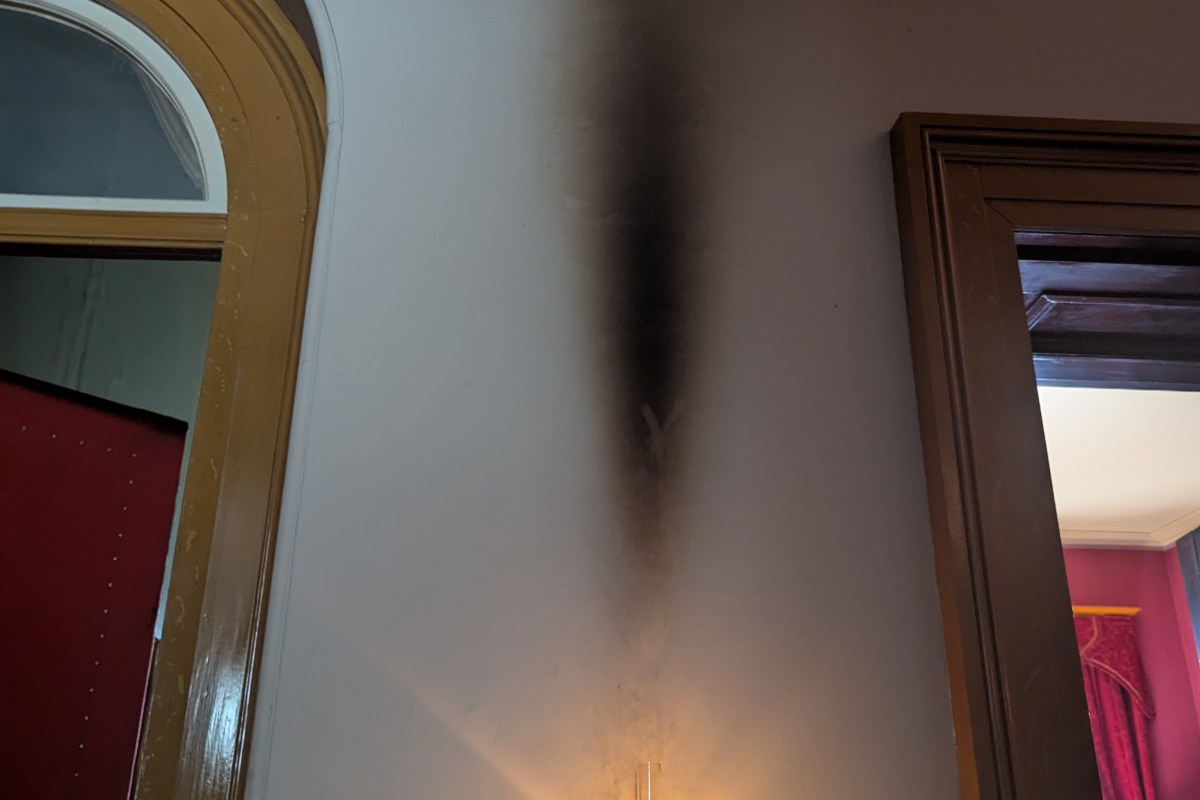
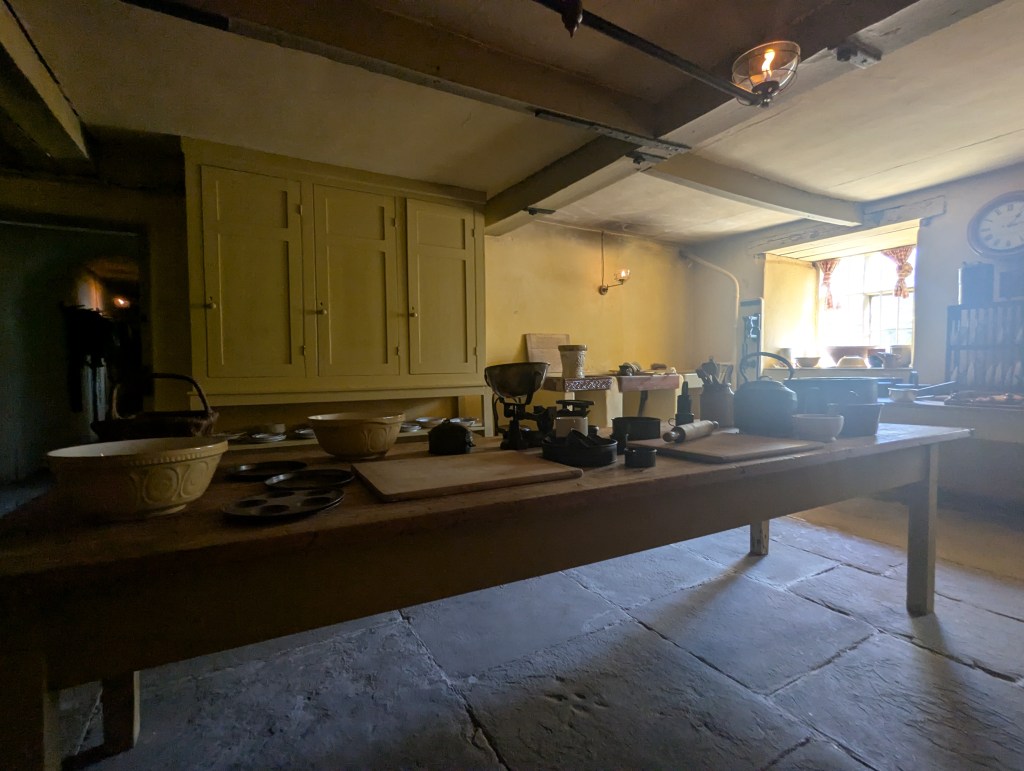
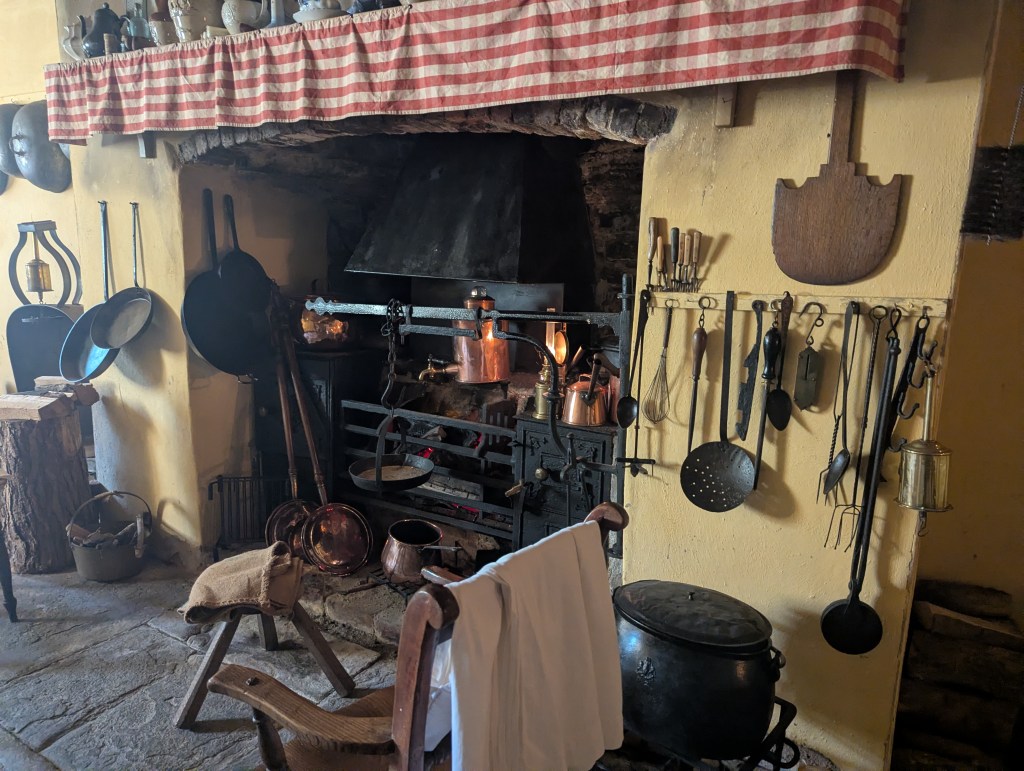
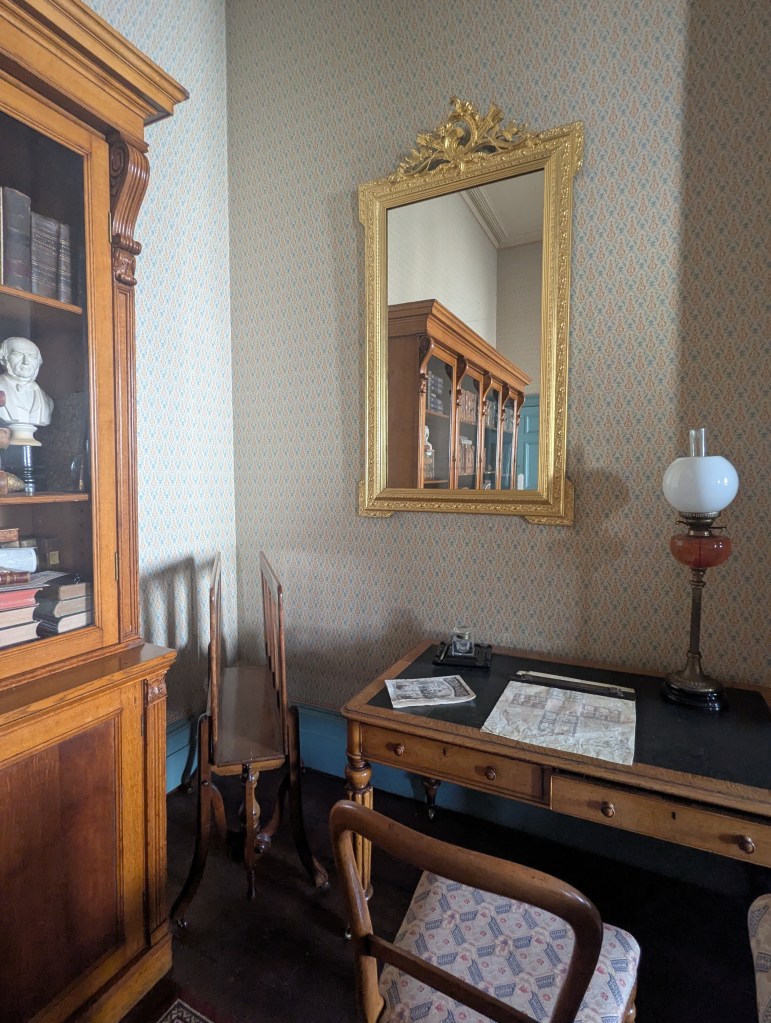
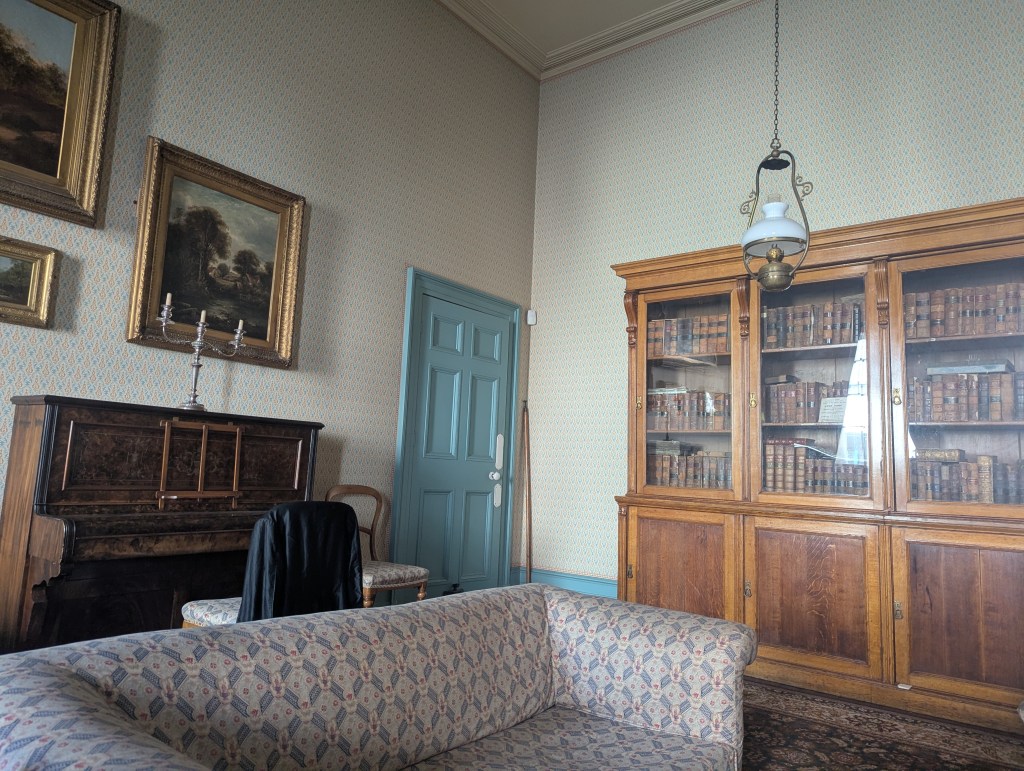
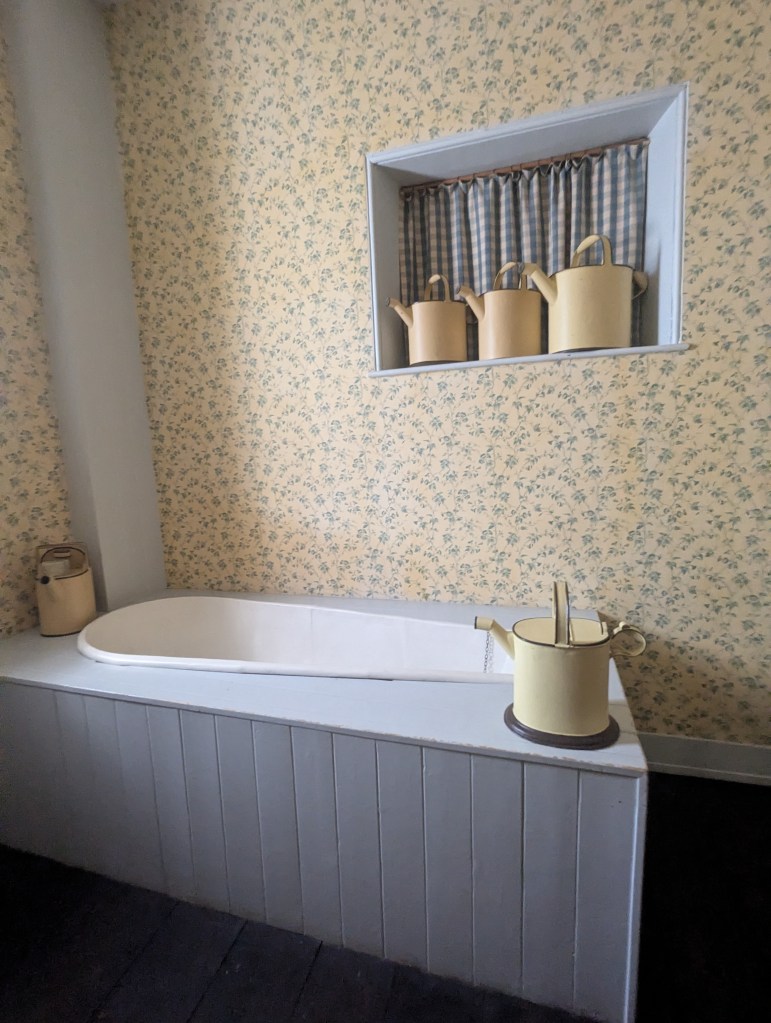
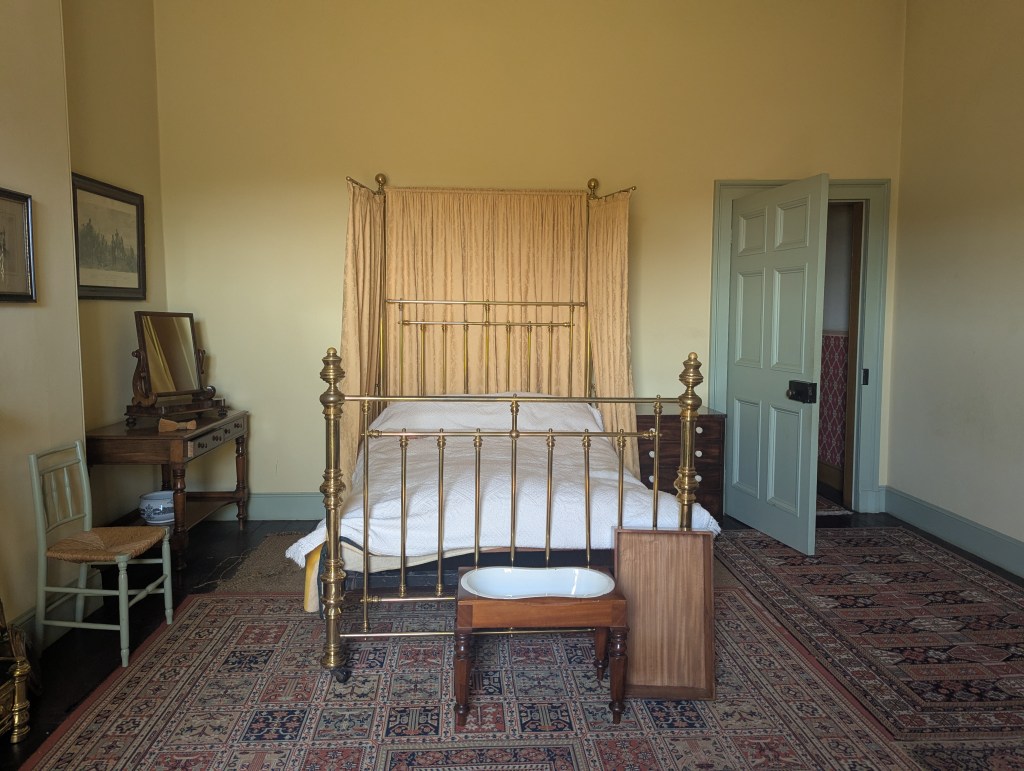
Scents can be so evocative, so it perhaps shouldn’t have been a surprise that the visceral smell of oil and gas lamps that greeted me as I entered The Judge’s Lodging in Presteigne gave such a connection to the past. History can often feel abstract, with tales of rich and powerful people living lives that seem very different to ours. From the focus on those in the ruling classes or aristocracy to different habits and practices, it can feel hard to have that sense of connection. Smelling the oil and gas lamps. feeling the effects of inhaling their fumes on myself, and observing it in the surroundings bridged that distance.
I have read about oil and gas lighting and the fact that it could create some soot but I didn’t really get an impression from reading about it quite how it manifested in practice. As soon as I saw and smelt the lamps, it was easy to connect them to the tracks of dirt and grime on the wall and up on the ceiling. Connecting the dots between the general description and how it worked in practice felt very satisfying – and I wondered if that was represented in period films. From there I found it easy to imagine how I might be annoyed if I lived then. Having decorated and made the place look lovely and then to see it getting messed up and dirty would really annoy me, in much the same way the first mark I notice on a newly painted wall does now. Of course it’s not a direct transplant from now to then and perhaps I would be more sanguine about it because that’s just the expected price that would be paid.
But then it also made me think, it isn’t as though there aren’t modern equivalents to those impacts. I look at that technology and it seems obvious that it’s not an ideal option. That’s because I’m comparing it to technologies that don’t have that same impact direct or visible impact in the home. In the home, the negative effects of gas heating can manifest in invisible impacts such as carbon monoxide poisoning, or there can be damp, condensation and mould from a mixture of how we use the home and the insulation levels. Yet those same technologies we now use also have impacts that are far worse at an aggregated level that doesn’t manifest directly in the home in the same clear cause and effect kind of way.
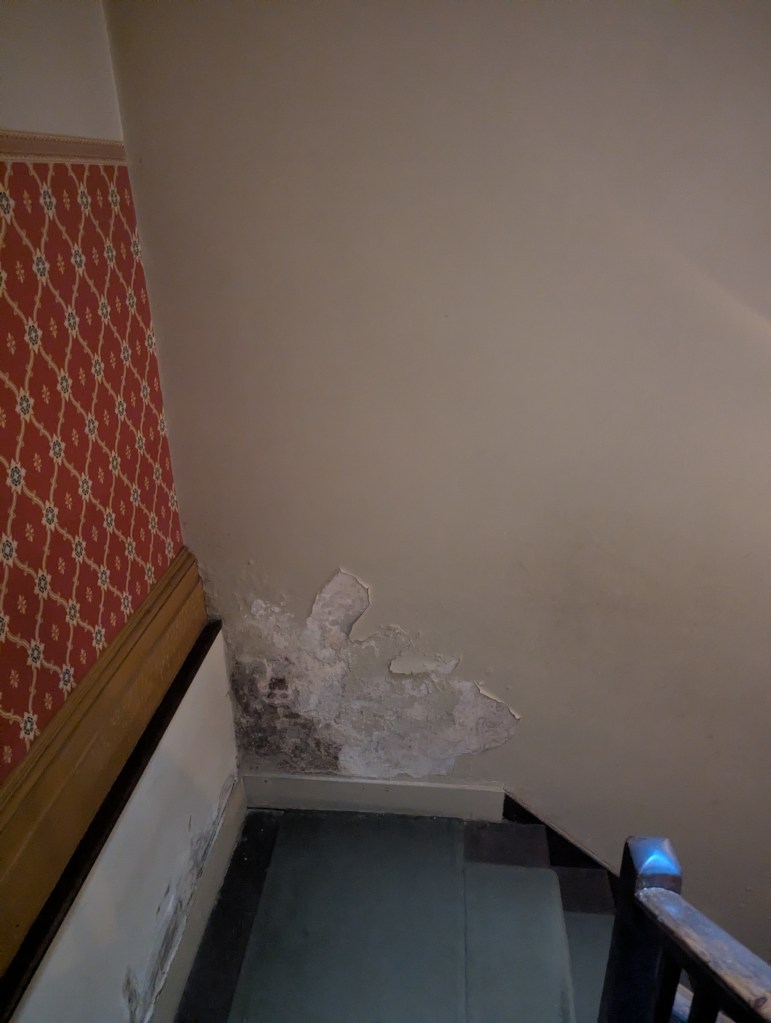
There was also a clear above and below stairs divide that I could both see and smell which felt starker than I had felt when I visited Uppark House last month. As the picture below shows, there was a transition from the nice wallpaper above stairs to the more damp and condensation filled part below stairs:
Where the Servants quarters in Uppark that we got to see felt quite light and airy, at The Judge’s Lodgings they were much darker, felt more damp and with low ceilings it was easy to imagine how much more stifling the cooking smells would have been there. There were also signs of damp around the place, which didn’t seem so surprising given the low ceilings, cooking and washing activities which would have been done there and the fact it would have been kept empty for large parts of the year when the court wasn’t in session.
The servants were the first to have the gas and oil lighting – it was tested out on them before the Judge’s had it. A precursor to the fact many schemes to try and increase deployment of insulation or renewable technologies have focused on the social housing sector where people have had less choice about whether they can accept things or not.
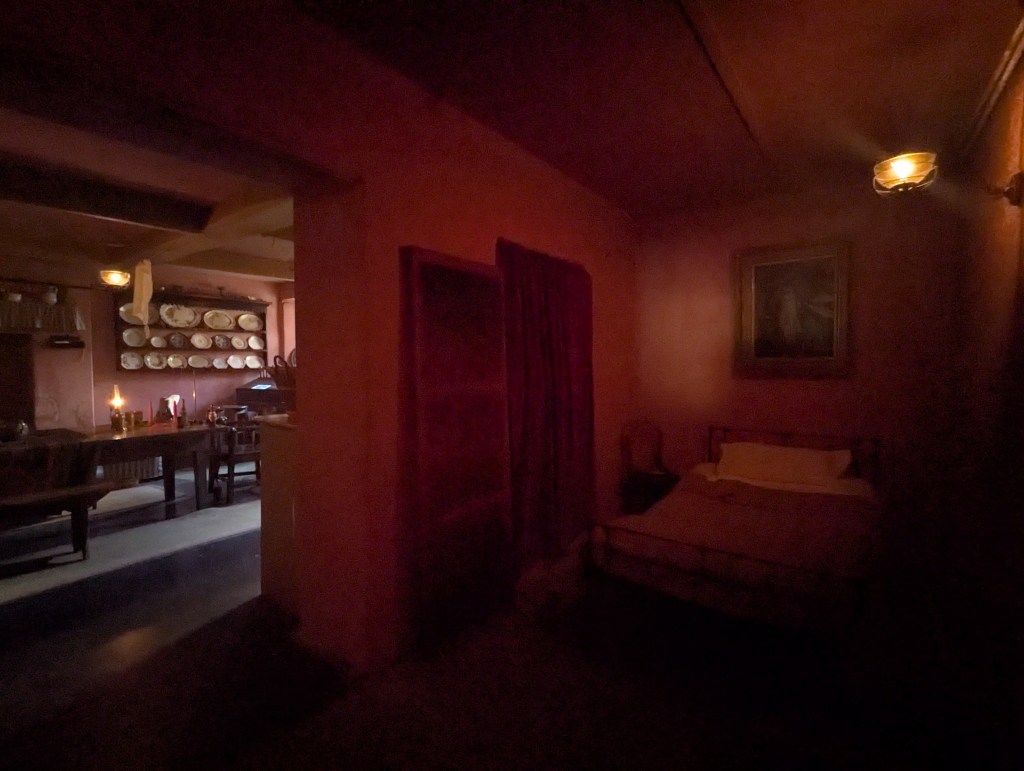
For whoever slept in the alcove off the space where they worked and ate, that sense of being unable to escape their work – both physically and also with the smells of the place, would have felt even more marked.
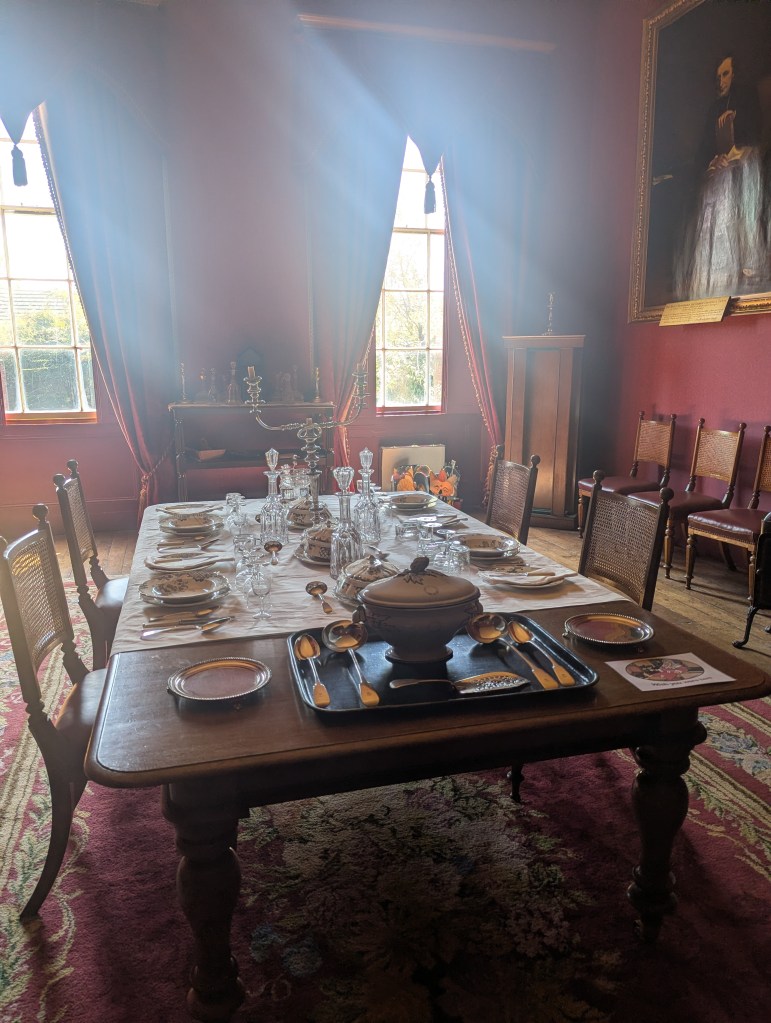
Although the Judge staying here would have experienced this place as a more relaxing space than the servants were likely to, for both the people living above and below stairs this was a working home, not just one for relaxation. However, even there, the comparison between the dark alcove for sleeping and living spaces below stairs, and those of the spaces above stairs showed, while there was a similarity in theory the practice would still have felt quite different.
A very different kind of home to others I’ve visited but it was great to see, and even better to briefly smell, the place and through it, get a clearer understanding of what it would have been like to live with those technologies.
Stately homes can often focus on just telling the story of the stately part, rather than also showing and exploring the work that keeps the stately afloat. As such I was looking forward to visiting Uppark House in West Sussex on my latest study date, because it’s a large country house which also has an accessible and well preserved servants quarters – allowing me to visit different homes within one space.
Uppark is a 17th century house which has been extended and renovated over time, much of the interior is broadly unchanged since the time of Sir Matthew and Lady Sarah Fetherstonhaugh who bought the house in 1747. They spent over £16,000 – equivalent to around £1.8 million now – transforming the house. That money seems to have come from extraction and subjugation. Matthew was one of the largest shareholders in the East India Company, invested in the Grand Ohio Company which got land from indigenous people of North America and there is also the suggestion of a link to slavery – Up Park Pen in Jamaica, a plantation worked by enslaved people and once owned by the Pink family of the local village of South Harting. That would always have been true but I wonder if that’s a part of the story which would have been part of the telling even just a few years ago.
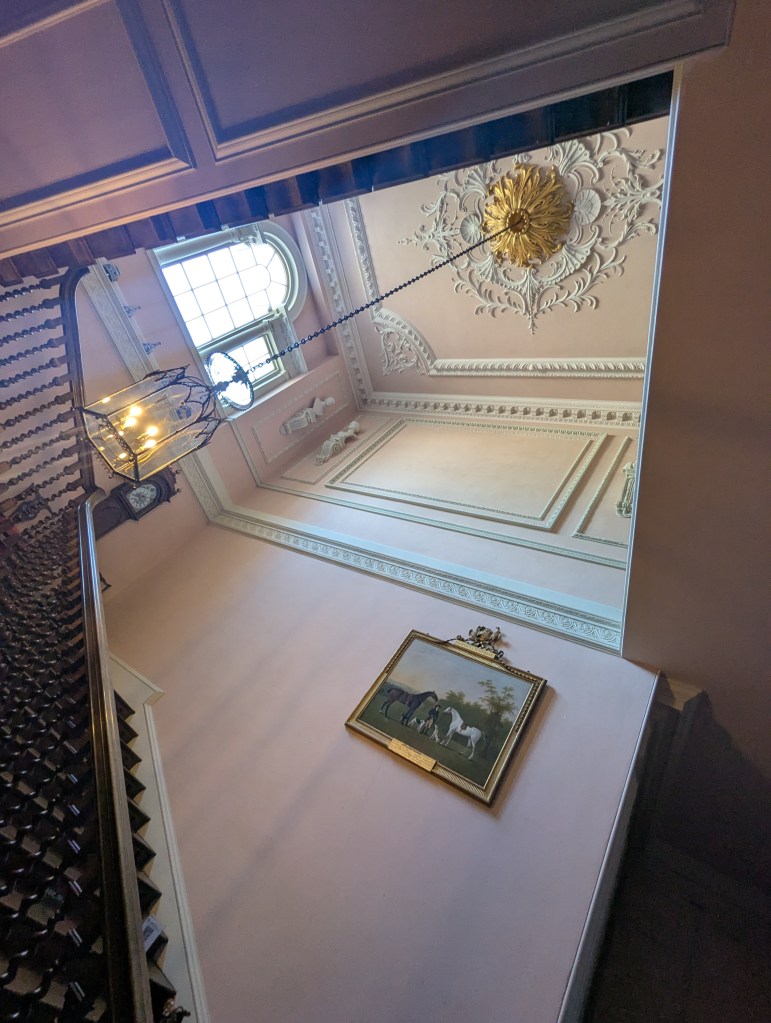
We started our visit in the entrance hall which was a later addition to the house, entering through a corridor with a low ceiling. This made the view of the double height hall feel that bit grander as we stood up straight to enter and take in the view after having bowed our way into the space.
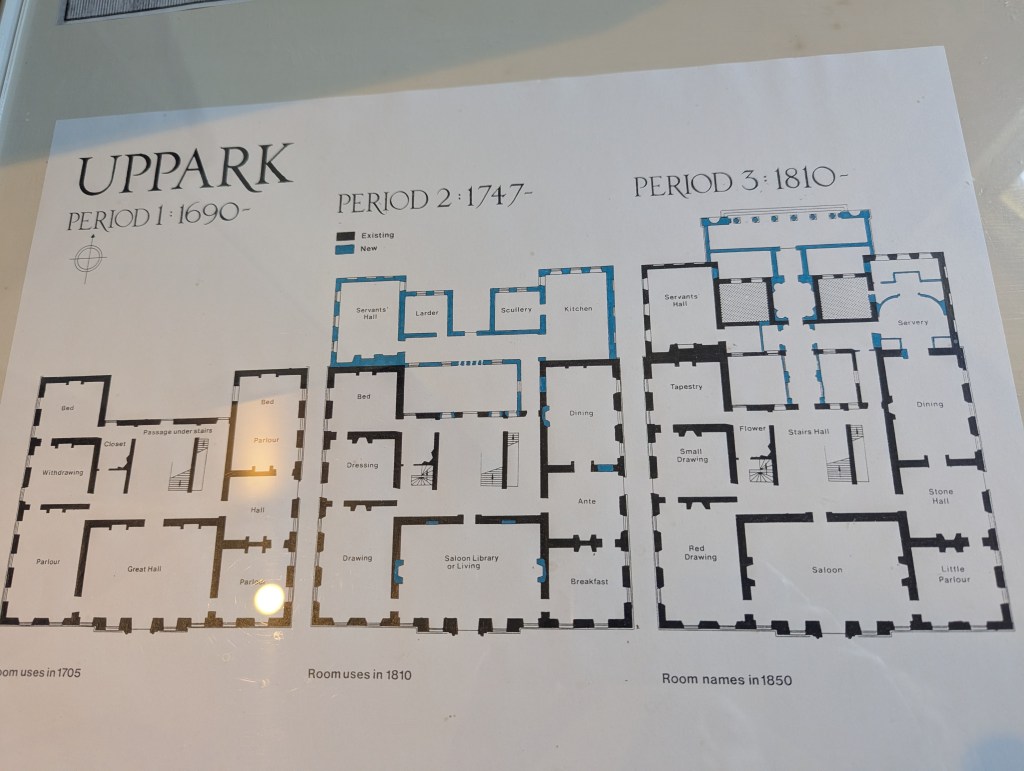
One of the things that is really interesting in exploring what people think and feel about their homes, and how that has changed over time, is looking at how people have used the spaces differently and what impact that has had. At Uppark a drawing is provided which shows how the floorplan has evolved, with spaces changing in their usage, and many spaces becoming more defined. The progression at Uppark shows the place becoming bigger, with more distinct spaces for the servants and over time the kinds of spaces servants would be working in, such as the kitchen, getting more removed from the rest of the house. The ground floor moves from being a much more mixed usage to one that is much more public facing space – a bedroom and dressing room disappear and become more drawing rooms. Dining moves from something that happens wherever people happen to be, to something that happens in a defined space.
There is a lot in the literature about how different spaces have changed over time, such as the bathroom as Barbara Penner’s book ‘Bathroom’ so clearly and graphically describes. Halls are another space that have changed a lot – as the floorplans above show, the hall was the main room, with a subsidiary hall. Gradually the use of the space changed and the hall became smaller. In Uppark the hall is still a big space but in many homes the hall has disappeared or become so small that it can’t function as the liminal, transitional space people want – leading them to adjust the layout to recreate that space. These changes in the design and layout of the building have impacts on how people live, which link back to further changes or amendments to the layout of the space. The fabric of the building and the way people live interacting with each other.
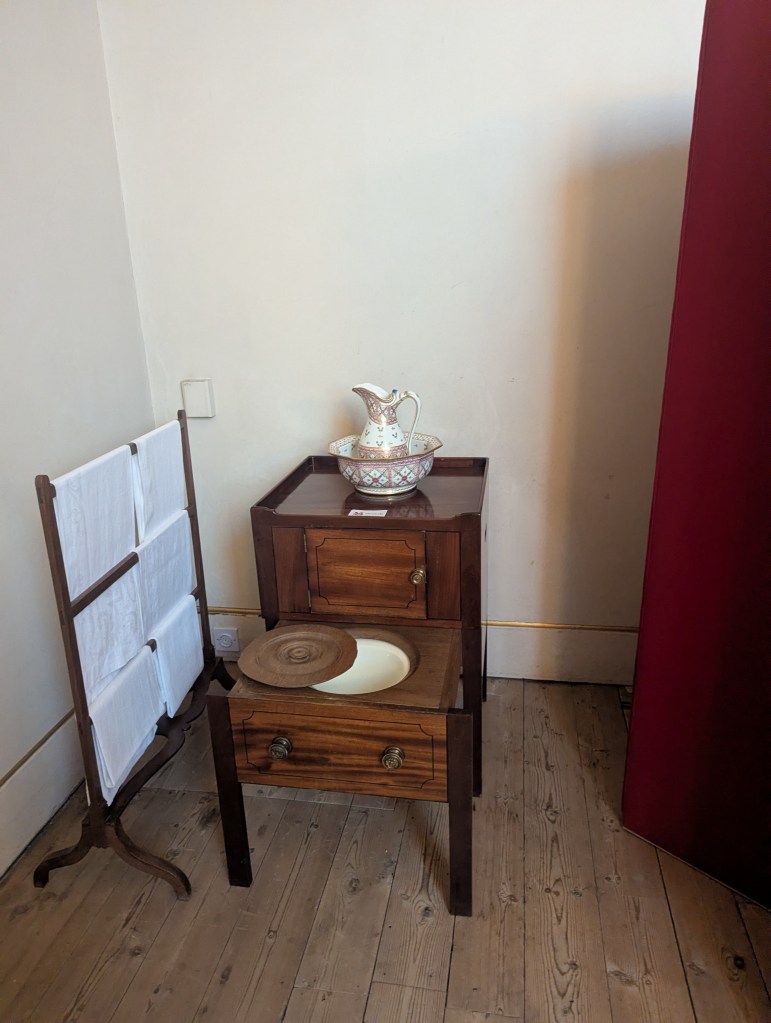
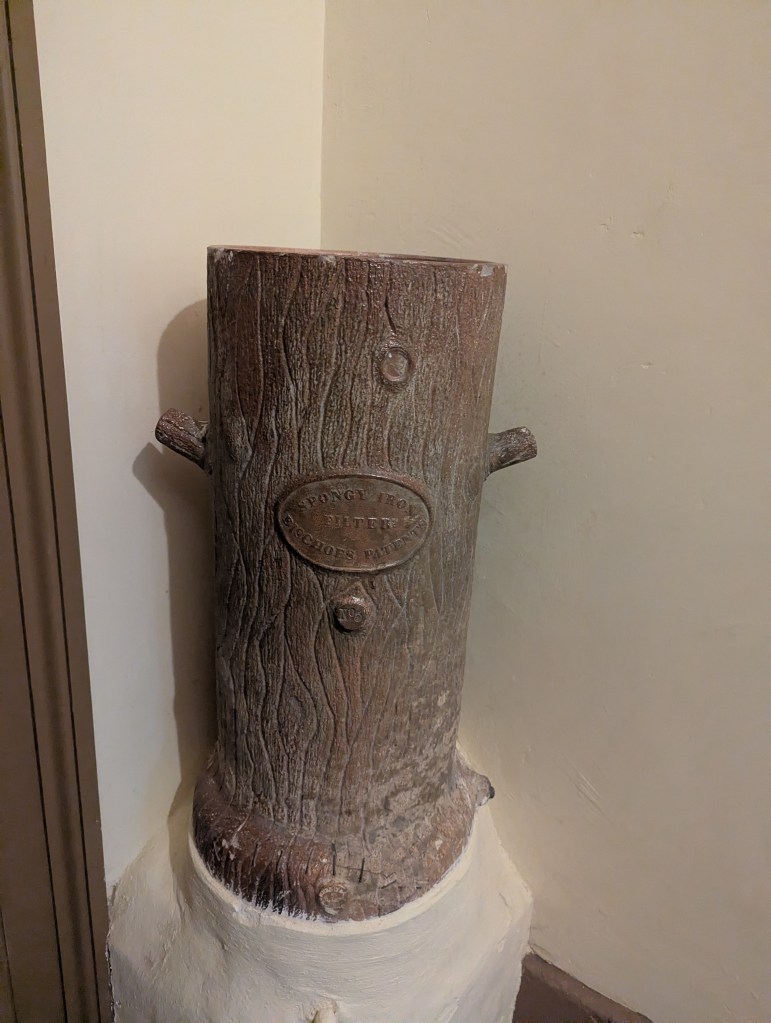
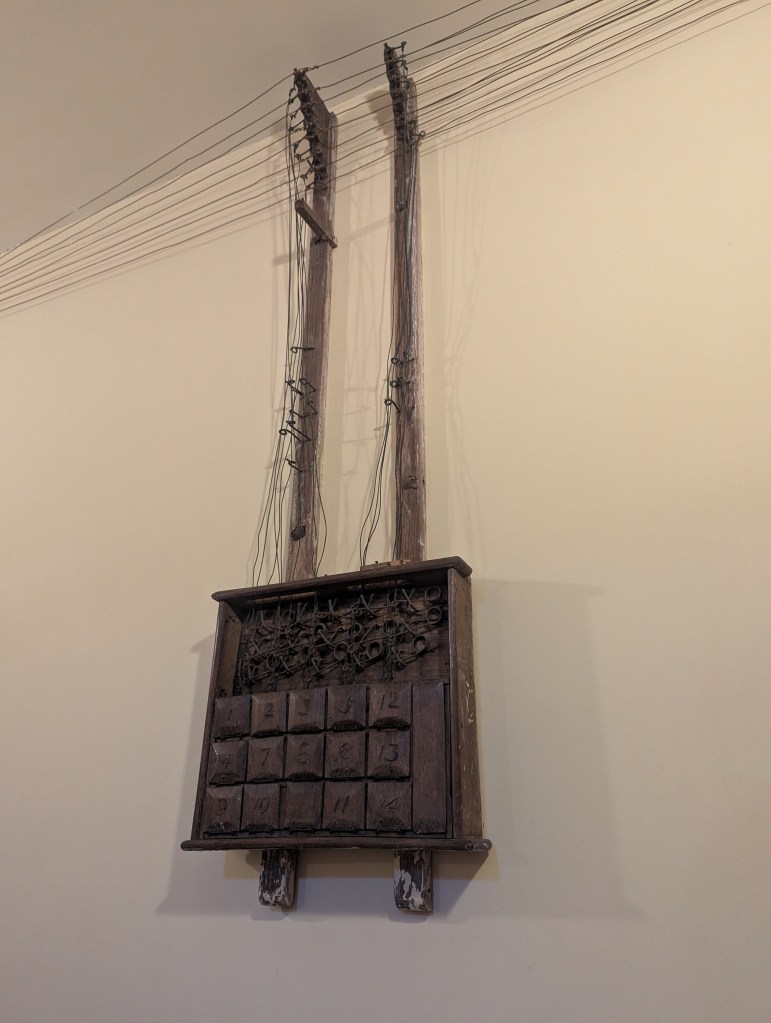
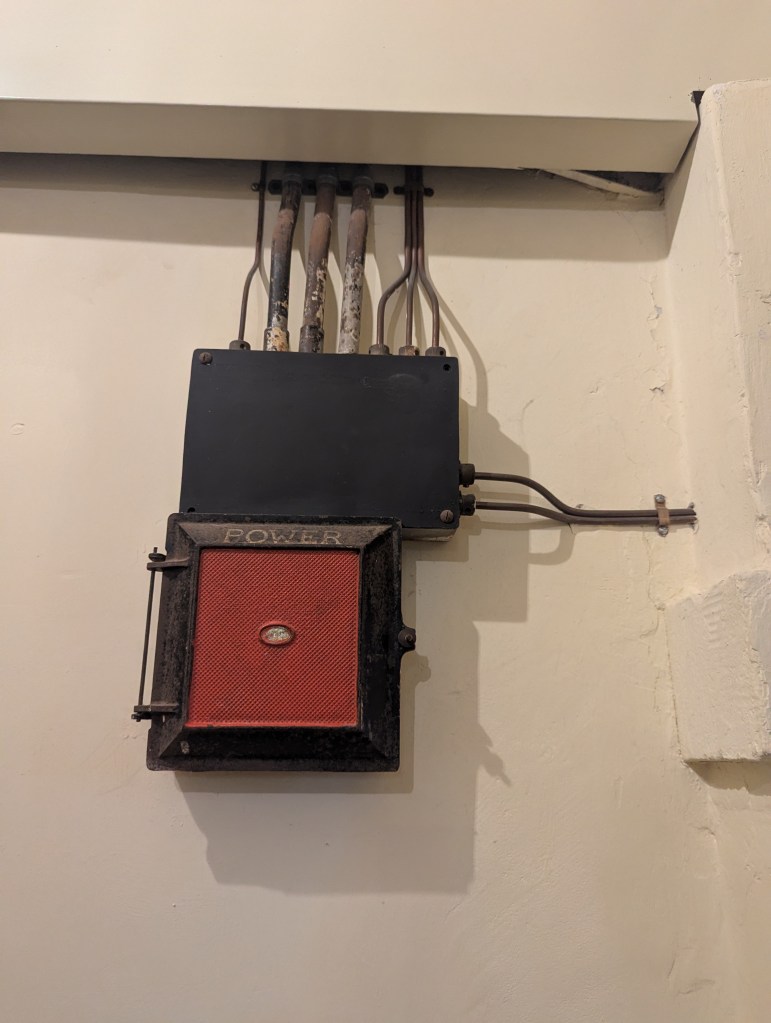
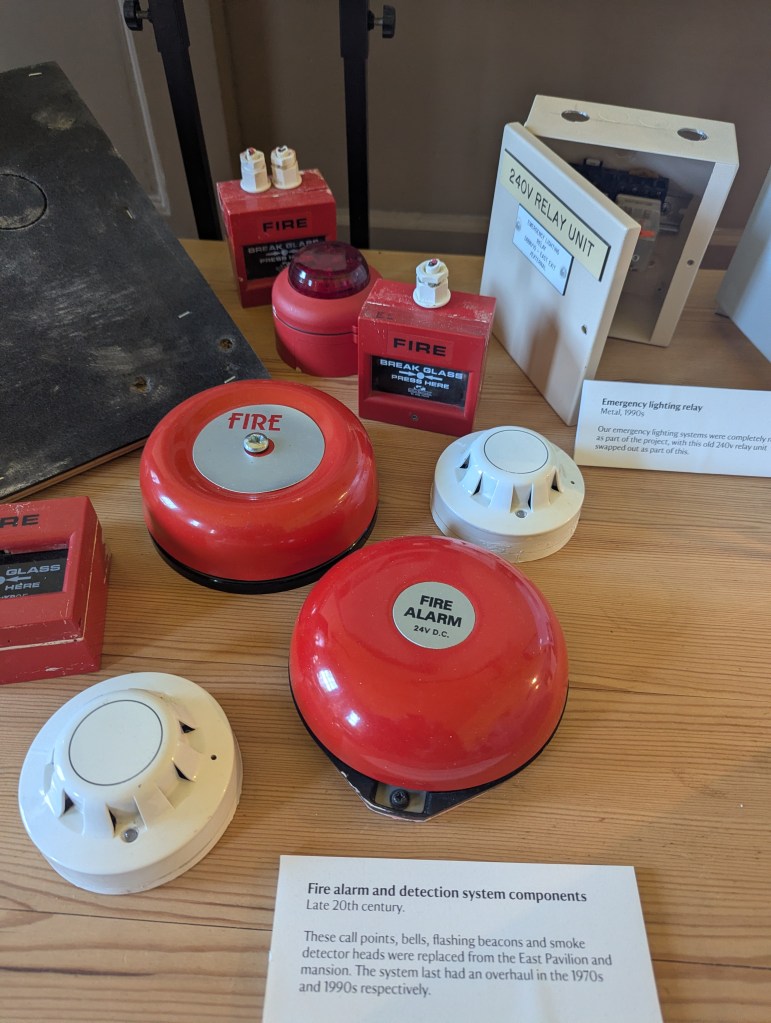
There were lots of elements within the house that showed those changes in technology and ways of living changing the space. From a chamber pot which was added to the Servery by the Dining Room when it became necessary for people to have more access to toilets, to water filtration, a bell ringing system that allowed the servants to easily see which room was ringing the bell and electricity.
All these changes were further indications of how technologies can get layered onto, or into buildings and rooms. That we change and adjust homes to suit our expectations and needs. Spaces, particularly ones that are decorated in what feels like a very old-fashioned way, were once the height of modernity. These changing but seemingly static spaces also reflect and can fit to new ways of being and living.
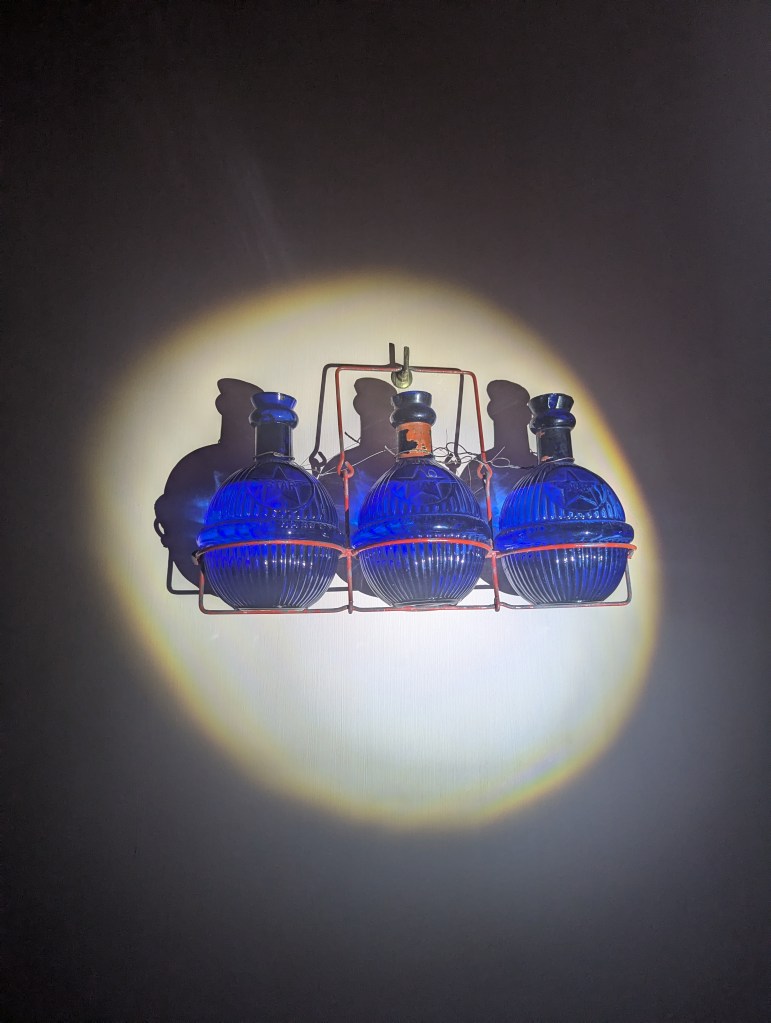
As someone who loves coloured glass, my eye was caught by these blue bottled beauties. One of the volunteer guides invited me to guess what this – hanging up in the hall is:
Lamps?
Water bottles?
Medicine?
Eventually he put me out of my poor-guesswork misery and told me they are a kind of fire retardant. The bottles would have contained a substance which would put out fires – the bottle would be broken over the fire in a hearth or elsewhere, glass and all. Apparently effective in putting out a fire but not ideal if they had to be used in bed.
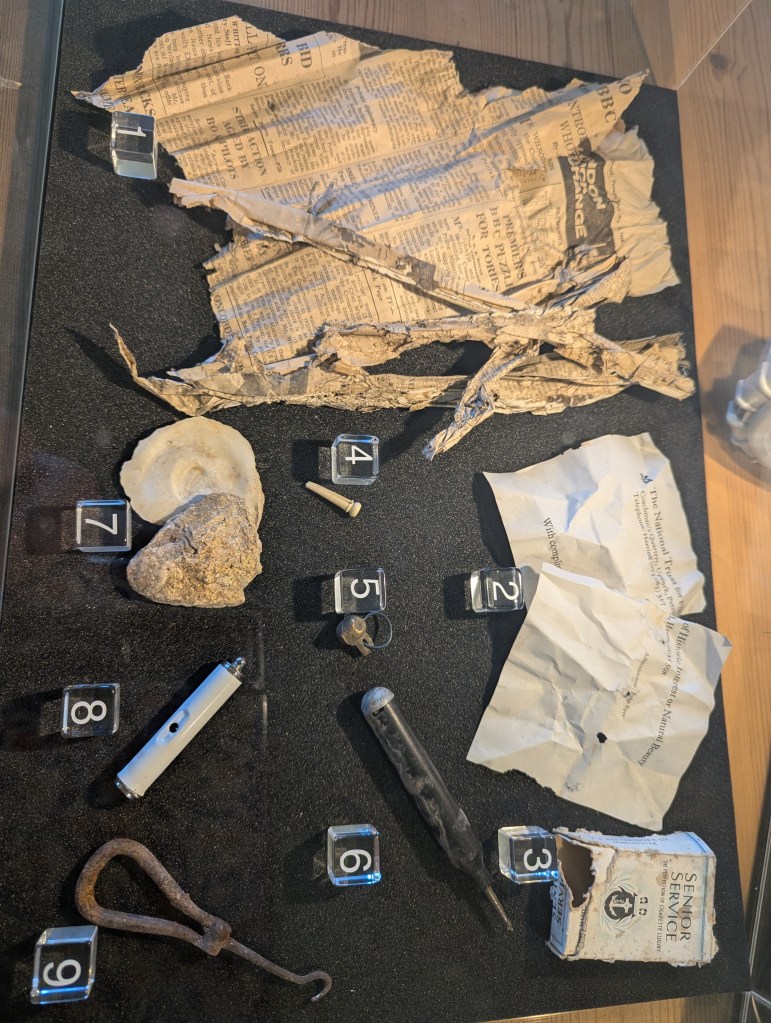
There was a big fire at Uppark in 1989 and it needed a good deal more than a couple of bottles of fire retardant to put out. Volunteers told us about there had been a massive effort to remove things from the burning building, such that much of the furniture and artwork was saved. Uppark became a huge restoration project – all the ash and rubble was gridded and collected, then sifted to find fragments of the building which could be reincorporated into the restored space.
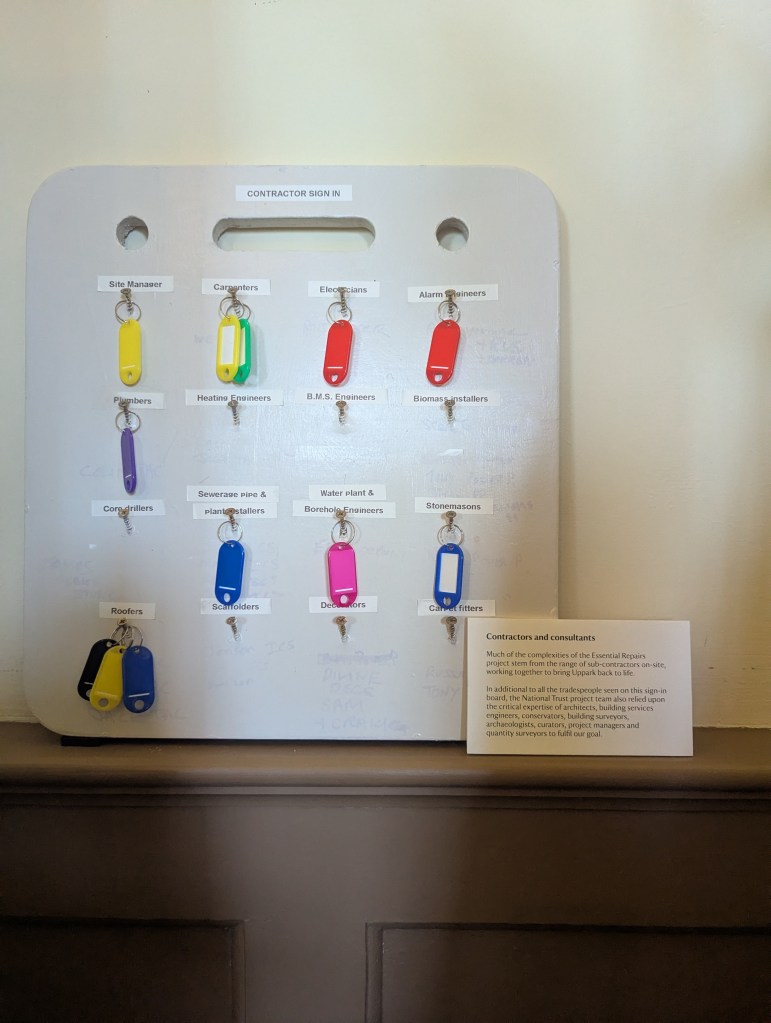
There is a display which talks about the work that was done to restore Uppark after the fire. I really loved the display of keys which was a good way to represent the variety of trades involved in the restoration work. The range of skills and the amount of care which has gone in to the house showed how complicated it can be to look after homes.
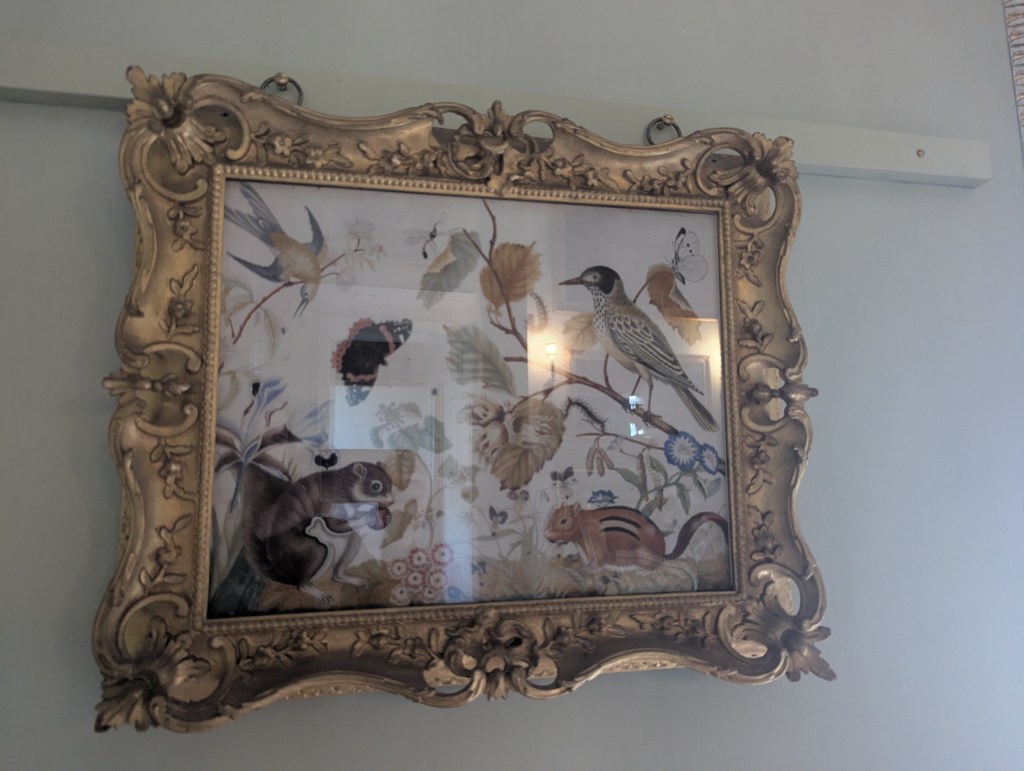
Hundreds of pieces of artwork were saved from the fire and are back on show. Rather than going to IKEA or similar, as was the custom of the time, much of the artwork was collected on a Grand Tour. There are lots of portraits of the family but I was particularly drawn to a fantastical painting by Lady Sarah which had a monkey in, alongside some creatures that might be more familiar visitors to the South Downs. A reminder of how, even at home, we can intentionally create connections to the outside world. And that in doing so we’re also communicating something to others about how we see ourselves in the world. This at a time when those extractive trades which funded the Fetherstonhaugh’s weren’t seen to be as problematic as they are now.
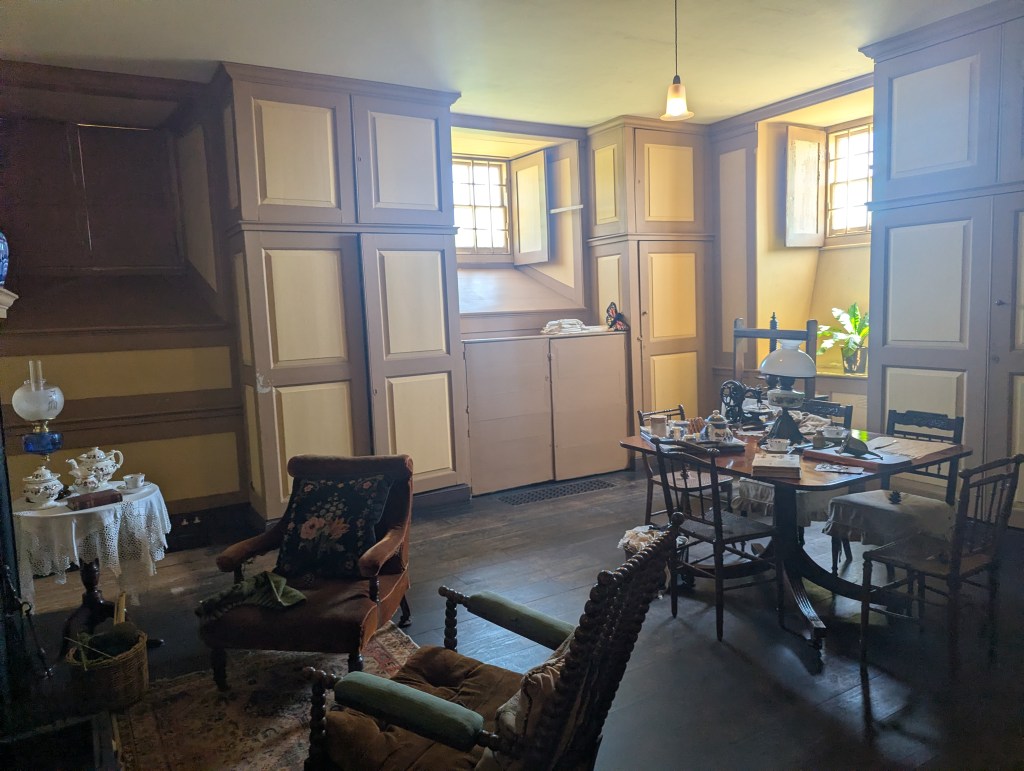
After having gone through the above stairs rooms I was happy to be able to also see the servants areas. I was surprised by the fact the servants quarters didn’t look totally awful and cramped and had some natural light coming in – which reflects my expectations of how servants tend to be treated. It seems very normal for servants to be treated poorly, so having more than a tiny crumb of space and some daylight seems luxurious. I was reminded of the servant Crosby in ‘The Years’ by Virginia Woolf. When the people who owned the place looked around the servants quarters as they get ready to sell up and leave they realise how cramped and dark it is, to which Crosby replies it was her home. Below is a picture of the Housekeeper’s room
Before getting too carried away with the idea of this as a more meritocratic place, it’s worth bearing in mind that H.G. Wells visited Uppark House as a child because his mother was the Housekeeper there. He had visited many times as a child and convalesced there. It is said that the house and the social hierarchy of the place helped to shape his socialist, liberal and meritocratic views.
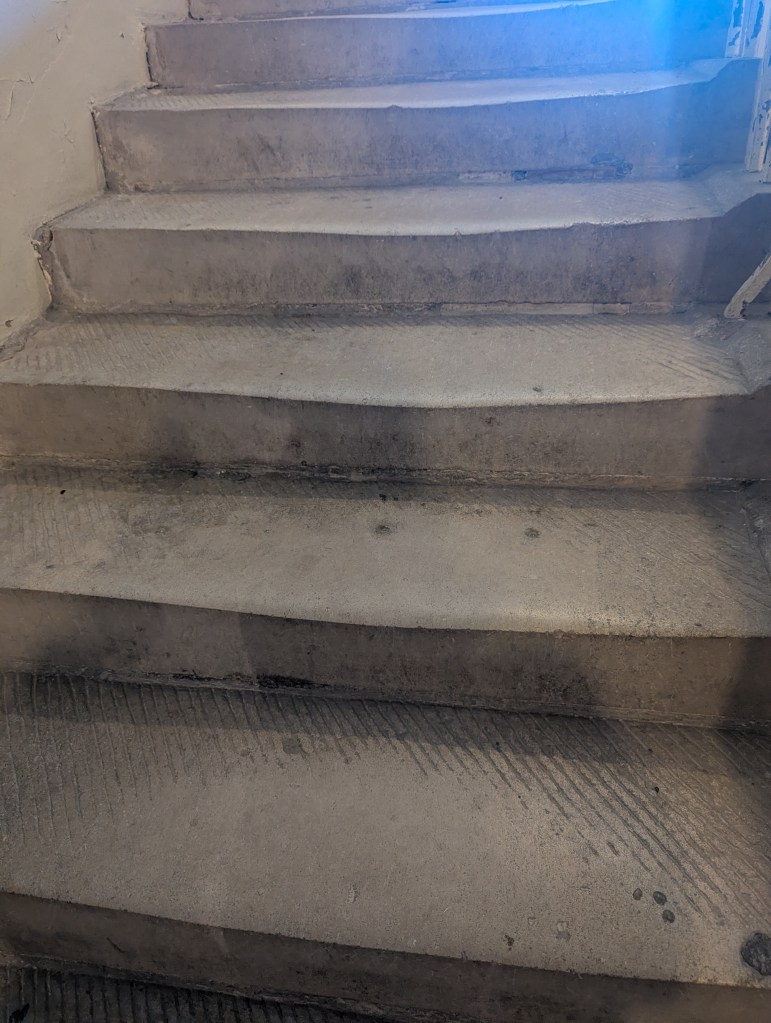
And even as the servants areas seemed less cramped than I had imagined they might be, there were still many signs of the work and effort that the servants had to put in. The well-worn stone steps in the servants quarters that have been eroded over time by tread after tread of servants tells a tale of the work they’ve done.
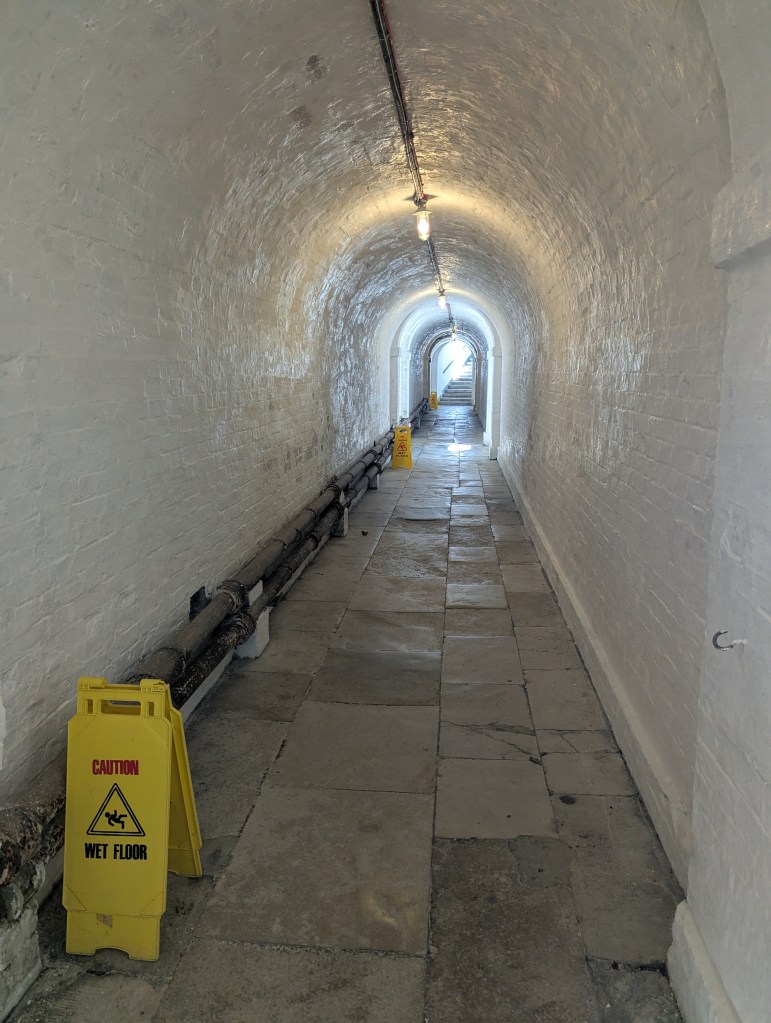
There were other elements which showed it wasn’t all plain sailing for the servants working there too. Because of smells arising from the kitchen, a new kitchen was built away from the house and connected by an underground tunnel. The servants then had to transport food from the kitchen through the tunnel – on kinds of hostess trollies which had warm coals on to try and keep the food warm. Walking through the tunnel it was easy to imagine what a faff it would have been to transport the food down the stairs, along the tunnel with the slightly uneven surface and then back up the stairs
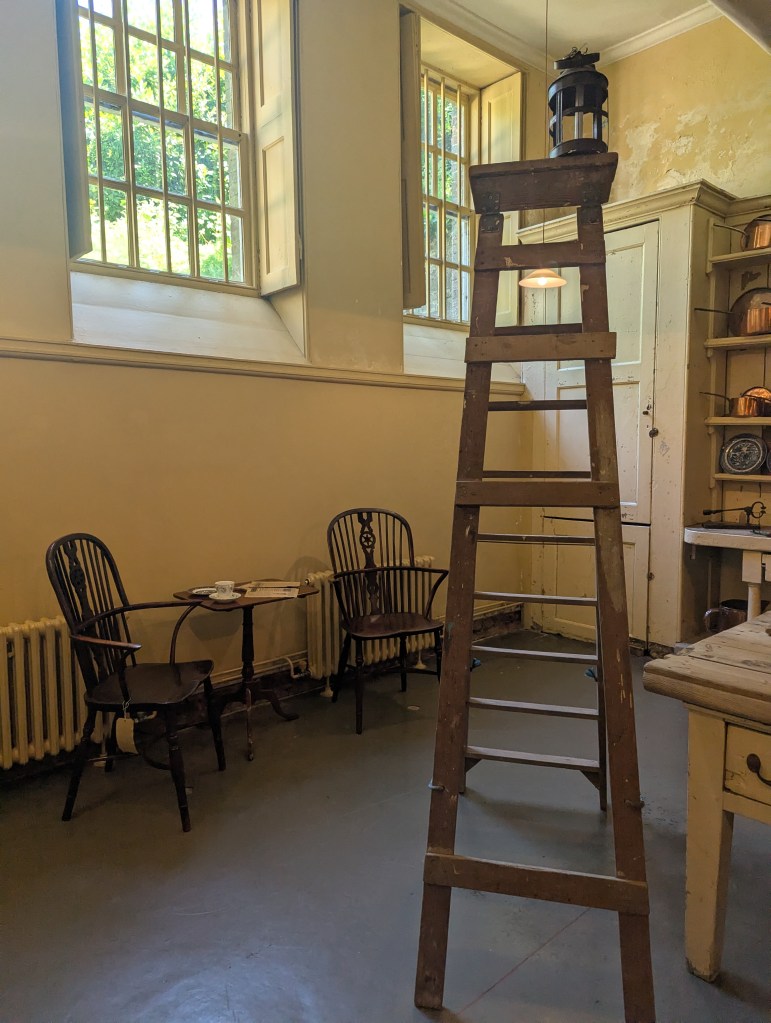
The ladder was in the middle of the original kitchen so that someone could go up it and hold up a lantern so that it would illuminate the stained glass that was over where the food was kept. A servant would have to stand on the ladder holding up a lantern for some amount of time, just for the effect it created.
Very different lives lived at Uppark and rare to be able to see something of how they all lived. What stuck with me was how the people who owned the place lived lives which were made possible by the labour they sought to make as invisible as possible. Even as the owners have moved out, at least from some of the spaces, it is those who work and have skills that have made and remade the place over time. It is that largely unseen labour which is really what has made the place it is, far more than the decorating efforts of a few rich people.
Don’t worry, this isn’t about watching England play at the World Cup. It’s about feeling the tension between different ways of working and noticing those issues can also translate into how people make decisions in day to day life. What has been emerging is that my own process is showing me that change and creativity don’t always emerge from maximum efficiency.
As someone who is self-funding their PhD beyond having a scholarship to pay their tuition fees, I’m definitely motivated to try and get my PhD completed more quickly. But I’m not ‘just’ here to get a PhD – I want to produce work that is useful and will make a difference.
In some respects then, that context creates the conditions to try and move more quickly and to let go of aspects that feel less clearly defined or on the critical path to delivery. Going for efficiency in the tasks and trying to find ways to do them as effectively as possible.
Yet I’ve had an ongoing tension between the sense that my ambitions and interests are broader than the subject of the PhD, while also needing to develop a PhD project that is discretely bounded enough that it can be completed. I didn’t realise I was doing this but I’ve been reaching towards a broader articulation of the subject and what it is I’m really trying to explore. That has led to a constant baseline level of questioning when doing things about that disconnect as it manifests in a particular area.
The background hum was getting louder and impacting on my ability to be more efficient and effective. The irony of observing myself feeling like I’ve made a decision about the next task I’m going to work on or how I’ll approach something and then feeling like it isn’t quite made as I have that discussion in my head. Eventually it brought me back to some activities that had been postponed week after week, despite having felt them to be useful, where I intentionally give myself a chunk of time to just think, explore and generally thought-shower and play without having to have an end goal in mind. It’s something I’m constantly wanting to do and so creating some time where I’ve got an outlet for that seemed like it was a good idea, felt great when I was doing it and yet got moved into the next week time after time because it didn’t feel like quite the right thing to do.
In giving myself the space to just play, listen to that background hum and try to make sense of it I think I now have a clearer sense of the different layers and linkages between those things. Seeing my PhD as a way to explore ideas through a particular case study that can inform the wider work and underlying questions I’m interested in. Peeling the onion and seeing that I’m still absolutely fascinated by my PhD but also being able to place it in the context of questions that are about what it is that enables some people to make a change and yet others don’t. Exploring and trying to make sense of what kinds of factors help indicate whether something is going to catalyse action or whether it is a good idea that won’t translate.
What felt like a luxury I could live without, even as I could see the value of it, became something that has helped speed things up and brought more clarity to the things I am doing. With that clearer articulation of the different layers and what I’m really trying to explore, I was able to revisit some things like the survey I had drafted and update the questions before they went out into the world. They are still aligned to answering the PhD but also link better to the overarching questions I’m interested in.
Given a lot of what I’m exploring through the PhD is around decision making, that sense of a tension between feeling like the need for speed was helping me make a decision, and realising it was hindering me has been interesting. There can be an underlying sense of a need for speed in decisions people are trying to get agreed that relate to environmental or climate issues – whether it’s an organisational or individual level. That might relate to the urgency of addressing issues that the science and natural systems drives, or it can be artificially generated urgency relating to funding or financing offers that are time limited. John Vaillant in ‘Fire and Flood’ is good at drawing out the different timescales that people can operate at and how time can be experienced differently – what feels fast in terms of the science can feel slow in terms of how humans experience it.
For myself, it’s been a good reminder from that some ways of working which are useful need to be protected in my days and weeks from a practical perspective. Doing a PhD gives me the space to make that happen and become embedded that will hopefully make it easier to protect that whatever comes next. It’s also been a useful reflection to take with me when looking at the circumstances that are being created for people we are trying to get decisions from.
As summer temperatures increase, at night as well as during the day, people are becoming increasingly aware of how uncomfortable their homes can be but there isn’t an easy fix. One of my PhD supervisors reflects on the fact that part of the challenge is that the same homes are both too hot in summer and too cold in winter. We’re not, for the most part, trying to address one issue in one set of homes and the other issue in the rest of the homes. Yet we’re better equipped for dealing with the cold than we are the hot.
In the event of cold weather, most homes can be improved if you were to throw lots of money at it, without doing anything to the home. You could just subsidise people’s bills, or flat out pay the whole lot. It would be massively expensive and wasteful but still, there’s an immediate lever that could be pulled if we lived in a parallel universe and felt that something needed to be done. We already have an equivalent for cold weather of the Winter Fuel Discount and the Energy Bills Support Scheme in 2022.
Most homes have central heating, so to try and warm up the homes it’s then a case of having the heating on more. Census data from 2021 suggests that only c.1.2% of homes don’t have central heating so there are a lot of homes where it is then easier to provide funding towards the cost of energy to make it more affordable. For those households that aren’t using mains electricity or gas to power their central heating there would be more steps because they have to procure extra oil or solid fuel. If they already have this fuel system, this is something that they are used to doing and would have suppliers that they are able to contact to try and source supplies.
That isn’t the case in terms of cooling a home though. Even if you subsidised everyone’s bills in the same way to try and make the home cooler, there would be more steps in between. Some of that would involve getting more immediate cooling options such as fans or cooling units. Having invested in a fan the internet told me was whisper quiet and effective, which turned out not to be so, I don’t think we can assume that it’s quick or straightforward for people to get something which will make a difference. There are things that could be done but they aren’t quick – from shades, shutters and awnings to more hard-core air conditioning units. That means there are a lot more steps, which need a lot more levers.
This also suggests that where possible, it obviously doesn’t make sense for people to be coming up with separate but related proposals. Too often adaptation and mitigation can get separated out but in many cases it should be the same approach which addresses both, or could be the same approach with some tweaks. That if there are going to be works done to a home, they should be things that will make sense for as many of those scenarios as possible. Instead – as my supervisor’s work surfaces – they can work against each other. Measures to improve the ability of the home to retain the warmth in winter can, if not properly detailed and dealt with as part of a wider approach which considers ventilation, make the home warmer or more difficult to cool in summer too.
If vulnerability is a mix of the underlying circumstances and the extent to which you can or can’t adjust, then these heatwaves reflect how much more vulnerable we are to hotter weather than cold weather. The design of our buildings increases our vulnerability as the climate warms up because, for the most part, they aren’t designed to cope with this amount of heat, this regularly – particularly with nights where the temperature doesn’t drop that much. The fact we have much less ability and focus on managing in the heat than the cold will continue to exacerbate this. A lack of quick levers we can pull to try and help (some?) people in emergencies compounds all of this.
Addressing this vulnerability therefore needs a focus on both addressing the underlying conditions alongside the levers to provide more immediate support. To date the focus has been more on trying to address the way buildings operate or how we can use them differently. Reducing the vulnerability to extreme heat will need a more systems based approach to try and make a substantive difference, focusing on one aspect is better than nothing but ultimately has limitations.
It sounds obvious but it can be helpful to think about the home in terms of the different parts and how they have changed, recognising elements don’t all change at the same time or in similar ways. This moves it away from thinking of it as one monolithic entity which changes in a monolithic way and it strikes me this feels like a shift from some ways in which people can talk about the home. And it made me wonder if perhaps part of why it can feel difficult to improve homes is that often the homes get conceived of as monoliths, which can feel quite daunting.
From a historical perspective, there’s been lots of investigations of how the home and parts of it have changed over time. Judith Flanders brilliant ‘The making of home’ takes the long view, while ‘The great indoors’ by Ben Highmore is looking at how homes have changed over the last 100 years or so in particular. There is also plenty of work looking at different aspects of the home, from Barbara Penners ‘Bathroom’ to chapters in Irene Cieraad’s ‘At home: an anthology of domestic space’ that variously cover how entrance halls have changed, Dutch windows or the move to open plan living.
Perhaps the focus on a ‘whole-house’ approach might be part of what drives that sense of the house as a monolithic space for many in the environmental sector. That the need is there to try and improve all of the building fabric, think holistically about the ventilation strategy and consider factors that will affect the movement and management of moisture in and around the building to avoid damaging the building or creating issues with mould and damp.
In part that view of the home as a monolithic entity also seems to stem from the understandable intention to try and avoid the performance gap. Treating the home as a whole system and trying to understand what’s particular about it – from a technical perspective but also in terms of what people value about the place. Albeit in practice that isn’t what happens enough of the time – either in terms of the design or the installation of measures.
It’s obviously possible to do a whole-house retrofit that takes place over time – so even if that’s the end goal it can then be more light in terms of the interventions. For a long time I had a great love for building renovation passports as a way to help people work out how to integrate retrofit measures into their wider home improvements. There’s lots of work happening in the social housing sector that takes a more piecemeal approach to improving homes over time. Some of that is driven by applying for sources of funding as and when they come up, and some of it reflects that over time a home will move through different teams who are responsible for works to homes – from voids to repairs and maintenance or special projects for instance.
Whereas if the discussion was dis-aggregated and focused around specific aspects, might it feel slightly less daunting? Dialling down the stress of it all, reducing the temperature a bit. It might feel easier to imagine looking to engage people with the need to change out a heating system rather than trying to get people on board with thinking about the whole house in one go. For most people, that’s how they think about their homes more generally – the bathroom needs doing, something needs to be done about the cupboard under the stairs etc – so it brings it in line with other elements too. In and of itself that makes it more manageable for people when thinking about their own homes.
This shift also allows for an approach which accepts that it isn’t just going to change incrementally in terms of aspects of the building but also over time too. So that then it isn’t about trying to claim that this is the ultimate perfection that can be offered but recognising that a particular technology might be the best for now, but that is likely to change in time too.
That change of mindset can then help people think more tactically too. My PhD is all about linking in environmental improvements to wider home improvements – instead of thinking about the whole house it’s then trying to find a way in and working from there. Going with the grain of works that either need to be done because something has broken, or works that people are exploring or choosing to get done.
There are lots of practical implications which arise from making that shift, and I hope to explore those further as my PhD progresses. But the act of thinking differently about our homes, and therefore parts of our homes, feels like it could be a helpful mindset shift that makes it much easier to talk to people about changes. Taking the idea apart to help put the actual space back together a bit differently.
For all of the talk of relational approaches to increasing the take-up of energy or environmental measures, I was struck when hearing a friend’s recent account of home renovations about the limits to that approach.
Talking about my PhD can often lead to reflections from people about their own homes and experiences. One friend talked about how their plumber had done some research and come to the conclusion that heat pumps didn’t work unless the home is really well insulated. On that basis my friends ended up going ahead and getting their ailing boiler replaced with a new one, with lots of attendant disruption to have a more efficient system put in. They also had a builder who didn’t understand building physics and hadn’t raised any concerns when my friends wanted some air bricks covered up as part of works to replaster and repaint walls.
Had my friends got a plumber who had investigated and come to a different view, which is quite possible given the increasing number of use cases that are coming online of heat pumps performing well in inefficient buildings, they might have been persuaded to have a heat pump. Similarly, had they got a builder who had a better understanding of building physics, when there was a discussion about covering over air vents the builder should have raised the ventilation point. The builder might have explained the premise of the ventilation strategy the home was built with and suggested some alternative options if they did still decide to cover them over. They could also have suggested mitigations in rooms where previous owners had already covered over or removed air vents. Instead my friends randomly found out about the ventilation approach because the algorithm served up some information.
That reliance on others who are seeming experts and placing trust in their views is very in keeping with a relational approach. This holds that we make decisions on the basis of how the home will be for those we care about but also that trades-people can have a big impact on the choices people make. However these examples from my friends also seems to suggest it really depends who you get and there’s an element of luck in that currently. In the absence of requirements or an environment where information about how homes work is a foundational part of being a trades-person, for a relational approach to energy to work for good performance outcomes a higher basic level of knowledge is needed.
It was another reminder of how far away we are from that baseline situation now and how normal it is that builders don’t consistently have, or need to have, a holistic level of knowledge. There were lots of ways in which the builder seemed to have done a good job but those were in aspects that were more visible to my friends than the potential impact of closing up the ventilation would be, at least in the short term. If it is incumbent upon non-experts to be in a position to challenge experts that seems to be a situation which is unlikely to drive good behaviours, isn’t realistic or fair on those who are getting the work done and leads to a situation that looks much like the one we have now.
This suggests the relational approach can be important in helping people make decisions and there’s something valuable in focusing on that as a route to reach people. However, without improving the underpinning levels of knowledge it feels like there’s a real risk that approach will end up perpetuating the idea the building trade can’t be trusted and does poor work – this time more explicitly in relation to energy or environmental measures. In a sector which has issues around the quality of work done through government and energy obligation funded schemes, widening the range of tenures mistakes get made in doesn’t feel ideal. Finding a way to have improvements in generating demand – for instance through the relational approach – going hand in hand with work to improve the quality of the supply chain feels like a way to try and sustainably address issues in the round.