Living the tension

Don’t worry, this isn’t about watching England play at the World Cup. It’s about feeling the tension between different ways of working and noticing those issues can also translate into how people make decisions in day to day life. What has been emerging is that my own process is showing me that change and creativity don’t always emerge from maximum efficiency.

As someone who is self-funding their PhD beyond having a scholarship to pay their tuition fees, I’m definitely motivated to try and get my PhD completed more quickly. But I’m not ‘just’ here to get a PhD – I want to produce work that is useful and will make a difference.

In some respects then, that context creates the conditions to try and move more quickly and to let go of aspects that feel less clearly defined or on the critical path to delivery. Going for efficiency in the tasks and trying to find ways to do them as effectively as possible.

Yet I’ve had an ongoing tension between the sense that my ambitions and interests are broader than the subject of the PhD, while also needing to develop a PhD project that is discretely bounded enough that it can be completed. I didn’t realise I was doing this but I’ve been reaching towards a broader articulation of the subject and what it is I’m really trying to explore. That has led to a constant baseline level of questioning when doing things about that disconnect as it manifests in a particular area.

The background hum was getting louder and impacting on my ability to be more efficient and effective. The irony of observing myself feeling like I’ve made a decision about the next task I’m going to work on or how I’ll approach something and then feeling like it isn’t quite made as I have that discussion in my head. Eventually it brought me back to some activities that had been postponed week after week, despite having felt them to be useful, where I intentionally give myself a chunk of time to just think, explore and generally thought-shower and play without having to have an end goal in mind. It’s something I’m constantly wanting to do and so creating some time where I’ve got an outlet for that seemed like it was a good idea, felt great when I was doing it and yet got moved into the next week time after time because it didn’t feel like quite the right thing to do.

In giving myself the space to just play, listen to that background hum and try to make sense of it I think I now have a clearer sense of the different layers and linkages between those things. Seeing my PhD as a way to explore ideas through a particular case study that can inform the wider work and underlying questions I’m interested in. Peeling the onion and seeing that I’m still absolutely fascinated by my PhD but also being able to place it in the context of questions that are about what it is that enables some people to make a change and yet others don’t. Exploring and trying to make sense of what kinds of factors help indicate whether something is going to catalyse action or whether it is a good idea that won’t translate.

What felt like a luxury I could live without, even as I could see the value of it, became something that has helped speed things up and brought more clarity to the things I am doing. With that clearer articulation of the different layers and what I’m really trying to explore, I was able to revisit some things like the survey I had drafted and update the questions before they went out into the world. They are still aligned to answering the PhD but also link better to the overarching questions I’m interested in.

Given a lot of what I’m exploring through the PhD is around decision making, that sense of a tension between feeling like the need for speed was helping me make a decision, and realising it was hindering me has been interesting. There can be an underlying sense of a need for speed in decisions people are trying to get agreed that relate to environmental or climate issues – whether it’s an organisational or individual level. That might relate to the urgency of addressing issues that the science and natural systems drives, or it can be artificially generated urgency relating to funding or financing offers that are time limited. John Vaillant in ‘Fire and Flood’ is good at drawing out the different timescales that people can operate at and how time can be experienced differently – what feels fast in terms of the science can feel slow in terms of how humans experience it.

For myself, it’s been a good reminder from that some ways of working which are useful need to be protected in my days and weeks from a practical perspective. Doing a PhD gives me the space to make that happen and become embedded that will hopefully make it easier to protect that whatever comes next. It’s also been a useful reflection to take with me when looking at the circumstances that are being created for people we are trying to get decisions from.
The Anna Karenina principle?

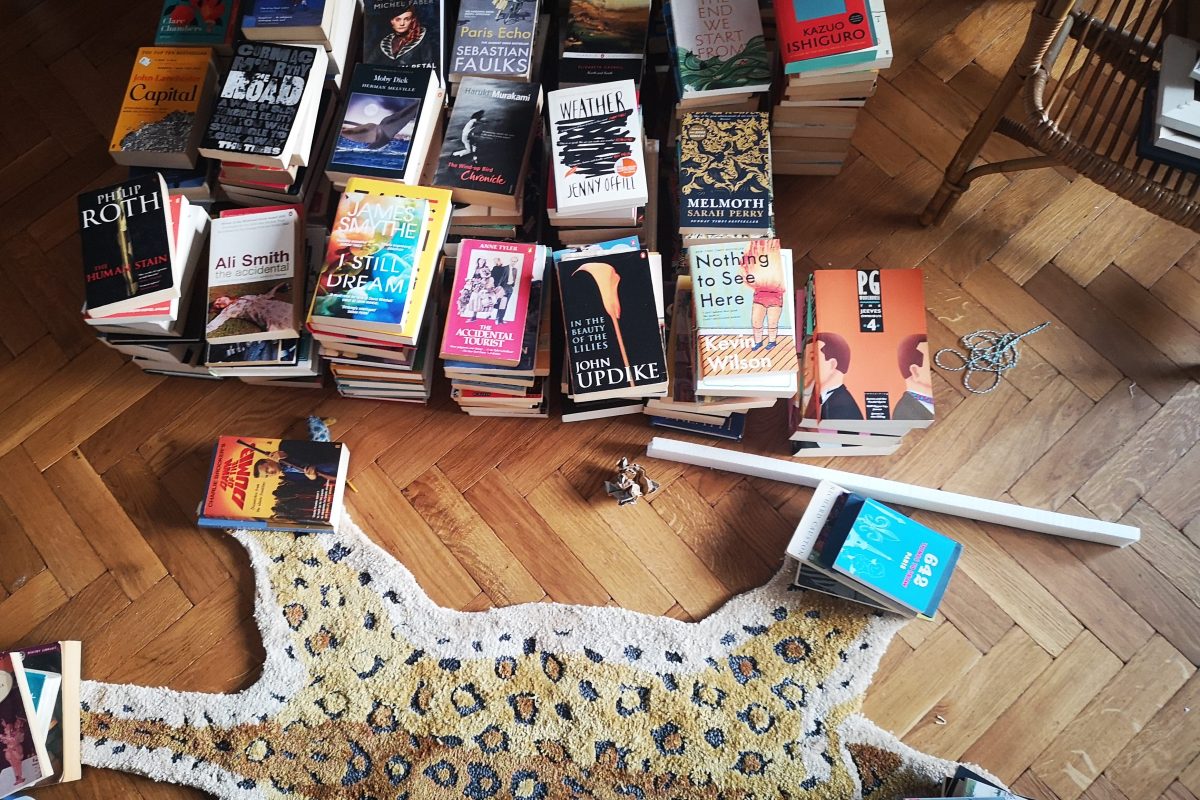
I was reminded of the Tolstoy quote from Anna Karenina that ‘All happy families are alike; every unhappy family is unhappy in its own way’ when thinking about the surprising absence so far in the novels I’m reading for my PhD. One of the strands of my research is looking at existing materials to try and get a perspective on homes and how they’ve been represented, what the view is on how to improve them or just what ‘good’ looks like. As part of this I’ve read a few novels, and have still lots more to read but I’ve been surprised not to have found many examples of ‘the ideal home’, or even ones which are very happy yet. In remembering the Tolstoy quote it made me wonder if there’s something inherent in novels that explains this lack, or whether it’s more a reflection of my limited reading so far.

The Anna Karenina principle takes the idea from Tolstoy and applies it more broadly, holding that there is only one way to achieve success in that the key factors need to be in place, but there are countless ways to fail. This principle has been applied in contexts as diverse as ecology, banking and the domestication of animals.

Turning to the novels, there are a few slightly oblique glimpses of homes that seem to be happy. The couple who have their home and themselves attacked by Alex and his droogs in Anthony Burgess’s ‘A clockwork orange’; the family home of one of the main characters in ‘Glass Houses’ by Francesca Reece – although that’s more how it is represented or seen through the eyes of a visitor than by the occupants. Maybe some traces in the Elizabeth Gaskell novel ‘Cranford’ – but even there it isn’t straightforward because of the financial concerns of many of the protagonists. Alice’s home in Sarah Moss’s ‘The Fell’ has some details in there about how she takes comfort from details around the place, yet there is also a real sense of her isolation as she is recovering from cancer alone in a time of pandemic.

Looking at the list of novels I’m still yet to explore, none of them jump out at me as being about homes that are harmonious, idyllic refuges. I might find some more representations of that in the surrounding characters but the central premise of many of the books is about the home as a site of, or representation of, things falling apart, disconnection and sadness.

Perhaps this is because fiction tends to have a narrative drive at the heart of it. A tension which needs to be resolved somehow, and so happiness can be less easy to place there because the ‘happy ever after’ is the end not the through-line. That there is something implied about unhappiness being ‘news’ or a step away from the norm of a happy home. The novel is then a way to show how the world could be, and is for many others with all of the pain and darkness that can bring. Allowing us to understand something we might not experience ourselves.

Or could it be that the home as an unhappy or unsafe place works as a plot device because it immediately enables the reader to compare the context to the idea and ideal of home. A difficult home context allows the reader to get a sense of the protagonist being in a bad place. This can make them more sympathetic to the character. It also makes it understandable the character would be seeking a way to improve their situation in a way the writer doesn’t need to explain as much as they might for some other choices or needs.

Of course it could also be because writers don’t see enough happy homes around the place to make them feel believable or true. Writing novels can be a way to draw attention to things that aren’t right. To reflect back things society needs to or isn’t engaging with. From Dickens and Hardy in Victorian times to the novels of the 2020’s, art and culture can offer insights to lives that are beyond our own, and empathy for them which makes taking action necessary. For the novels of the 2020’s on my reading list, without even having read most of them there’s a clear theme emerging around how precarious housing can be. From Ella Frears’ ‘Goodlord’ which takes the form of an extended email to an unscrupulous estate agent to Megan Nolan’s ‘Ordinary human failings’ about families in temporary accommodation, to the 2024 novels ‘I see buildings fall like lightning’ by Keiran Goddard and ‘The lodgers’ by Holly Pester, about a housing estate and the UK housing crisis respectively.

That leaves me wondering if it’s less of a surprise I’m not finding more happy homes in the novels. While the quote from Tolstoy helped shape that sense of surprise, the principle doesn’t feel quite right in terms of the view of home. It’s true that even in the 14 novels I’ve read so far I’ve loved the diversity of style, tone and characters – a huge range even as the subject itself remains fixed and the homes are largely unhappy. Yet while there are lots of commonalities in the factors constituting a happy home, the plurality of ways a good home can be made seems to undermine the principle from that direction.

Lists of lists

Recently the reading I’ve been doing is about the meaning of home or, really, the meanings of home. Cumulatively it can feel a bit like the scene in ‘Being John Malkovich’ where John is in a restaurant surrounded by people who are all variations of him, all talking but the only word they say is Malkovich. The word ‘home’ starts to blur as it gets repeated over and over and over and. It feels like the words fold into each other, until the meaning starts to go or it all becomes quite Malkovich, Malkovich. That could just be because I’m marinating myself in the subject but it’s also made me reflect on what turns those lists and frameworks into things that are useful and used.

Reading Jeanne Moore’s (2000) piece ‘Placing home in context’, I think she’s great at setting out a variety of ways in which the meaning of home has shifted over time, and how it can vary across countries. How different disciplines have engaged with the idea of home and how meanings of and feelings about home have been represented. It’s a bit of a speedy romp through the subject so it’s more about breadth than depth.

She does draw together lots of lists and frameworks that have been developed to try and capture the meaning of home. Seeing so many of them together in one short article makes her reflection that lists ‘imply all meanings are equally experienced, and do not encourage a focus on the relationships between items’ more apt. A sense there are so many different ways of describing what comes through as quite a consistent set of messages. Lots of overlap and commonality between them, with Putnam & Newton (1990) finding that privacy; security; family; intimacy; comfort, and control consistently appear in research about the meaning of home. Other lists have the same words or similar meanings, which perhaps isn’t so surprising, at least for those lists and frameworks that are talking about a suggested ideal of home.

I went to the Museum of Home for their event ‘More Than a Place: Centre for Studies of Home Annual Lecture 2026’ which was a talk and Q&A with Katie McCrory exploring what she describes as the eight universal emotions that come together to create ‘a feeling of home’. This work is based upon the Life at Home report by IKEA, and in the book she identifies ‘comfort, control, security, accomplishment, belonging, nurture, enjoyment and aspiration’ as the eight emotions. Plenty of venn diagram overlap there with other lists and frameworks too.

Within an academic context I can see that lists and frameworks provide scaffolding for thought and a way to organise and reflect findings. A drawing together of what’s been learned and found, a chance to reflect on how those findings relate to the wider literature – findings suggested x which differs from the previous literature in y scenarios. Trying to represent and honour what’s been found in a way that some other literature might not quite feel it does, even that which can appear to be similar. So if people talk about security rather than privacy, it would make sense that security is the word that’s used, even though the sentiments might be analogous to another piece of research where people talked in the language of privacy. The weight of different words can vary from person to person and so when analysing the research, in the absence of anything within the wording which explicitly suggests one or other of those choices, different researchers might lean towards one rather than the other. Over time, the development of the frameworks and lists helps build up an understanding of an area and that can develop into recommendations and more directional proposals.

From a policy and practitioner perspective, I’m conscious that lots of reading I’ve done which suggests a framework has been developed, has seemed hard to translate into practice. Thinking about frameworks I’ve used in a policy or delivery context, they would be ones that have some actions or processes attached to them. There would have been underpinning research which led to the development of the list of criteria. No doubt there could be the same questions about why some options or wording were selected rather than others but when it’s accompanied by input which allows the framework to be used, rightly or wrongly, that can feel less of a pressing concern. Or at least, if the framework itself feels useful, if it seems totally bonkers then that’s obviously something else altogether.

Having a sense of who I want the work to help and what they might need, then helps shift some of that Malkovich, Malkovich energy. Given I’m intending to develop a framework as part of the outputs of my research it’s useful to have in mind more of a sense of where I want to be aiming towards. It helps explain why lots of the ones I’ve seen haven’t felt very satisfactory, that I find myself asking ‘and then what?’ about them. Being able to take a step back from the lists and lists, and indeed the lists of lists, to see the aspects that are common across those and why and where there might be gaps. Holding in mind that it is about being able to translate those lists and frameworks into action and activity that’s useful, rather than feeling like what I’m trying to do is come up with one list to rule them all. How to do that is another question, for another day, but having a sharper idea of what I’m aiming towards is very clarifying.

It takes how long?

In a world of life hacks and hustle, a focus on productivity and top tips, it feels gently radical to work on a long-term project. One of the biggest differences I’ve experienced so far in the move from work world to a PhD is having more time to do things. While the change was intentionally sought out and feels wonderful, getting used to that difference and working within it doesn’t always feel easy as it might initially seem.

During previous roles I was used to covering lots of vacant posts, having work plans for the days and weeks of myself and my team that I would constantly juggle as new ‘urgent’ things came in which meant re- and de-prioritising activities. Whether it was true or not, and I definitely feel there’s been an outbreak of busy-ness amongst people which I try not to feed into, I always felt like there wasn’t enough time to do things properly.

I think I was good at coaching other people to accept that not everything needs to be gold-plated, and good enough is great most of the time. That what matters is making progress and much of the time good enough does that. The trick is to understand when good enough is good enough though. Even within that idea, it often felt like myself and my team were being asked to do pieces of work with insufficient time to really explore the subject, consider options, understand the wider landscape or even simply have time to proof-read things.

Now though, thoughts which I am sure I’ll look back on and shake my head at, I find myself looking at the timelines for a PhD and thinking it seems improbable to have so long to do one overall piece of work. Even thinking about it as multiple workstreams for different research activities, it seems like a really long time relative to the kind of timings I’ve had before. That might be a reflection of not having worked in a context of an organisation that was really looking to take the long view but I don’t think it’s just that.

The fact I’ve gone from managing a team who would be doing large amounts of work towards a project might be a factor. Now I’m the only one doing the work, so all of the small sub-sub-tasks needed for an activity to be done, including things that are necessary but can be a bit time-consuming and fiddly have to be done by me too.

Things can take longer than I think they will take and one of the things that I have been noticing as my PhD unfolds, is a tension between expecting or being used to doing things quickly, and having the time to be more considered or thorough. Often when working on something now I have a voice in my head that has checked how long it’s taken me to do something and thinks I’ve been too slow. I then chastise myself for being slow and get into a back and forth discussion with myself about if or how I’m being slow. Taking turns to prosecute or defend myself but a lot of the tension is from expectations which probably weren’t correctly calibrated to start with. If my expectation is that everything should be done as quickly as possible and that I might not have time to do a good job, it’s unsurprising there might be some discomfort about the time something needs.

Looking beyond my immediate task to the longer list of things I’d love to do for my PhD and beyond, and then more widely still to issues and challenges in the world, such as climate change, there’s such a sense of urgency. A want and need for things to be moving more quickly. A sense of the impacts building up, spiralling out in time and place to this and future generations, all affected by our slowness and inaction. Or back to myself, thinking about all of the things I’m not doing, can’t do, will never do. That suffocating sense of it, rage and fury and want and need. Feeling like it’s wasteful not radical to have this time.

Then as I’m writing this, I see a man walk past my window, or in truth, very slowly shuffle past my window. I’m distracted from writing this piece, exploring my own sense of frustration and astonishment at the opportunities I have by him. It takes him, relatively or comparably, longer to pass through my line of sight than I would expect it to take me. For him, on the basis of the times I’ve seen him go by, that seems to be his normal, glacial pace. Everything he does or plans to do must presumably be calibrated to how long it takes him to get places. The actual him, not the him he perhaps used to be or wants to be. Maybe he and I might make the same journey but his expectation of timings might be double what mine would be.

As I look back to a screen full of news reports about how climate change has likely made Hurricane Melissa four times more likely, the fraying consensus around the need to act on climate change, slow progress ahead of the upcoming COP30, it all feels so very slow. Too slow. The urgency not matched with action.

I try to soothe myself with thoughts of the man shuffling past my window, telling myself that sometimes things just take longer than it seems they should take. That he might not want things to take so long either, might also be furious and frustrated but that doesn’t make things any faster, probably the opposite.

I stretch and play with the analogy, coming back to it over and over to see if it can help me think differently. To find a way to translate the dignity of the man shuffling by, still trying and doing, into something that makes sense of what I see around the action on climate. For now at least I just have to hold those different things in the same view because they don’t feel like they can easily be reconciled. Things can take too long, longer than we want or need and things flow from that – sometimes good, sometimes bad, often unclear at the time or changing in hindsight. Back to the same message, over and over, to just start from where I am and do what I can. Sometimes that feels enough and sometimes it doesn’t.

Back to the future

Visiting archives is a way to physically connect with the past, so I am keen to do so as a way to explore the stories that shape how we understand homes, communities, and change over time. As soon as I stepped into the Southwark Archives I realised that of course this is what an archives should smell like. That slightly dry, dusty but richly inviting smell. Absolutely ideal.

From that on-point smell, my visit to an archives only got better. As a first-time visitor to an archives, and going in an exploratory way to get a sense of the lay of the land, I didn’t have much of a sense of what I’d find, how it would all work.

The amazing archivist that I’d e-mailed before I arrived had, on the basis of a very broad set of parameters, collected together some information for me and it was all laid out ready when I arrived. I just delved right in, looking to see what piqued my interest, or felt like it related to my PhD.

The generosity of this work, people working to preserve parts of the past and help others make sense of it just blew me away. Watching one of the archivists respectfully and patiently respond to a million questions from a couple of people who had booked a visit. Finding and helping, making resources available and helping people who are coming to the archives with all kinds of interests and questions. The act of archiving, as they acknowledged themselves when talking about the changing norms in society, is obviously an act of choosing what is important, what should be kept, that says something about the time, place and people – even if those views reflect a worldview that most of us would now no longer agree with.

It was so incredible to actually physically hold documents going back over 100 years. Although virtual things are great and give us access to so much information easily, that sense of literally holding parts of history in my hands had me feeling quite emotional at times. The more so because most of what I looked at was the stuff of everyday life – brochures, flyers, news stories and reports. Often it’s the so-called ‘extraordinary’ moments that get recorded – moments in which most people are observers rather than participants, such as sporting events, the details of rich peoples lives. It was really lovely to see a richer reflection and recognition of people’s lives beyond that small slice of it.

Even though I felt like I was in hunter gathering mode, rather than really processing what I was seeing, there were still some themes which came through:

  • the care people put into looking after each other – the different schemes and plans to look after each other, to try and find ways to help people live healthier, better lives
  • an increasingly common mismatch between the amount of funding needed to look after, let alone improve social housing and what has been made available
  • restrictions on how people can live in homes they don’t own, regulations from an 1897 publication, much of which would still feel familiar today
  • different manifestations of the tensions between people and other creatures. Lots of news stories about rats, ants, mice, cockroaches and other insects and animals that are trying to make themselves at home

There were also some fascinating gems, including:

  • a sense of the changing expectations of homes coming through in a drawing from a 1928 publication. This proudly showed a lovely home that had a properly plumbed in bath in the kitchen. This would now be considered unacceptable but was then considered quite an upgrade
  • photo’s and stories from people giving glimpses into the different ways people navigate the world and place their home within it – from the landmarks around the place a registered blind person uses to orientate himself, to transient spaces briefly becoming homes for homeless people
  • Montagu H. Cox, the Clerk of the Council, wrote in January 1928 about ‘the housing problem’ in a way which felt both humble and yet purposeful – ‘These are striking figures (numbers of homes built), but it must not be supposed that the housing problem is already solved. Slums have not yet been wholly swept away, nor have houses yet been provided for all who need them. Moreover, the housing standards of to-day will not necessarily be those of to-morrow, and some areas not at present classed as slums are certain in course of time to come within this category. Nevertheless, much has been accomplished, the lines of future progress are more clearly discernible, and the time has been brought appreciably nearer when it may be possible to say that the solution of one of the most difficult and serious social problems of the age is at last within sight’. Much in there which would still hold true – from housing standards changing to homes and areas changing in character. That sense of a solution, written in a beautifully printed and bound book, looking positively to the future felt tonally very different to much of the public discourse we see and hear now about what’s possible.

My favourite find though was in the seemingly unlikely place of a 1939 brochure by the Borough of Bermondsey Electricity Committee. You’d be forgiven for thinking this might be an offering as dry and dusty as the air in archives but you would be wrong – richness indeed in that brochure, as in the archival air. Here’s a small sample from ‘The magic of electricity’:

‘Once upon a time, a little girl named Alice discovered a Wonderland where philosophic caterpillars smoked hookahs, and lobsters danced quadrilles, while the Mock Turtle sobbed without ceasing – a queer quarrelsome Wonderland of muddled magic. There was a lovely garden in this Wonderland, but Alice could not find the way into it until the middle of the story, when a golden key unlocked the door the led to the bright flower-beds and cool fountains.

Housewives who use the old-fashioned methods of lighting, heating, cooking and cleaning are just in Alice’s shoes. They are surrounded by a quarrelsome Wonderland of smoky fires, inadequate lighting, dirt that needs continual clearing away, and unending labour over the simplest tasks. They have not discovered the key that gives access to the lovely garden of Leisure – the golden key that is clearly marked “Electricity”.

With this little book, the Electricity Committee presents every modern Alice who lives in Bermondsey with the key.’

Key’s indeed to be found, in that brochure and the rest of the archives. An absolute privilege to be able to explore them, my first visit but hopefully not my last to that kind of ‘quarrelsome Wonderland’.

Half-price posters at the Union

Every discipline or work area has it’s own activities and customs. Things which seem normal and are understood to those who are part of that world, that create a sense of belonging and give a shared vocabulary.

Moving into academia means I’m constantly discovering new ways of working or things which are part of this world that were previously unknown to me. There are plenty of situations where that sense of not knowing can feel stressful and hard, luckily so far it just feels novel and a sign of how different the world is that I’m discovering these things.

At a recent conference, during the break, one of the Professors said he was going to see the posters and invited me to go with him to have a look.

My immediate thought was that there was a half price poster sale at the Union and we were going to see. Which seemed incongruous but why not, they can be very good value.

Turns out we were going to see posters made by the people presenting at the conference, displayed as a kind of exhibition. Posters are ‘a thing’ it transpires in academia. The act and art of making a poster is a way to convey a lot of information about the project to people. It needs to be concise – both verbally and visually for people to be able to easily navigate into the project.

There can be competitions at those kind of events as to who has the best poster. So the poster itself becomes something that people try to do well, beyond and alongside the communication about the project.

I had various chats with people who are more in this world about posters, and they talked about the challenges of putting together a poster. From the difficulties of being able to find a good printer to be able to print off an A1 poster, to the need to have one on hand so that if an event appears at short notice then you’ve got a poster ready to go. I went to put need in that previous sentence into quotes, and even doing that I realised how I’m not yet in that realm – for those who are more embedded it’s as much of a need as lots of other things might seem to be for me.

Navigating through a world that feels very different to ones you’ve known before is an amazing opportunity, and I constantly feel like Alice through the looking glass. In this situation it was an easy and fun one to discover. It struck me both how improbable the transition is, with this serving as another point of difference to my previous work, whilst also reminding me how hard it can be to explore Rumsfeld’s unknown unknowns.

Separated by a common language

In making the shift from policy and delivery to academia, I definitely wanted, want, to try and share the learning as I go. Keep the connections up with those I worked with in what now feels like a whole other lifetime. Make sure the work that I’m doing is useful and can help to increase the considered and urgently needed action. Share the fascinating research that lots of colleagues in the sector would be interested in, find useful and are probably unaware of. Helping to find ways to avoid the groups from talking about the same things in different ways and often not to or with each other.

I’ve asked around around for ideas on how I can share the learning as I go – glazed expressions on all sides when I say this.

Policy and delivery people don’t seem to have any frame of reference for this concept. Which I can’t be surprised by. I’m unable to think of many examples from my own experience in policy and delivery to draw upon. A previous organisation I was at explored doing an Area of Research Interest in the subject I was working on but the decision was taken not to proceed. Given we had found it hard to identify something suitable that both needed to be done and could justify time, yet could wait at least 6 months until it was done, it was hard to argue with that. Academic work can feel too abstract, too wrapped up in complicated, impenetrable language for many people in policy or delivery roles to engage with

On the academia side of things, when I asked one of the Professor’s at my Uni about external activities, networks and dissemination he said it was the first time he had been asked that by any student. That said, there is some work going on trying to bridge the gap and I’m keen to get in amongst it where it is possible and seems to make sense to do so.

There’s still plenty of disconnects though. So much great research I’ve seen, which I’m obviously not going to name, is seemingly aimed at policy makers. Referencing policy implications either directly in the title of the piece or within the framing of the article. Yet it’s really hard to see what the recommendations are, beyond the classic more research is needed. Setting aside the fact that lots of articles include or present content in ways which don’t seem aimed at policy makers, I’m only scratching the surface of the work that’s been done and yet there are very few pieces I’ve read which make it clear what they think the policy implications are of the work. Of course there are lots of reasons why that might be the case, from a reluctance of academics to be seen to be political or proscriptive, to not feeling comfortable asserting something unless it’s clearly evidenced. Yet policy makers have to take action and make decisions, even when they are dealing with imperfect information.

I’ve not yet found a clear template for how I can share as I go, how I can help to bridge the gap. So it’s a question of exploring and seeing, trying and connecting up with others. Looking at where and how I can start to make that intention true. What existing things are a good fit and where I can helpfully add to those or where I can make my own. Let’s see…

On not knowing…

It’s a weird space to be in, to not know things but be trying to know and explore. To bump up against the edges of not knowing. To not know how to know. To allow yourself to be bored and uncomfortable. To go down some rabbit holes without knowing if they are rabbit holes or the thing that will unlock the knowing…

It’s rare to be in a space where it’s okay to not know. To be able to admit that – because it feels possible, permissible and safe to do so.

I was reminded again of this whilst reading the rightly furious and urgent piece by Rachel Donald – ‘The crisis of imagination’. It’s easy to think we have such a rich understanding of the world – from ever more detailed research, footage from space and down deep into the earth’s core and back in time which shows us our world in so many different ways. Yet public discourse, in politics and online, often isn’t kind to those who admit they don’t have all the answers.

Making ways to allow ourselves, individually and collectively to not know – and not to stop there but be open to finding out – is key. To be prepared to face some mild discomfort in admitting our ignorance, so we can better focus on what needs to be done.