History may not repeat itself, but it might rhyme

Reading Barbara Penner’s fascinating book ‘Bathroom’ (2013) about how the modern, predominantly Western, bathroom has evolved, the parallels with the energy transition felt noticeable. Very different technologies involved but both water and energy consumption are so firmly entrenched in our lives, expectations and daily practices. The history of bathrooms shows how differently we can behave and therefore suggests we shouldn’t assume we’ve reached an unimprovable, or unchanging situation with the current entrenched position of bathrooms in our lives. How they came to be so offers reflections for the energy transition.

Penner traces the development and refinement of different technologies, showing a mix of reasons and circumstance that dictated which became more widely adopted and which fell by the wayside. How, despite new bathroom related technologies becoming available, there were issues with deployment. They were usually only available to the rich, and even then often only taken up by those who were prepared to deal with the issues getting technologies put in to their home, particularly when the wider infrastructure like sewage pipes wasn’t there to support it. Many poorer areas struggled to get the new products because companies weren’t interested, with a more widespread approach only happening when the public sector got involved. Where efforts were targeted at those who were less well-off, it was often driven by a sense of morality and desire to improve health but also behaviour. Henry Roberts, a Victorian architect, designed flats for poor families which were radical in their inclusion of a room specifically designated as a bathroom. The aim of Roberts was to provide the occupants with the ‘moral training of a well-ordered family’, looking to introduce and enforce an appropriate distance between the bodies of the various occupants and also between the bodies and their waste.

The patchy, ad hoc nature of the change and take-up of bathrooms was interesting to read about. In a world where fitted, matching suites are the norm, hearing about people starting to get some elements of what we would now consider to be fundamental parts of the bathroom, the toilet, sink and bath or shower, but not all of them showed how much has changed. Striking too, how those decisions would be driven by considerations around space, cost and availability, with factors such as health, morality and norms also playing a big part. Even where people did get some aspects of the bathroom put into their home, they would often continue with older technologies in parallel.

In the world of energy transitions, the take-up of new technologies is patchy too – globally but also within countries and across geographies, property types and personal circumstances. Even in the same home, people can have a few different technologies. Perhaps getting some insulation or a heat pump to serve an extension, whilst still having the boiler as the main heating source for instance. Although less explicitly moralistic than some of the efforts in relation to water and bathrooms, there is still a sense that it’s the ‘right thing to do’ to try and support those who are less well-off to get energy measures installed. That said, it’s also true that lots of the early adopters for energy measures are those who are well-off and prepared to navigate the complexity of installation.

Penner is also really strong on showing how the development of the bathroom allowed for our homes and bodies to become much more private spaces whilst also making bathrooms, and by extension homes, much more connected to the public sphere and regulated. Previously, all the functions we would use a bathroom for were done in more communal spaces. People would go to the toilet together, or in more public or shared spaces. Bathing, or cleaning yourself if not actually taking a bath, would be done in spaces with other uses, such as the kitchen, scullery or bedroom. As well as sharing spaces, people would often share the washing water itself.

To allow for the infrastructure which could underpin the kind of toilets we now consider to be standard, regulation and government action happened. The Public Health Act 1848 had clauses regarding domestic sanitary arrangements, marking the first moment when government entered the private bathroom in a meaningful way. The Act required that any new built or rebuilt house needed a sufficient WC or privy and an ashpit with doors and covering. Homeowners were required to notify the local board of health in writing prior to constructing privy/cesspool and surveyors were given the power to shut down any judged to be nuisance or injurious to health. Eventually The Great Stink of 1858 led to the closing of private cesspools and stopped people putting their waste into the Thames, facilitated by the building of a co-ordinated waste system to manage and treat the waste. This led to the adoption of that approach nationally and internationally too.

A criticism of action on climate by those who would consider themselves to be right-wing is that it’s really just cover for more intervention by the State. It was clear reading the book how development of products by the market helped make deployment possible. Without that range of options available, the problem solving to try and improve measures and the mix and match potential that marked the start of the development of the bathroom, it’s hard to see either why more infrastructure might be needed or how it could develop. That said, and I’ve not done further reading so perhaps other accounts might take a different view, it’s hard to see how the development of the infrastructure could have developed in an holistic way without the intervention of government. The private sector focus on generating a desire in those who could pay, and would put up with the challenges of getting measures installed and adapting their homes and way of life, didn’t seem able to provide a comprehensive offer to everyone. Private sector effort and enterprise could generate a want and partially fulfil it.

That sense of the attitudinal changes shifting over time, which fed into and out of the technology changes, was such a strong part of the story for me. As someone who has been brought up with certain norms around cleanliness, so much of what was normal for so many seems unthinkable now. It was a reminder of the fact that even though things can feel quite fixed in terms of behaviours and norms, they are constantly changing, as are how we use spaces, or even if we have designated spaces at all for certain activities. With the advent of new technologies it became easier for people to decry public defecation, once normal and necessary but less so when technology provided other options and design allowed for privacy.

I came to the book to get an understanding of how a part of the home has changed. One of the things that became quickly obvious but I hadn’t consciously engaged with when starting my PhD, was that different parts of the home are subject to change in different ways and over varied timescales. It was therefore really useful to get a sense of how changes to bathing and toilet habits have affected what we now think of as the bathroom, as well as other parts of the home. What was reassuring was how much of it felt relevant for the changes in how homes are designed and used now from an energy and broader environmental perspective. Despite the different technical challenges, I finished the book with a deeper sense of how fundamental social and cultural changes are to if and how positive change unfolds.

‘While it often feels as if change is unthinkable – that people’s beliefs and behaviours are as deeply entrenched and immovable as infrastructure – this history has shown time and time again that our ideas about and our methods of dealing with water and waste are much less uniform, inevitable and fixed than we usually realize. Bathrooms, like sewers, are relatively recent inventions and they constantly evolve and adapt in the face of shifting social, medical, economic, political and environmental factors.’

Barbara Penner, ‘Bathroom’

The hard sell

I was at Elemental London earlier this week. A trade show and conference about the built environment. Plenty of flanges and pumps and gadget goodness to try and make sense of.

At one of the sessions I did go to, someone giving a presentation said that it’s hard to sell heating systems because people only want to talk about them if something goes wrong. A gentle, knowing laugh went around the space.

It feels like there’s plenty of truth in that. Heating systems aren’t the most exciting thing to talk about, there’s lots of technical details which don’t mean much to most people. The language and technical details can be off-putting to most.

So why try and sell a heating system? Why not talk about the things that do interest people instead? Warmth and comfort and relaxation. As Fouquet discusses, people think about energy services – not exactly marketing ready language but that phrasing more readily engages with what people are actually looking for. The outputs and opportunities that flow from the energy, rather than actively being interested in the energy source itself.

We can either keep being frustrated with people or we can go to where they are and really engage with what interests them. There was some sense of an attempt to do that in sessions around the conference, with discussions around co-creation and protecting what’s important to people. More of that is needed to turn fledgling ideas and approaches into things that can more consistently appeal to people.

A scone-fuelled mission

It’s fun to have a mission.

I’ve been to the Tate Britain many times before but this was the first time I had a mission – I was looking for artworks that had representations of home in them.

Often I wander around museums and don’t really feel like I’m engaging with them. I did a short ethnography course a million years ago and the activity I undertook was watching others interacting with an artwork. Sitting there for an afternoon I felt quite exposed because, although I’d picked a quite well known and large piece of art to watch the watchers, most people passed it by very quickly indeed. My sitting there for so long felt very out of place compared to how long others were interacting with the artwork.

As someone who’s never learned ‘how to’ interpret art, I don’t feel like I come to it with a very wide vocabulary to understand what I’m seeing. That’s partly why I’m so interested in including reviewing different cultural materials in my PhD – it’s a way for me to learn some skills and approaches to understanding and interrogating artwork.

I love going to museums and galleries and enjoy exploring, so being able to get more ways to understand pieces of art and find ways to interact with them in a more meaningful way feels like such an enriching thing to be able to do. The fact that it’s in the service of something that feels useful in terms of answering the questions of my wider PhD then means I can allow myself to enjoy it without the more puritanical streak in me freaking out.

I also got to have some delicious tea and a lovely scone with an absolutely stonking amount of clotted cream and jam to refresh me part-way through the endeavour. If anyone had told me this is what working on the weekend could be like I think past me would find it as hard as current me to fathom this could be the case.

In that context then, I really enjoyed having that sense of purpose – being able to make my way around the exhibition with a hook to see what I could find. I also passed on my mission to the posse I was with which added to the fun, for me at least – I didn’t do a feedback poll to see how the others felt about it.

I had expected to be able to find more things along the way than I did though. Lots of pieces either didn’t seem to relate to the home or didn’t show people in that context.

Here are a few of the ones I did find along the way.

Walter Sickert, Ennui, 1914

A fascinating piece, with such a story within it of the relationship between the two people. Virginia Woolf wrote an essay about Sickert, and particularly this piece, as a response. Albeit Woolf was writing in response to another version of the painting done by Sickert and held at the Ashmolean Museum – that one has much more vibrant colours and decor but the people within it are unchanged. Stuck and bored whatever their surroundings.

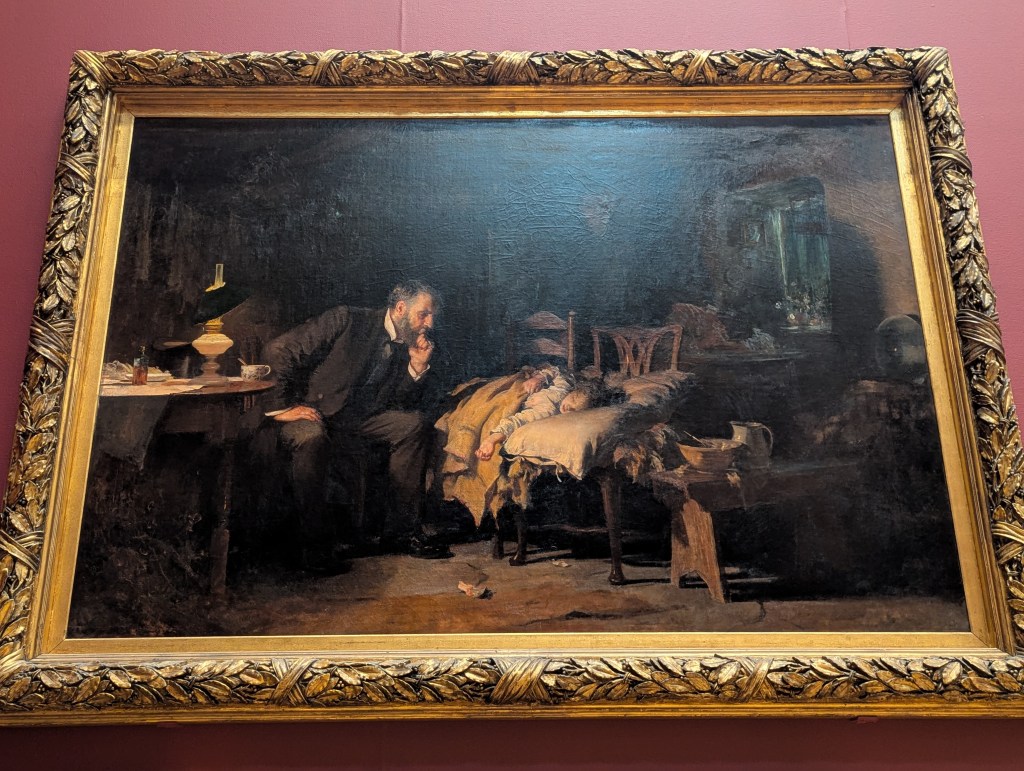
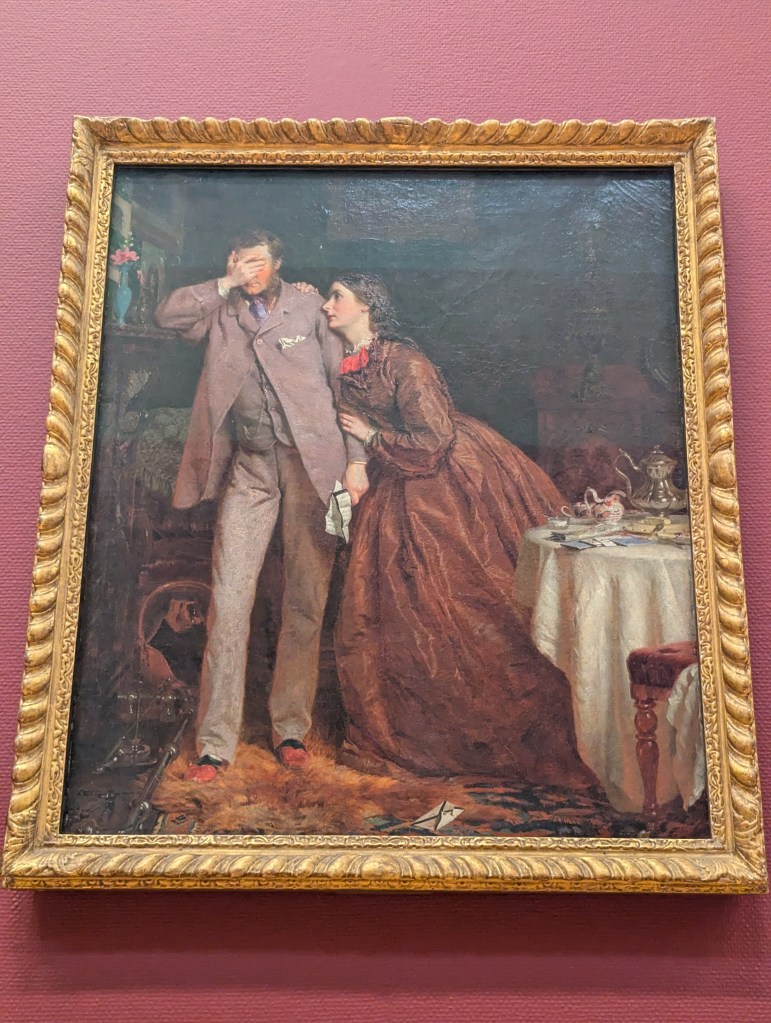
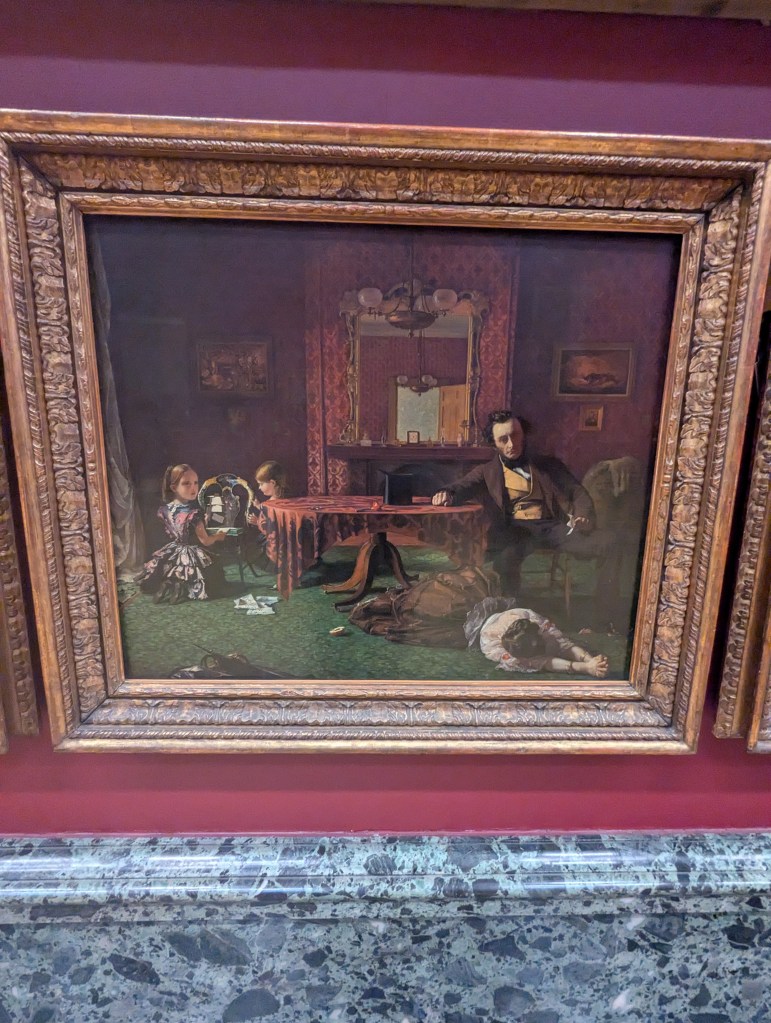
That sense of a story in the paintings comes through much more strongly in those pieces where there are multiple people in. From a Dr looking after a sick child, to men distraught – sometimes supported by their wife as in Hick’s work, at other times, as in Egg’s the prostrate woman is apparently the cause. Of course that also makes it harder to see the interiors though…

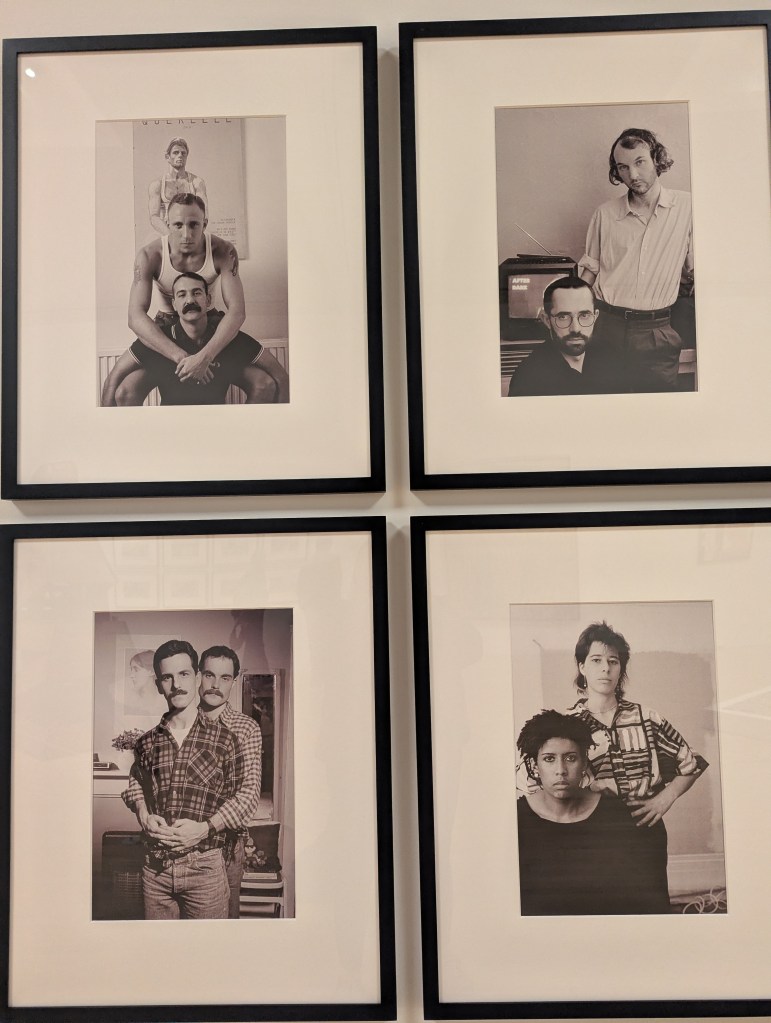
Woolf makes another appearance in the home of one couple in Gupta’s series showing homosexual couples at home. The photos were taken at a time in the 1980s when homosexuality was being portrayed as deviant whilst these photos present them as ordinary rather than other.

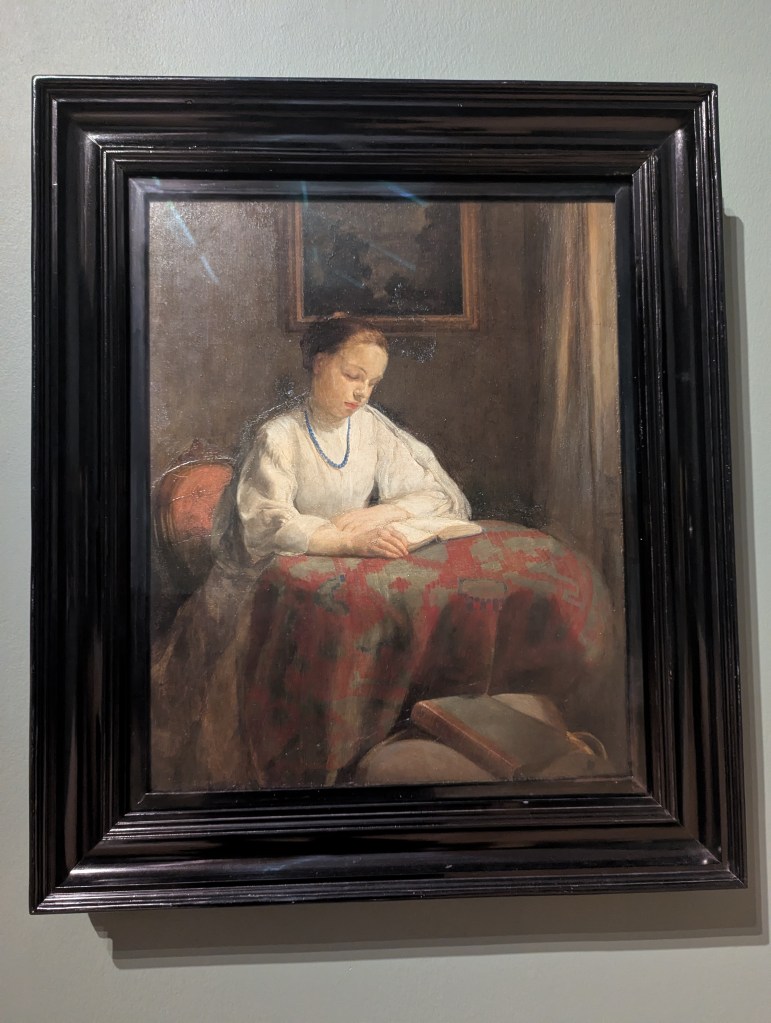
All of the paintings have a story to tell but from this collection of paintings at least, it’s a gentler story in those with just one person in. Peace, quiet and reflection in the scenes but, apart from McEvoy’s painting the interiors themselves are vibrant and busy – full of colour and objects.

More wandering and exploring, a beautiful richly coloured and empty view of the room where Shakespeare was apparently born; a side-quest visit to see the Henry Moore’s because I can still enjoy the stark, sensual beauty of them whilst working hard.

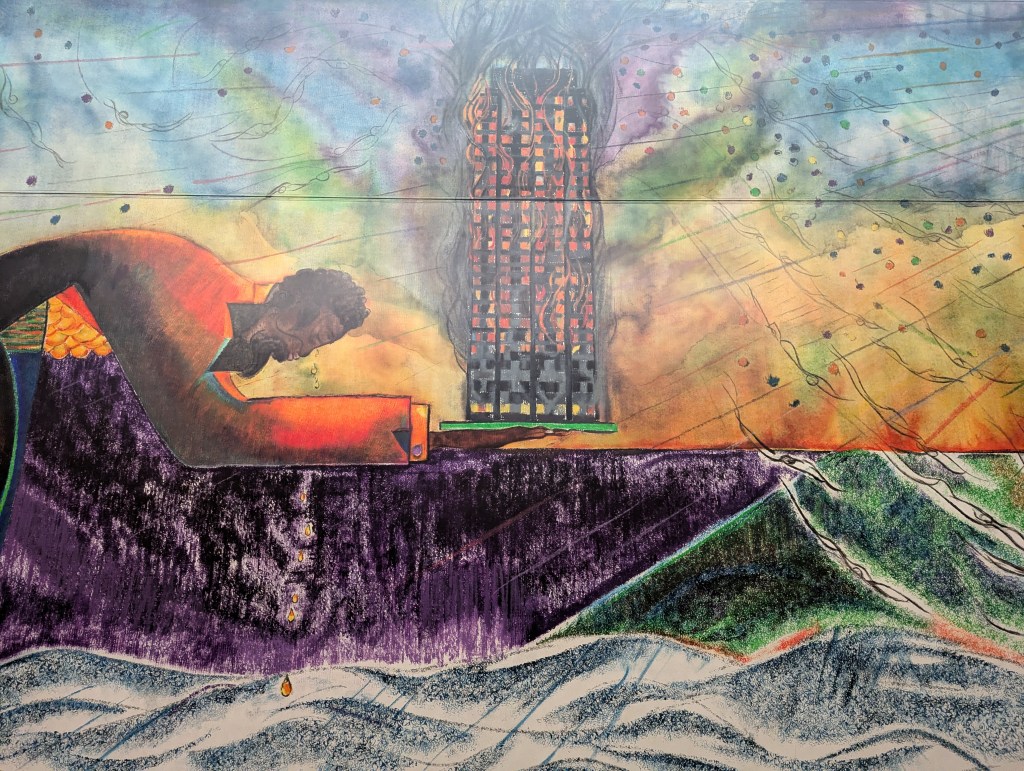
Then, as we left the building, we were met by Chris Ofili’s colourful, elegiac piece in memory of those who died in the Grenfell Tower fire. A totally different piece. The scale monumental compared to the smaller pieces I’d seen. Richly coloured and far removed from the gentle, quiet reflections. As with some of the other pieces, telling a story about when things have gone wrong, failings and harm. This time, at a societal level rather than between two people. The painting itself has a dreamlike quality about a nightmarish situation.

Chris Ofili, Requiem, 2023

Only a few pieces of art found on my visit but that small selection shows just how varied homes and home-making and un-making can be, how fundamental they are to our lives and wellbeing.

Moons and moons and moons

Talking about other planets often seems to be another way of talking about Earth. ‘Orbital’ by Samantha Harvey, the poetic, beautiful book about a day in the life on the International Space Station, much of what made it so wonderful to read was being taken to somewhere else I’d never get to go to and seeing Earth afresh. Being shown the wonder, richness and improbable aloneness of our Earth in the universe.

In ‘Moon’, Duncan Jones’ 2009 film, so much of the story is about the focus of Sam Rockwell’s character Sam Bell on looking after himself as he counts down towards the end of his three year stay on the Moon so he can return to Earth, his wife and family. Sam is all alone on the Moon, alone apart from an AI helper and ‘buddy’, mining for helium-3. He is limited to getting intermittent messages from them as the live communications links between the Moon and Earth are down.

At the start of the film we see Sam trying to keep himself together physically and mentally. The toll the work, location and dislocation from home, his life and family have taken on him is increasingly apparent. We see how much he wants to get back to Earth, to his home and family, how close it all seems and yet how far given what seems to be a declining state of health. As the film unfolds, we watch his health deteriorate.

Seeing him as he gets physically injured, as his mental health seems to be affected, it felt like I was seeing the madness of our pursuit for energy playing out on one person. Getting sick and going mad as an allegory of our collective madness. How this plays out on him – his health suffering, physically and mentally scarred, bruised, burned and eventually left for dead. Disconnected from those he loves, watching them from afar, intermittently, as they grow and change without him there.

Heidegger talks about how technology can alienate us from ourselves and our true sense of being. That we are all beings in this world, having relationships to each other but technology can lead us to see nature and other people simply as raw materials. This takes us away from our sense of self, our way of being in the world which Heidegger sees as crucial to our humanity. Although there’s much to criticise Heidegger for – professionally and personally – ‘Moon’ gives a cinematic view of what that disconnect can look like.

The distant company Sam is working for, distant both physically and emotionally, seem to be operating from this Heideggerian perspective – they give meaningless platitudinal reassurance but don’t do anything to fix equipment or look after him in ways which would actually be useful to him. Sam continues to work even whilst he is unwell out of a sense of obligation. Potentially also because it is hard for him to imagine what it is that he would do if he doesn’t work. He has some interests there – making a model replica of his hometown and exercising – but his whole life has become so built around the work that perhaps he needs to keep working to not have to grapple with who he is without the work. That there isn’t anything there for him apart from the work, so he needs to keep working to help make sense of the place.

Seeing the mining unfolding on the Moon, what I think of as a pristine environment, somehow seems more shocking and throws into further relief what we are doing on Earth. Compared to earth, where it’s estimated there is only about 100kg globally, the amount on the Moon is relatively more abundant. Although there is only a low concentration of helium-3 on the Moon, different samples have found up to 10 parts per billion(ppb), with the average about 4 ppb, it’s still something lots of companies and organisations have considered or investigated. Currently helium-3 is used in a few ways, including in cryogenics and quantum computing but it’s also considered a potential future source of energy, as the film proposes it is used. The film shows the Moon’s surface getting utterly churned up as Sam tries to find crumbs of helium-3 to send back to Earth.

Reading about energy transitions and one of the key discussions in that area is whether there have in fact been energy transitions or whether it’s simply a case of energy additions. The argument for energy transitions is about progress away from older energy sources and bringing online new ones. Particularly one, the discussion is about a transition away from filthy fossil fuels to cleaner sources of energy – renewable sources such as solar, wind or hydroelectric, as well as cleaner by some metrics ones such as nuclear.

Fressoz’s book ‘More and more and more’ talks about how, rather than energy transitions, what we’ve had, and are going through, are energy additions. What we’ve seen over time, and see still, is energy additions, we’re still using old technologies. Data from ‘Our World in Data’ shows that more traditional biomass is burnt globally now than 100s of years ago. We’re still using coal and gas. This year has seen the highest ever level of coal usage globally. Whilst more renewable technologies are coming online, we’re also seeing an overall increase in the amount of energy being consumed globally.

As Fouquet and others show – for instance in Fouquet and Pearson’s 1998 article ‘A Thousand Years of Energy Use in the United Kingdom’, the more energy that becomes available, and the more affordable it becomes, the more likely we are to spend any disposable income on energy. The more people are using energy, the more it becomes worth investigating how people can more efficiently use energy, or finding new ways to use energy. So then it becomes more affordable, and more normal, for more people to use energy. Then we go around the loop again.

Shove talks about the adoption of practices and how comfort becomes something that people seek. This feedback loop between availability, use and rising expectations or changing norms can then feed off itself. We can justify the mess we make of places on Earth or, in a potential future, the Moon or indeed other planets – apparently Jupiter has the most helium-3 of all the planets but that’s even more inaccessible than the Moon – because of all the uses we make of energy.

I found the watching ‘Moon’ to be an unsettling story in many ways, yet it was also like watching a story I’ve seen many times before. The film provided a near-future reflection on scenes and stories that continue to be played out across the world for other resources.

It takes how long?

One of the biggest differences I’ve experienced so far in the move from work world to a PhD is having more time to do things.

In previous roles I was used to covering lots of vacant posts, having work plans for the days and weeks of myself and my team that I would constantly juggle as new ‘urgent’ things came in which meant re- and de-prioritising things. Whether it was true or not, and I definitely feel there’s been an outbreak of busy-ness amongst people that even as I try not to feed into myself, either in terms of talking to myself or presenting my workload to others, I always felt like there wasn’t enough time to do things properly.

I think I was good at coaching other people to accept that not everything needs to be gold-plated, and good enough is great most of the time. Even within that, it often felt like myself and my team were being asked to do pieces of work without much time to really explore the subject, consider options, understand the wider landscape or even just have time to think or proof-read things.

Now though, thoughts which I am sure I’ll look back on and shake my head at, I find myself looking at the timelines for a PhD and thinking it seems improbable to have so long to do one overall piece of work. Even thinking about it as multiple workstreams for different research activities, it seems like a really long time relative to the kinds of timings I’ve had before. The fact I’m the only one doing the work, whereas in work world the project plan would be capturing activity for the whole team I was managing, is obviously a big difference.

Things can take longer than I think they will take and one of the things that I have been noticing as my PhD unfolds, is a tension between expecting or being used to doing things quickly, and having the time to be more considered or thorough. Often when working on something now I have a voice in my head that has checked how long it’s taken me to do something and thinks I’ve been too slow. I then chastise myself for being slow and get into a back and forth discussion with myself about if or how I’m being slow. Taking turns to prosecute or defend myself.

Looking more widely, beyond an immediate task to the list of things I’d love to do, then more widely still to issues and challenges in the world, such as climate change, there’s a sense of urgency. A want and need for things to be moving more quickly. A sense of the impacts building up, spiralling out in time and place to this and future generations, all affected by our slowness and inaction. Or back to myself, thinking about all of the things I’m not doing, can’t do, will never do. That suffocating sense of it, rage and fury and want and need.

Then as I’m writing this, I see a man walk past my window, or in truth, very slowly shuffle past my window. I’m distracted from writing this piece, exploring my own sense of frustration and astonishment at the opportunities I have by him. It takes him, relatively or comparably, longer to pass through my line of sight than I would expect it to take me. For him, on the basis of the times I’ve seen him go by, that seems to be his normal, glacial pace. Everything he does or plans to do must presumably be calibrated to how long it takes him to get places. The actual him, not the him he perhaps used to be or wants to be. Maybe he and I might make the same journey but his expectation of timings might be double what mine would be.

As I look back to a screen full of news reports about how climate change has likely made Hurricane Melissa four times more likely, the fraying consensus around the need to act on climate change, slow progress ahead of the upcoming COP30, it all feels so very slow. Too slow. The urgency not matched with action.

I try to soothe myself with thoughts of the man shuffling past my window, telling myself that sometimes things just take longer than it seems they should take. That he might not want things to take so long either, might also be furious and frustrated but that doesn’t make things faster, probably the opposite.

I stretch and play with the analogy, coming back to it over and over to see if it can help me think differently. To find a way to translate the dignity of the man shuffling by, still trying and doing, into something that makes sense of what I see around the action on climate. For now at least I just have to hold those different things in the same view because they don’t feel like they can easily be reconciled. Things can take too long, longer than we want or need and things flow from that – sometimes good, sometimes bad, often unclear at the time or changing in hindsight. Back to the same message, over and over, to just start from where I am and do what I can. Sometimes that feels enough and sometimes it doesn’t.

Back to the future

Visiting archives is a way to physically connect with the past, so I am keen to do so as a way to explore the stories that shape how we understand homes, communities, and change over time. As soon as I stepped into the Southwark Archives I realised that of course this is what an archives should smell like. That slightly dry, dusty but richly inviting smell. Absolutely ideal.

From that on-point smell, my visit to an archives only got better. As a first-time visitor to an archives, and going in an exploratory way to get a sense of the lay of the land, I didn’t have much of a sense of what I’d find, how it would all work.

The amazing archivist that I’d e-mailed before I arrived had, on the basis of a very broad set of parameters, collected together some information for me and it was all laid out ready when I arrived. I just delved right in, looking to see what piqued my interest, or felt like it related to my PhD.

The generosity of this work, people working to preserve parts of the past and help others make sense of it just blew me away. Watching one of the archivists respectfully and patiently respond to a million questions from a couple of people who had booked a visit. Finding and helping, making resources available and helping people who are coming to the archives with all kinds of interests and questions. The act of archiving, as they acknowledged themselves when talking about the changing norms in society, is obviously an act of choosing what is important, what should be kept, that says something about the time, place and people – even if those views reflect a worldview that most of us would now no longer agree with.

It was so incredible to actually physically hold documents going back over 100 years. Although virtual things are great and give us access to so much information easily, that sense of literally holding parts of history in my hands had me feeling quite emotional at times. The more so because most of what I looked at was the stuff of everyday life – brochures, flyers, news stories and reports. Often it’s the so-called ‘extraordinary’ moments that get recorded – moments in which most people are observers rather than participants, such as sporting events, the details of rich peoples lives. It was really lovely to see a richer reflection and recognition of people’s lives beyond that small slice of it.

Even though I felt like I was in hunter gathering mode, rather than really processing what I was seeing, there were still some themes which came through:

  • the care people put into looking after each other – the different schemes and plans to look after each other, to try and find ways to help people live healthier, better lives
  • an increasingly common mismatch between the amount of funding needed to look after, let alone improve social housing and what has been made available
  • restrictions on how people can live in homes they don’t own, regulations from an 1897 publication, much of which would still feel familiar today
  • different manifestations of the tensions between people and other creatures. Lots of news stories about rats, ants, mice, cockroaches and other insects and animals that are trying to make themselves at home

There were also some fascinating gems, including:

  • a sense of the changing expectations of homes coming through in a drawing from a 1928 publication. This proudly showed a lovely home that had a properly plumbed in bath in the kitchen. This would now be considered unacceptable but was then considered quite an upgrade
  • photo’s and stories from people giving glimpses into the different ways people navigate the world and place their home within it – from the landmarks around the place a registered blind person uses to orientate himself, to transient spaces briefly becoming homes for homeless people
  • Montagu H. Cox, the Clerk of the Council, wrote in January 1928 about ‘the housing problem’ in a way which felt both humble and yet purposeful – ‘These are striking figures (numbers of homes built), but it must not be supposed that the housing problem is already solved. Slums have not yet been wholly swept away, nor have houses yet been provided for all who need them. Moreover, the housing standards of to-day will not necessarily be those of to-morrow, and some areas not at present classed as slums are certain in course of time to come within this category. Nevertheless, much has been accomplished, the lines of future progress are more clearly discernible, and the time has been brought appreciably nearer when it may be possible to say that the solution of one of the most difficult and serious social problems of the age is at last within sight’. Much in there which would still hold true – from housing standards changing to homes and areas changing in character. That sense of a solution, written in a beautifully printed and bound book, looking positively to the future felt tonally very different to much of the public discourse we see and hear now about what’s possible.

My favourite find though was in the seemingly unlikely place of a 1939 brochure by the Borough of Bermondsey Electricity Committee. You’d be forgiven for thinking this might be an offering as dry and dusty as the air in archives but you would be wrong – richness indeed in that brochure, as in the archival air. Here’s a small sample from ‘The magic of electricity’:

‘Once upon a time, a little girl named Alice discovered a Wonderland where philosophic caterpillars smoked hookahs, and lobsters danced quadrilles, while the Mock Turtle sobbed without ceasing – a queer quarrelsome Wonderland of muddled magic. There was a lovely garden in this Wonderland, but Alice could not find the way into it until the middle of the story, when a golden key unlocked the door the led to the bright flower-beds and cool fountains.

Housewives who use the old-fashioned methods of lighting, heating, cooking and cleaning are just in Alice’s shoes. They are surrounded by a quarrelsome Wonderland of smoky fires, inadequate lighting, dirt that needs continual clearing away, and unending labour over the simplest tasks. They have not discovered the key that gives access to the lovely garden of Leisure – the golden key that is clearly marked “Electricity”.

With this little book, the Electricity Committee presents every modern Alice who lives in Bermondsey with the key.’

Key’s indeed to be found, in that brochure and the rest of the archives. An absolute privilege to be able to explore them, my first visit but hopefully not my last to that kind of ‘quarrelsome Wonderland’.

Seeing is believing?

With all of the discussion about clean energy transitions, it can feel very abstract for most people. Massive power plants, huge wind turbines.

Talk about the energy transition seems like it would feel more tangible and real to people if they are actually part of it. Every day you’d be likely to see your panels, or those of your neighbours. The talk of a transition would feel like something you were a part of. It would feel true and real and you’d be able to see how your life was better as a result.

Public acceptance of solar across the board seems to be high. The recent ‘Britain talks climate and nature’ report by Climate Outreach found only 11% of people don’t like seeing solar on roofs. That’s a huge level of public acceptance of a measure which can make quite a difference to the aesthetics of a home or street. People are also much more likely to get solar if their neighbours have got it, creating a potentially virtuous circle in terms of acceptance and take-up.

Solar installs are much quicker than lots of other measures, and less disruptive too. In terms of integrating solar into day to day life, there aren’t really any adjustments needed once it has been installed. Unlike with heat pumps which require space to be found for them and then they are using that space on an ongoing basis.

Immediately people get a benefit in terms of the energy being generated but there’s no lifestyle changes needed to be able to use it. There are lifestyle changes you might be incentivised to make as a result of having them – switching some activities to during the day, like using the dishwasher or washing machine – but if you don’t you are the one who might lose out.

With other energy efficiency or low carbon measures, there might be adjustments which are needed to make sure it works properly. There are also potential risks from an energy and climate perspective of the rebound effect. For those who have been under-heating their home that can actively be a good thing in terms of moving to a level of comfort which is better for health and wellbeing.

Directly providing measures which improve homes could also go some way to addressing the phenomenon Chen et al, (2025) identified, where the messaging on affordability doesn’t resonate with those on low incomes. This is something that people within the environmental sector can focus on around the benefits of some measures or the approach to decarbonisation more generally. So it’s humbling but helpful to get some insights into why that message can actually alienate many of the people it’s specifically trying to help. That messaging makes people feel nervous thinking about the costs because they don’t feel they can afford it. This is exacerbated by the fact they don’t think they will benefit from any transition so the costs are for them but not the benefits.

Being able to tangibly show people it’s for them can change that. With some things, like insulation, the measures themselves just aren’t visible to people unless they’ve been badly installed and then it becomes apparent through the mould, damp and other structural issues. Otherwise the impacts of the insulation can easily become invisible. People tend to take the savings from the energy efficiency and use it to fund an increased level of comfort – which can be the intention in fuel poverty schemes – or the savings get lost as prices rise anyway. So people feel frustrated because they were expecting a reduction in costs and instead see an increase.

In the medium term increasing the deployment of solar will also make it easier to shift costs from electricity to gas because people are less reliant on gas. Making that change is something that needs to happen to support the electrification of energy. Given most people are currently reliant on gas for their heating and hot water, there is an understandable concern about the impact of that shift on people’s health and incomes. Reducing the cost to people of electricity through the provision of free solar can then create the space to fairly and progressively make changes to costs.

Finding a way to give people a more tangible sense of ownership of the move to a decarbonised future feels utterly fundamental to getting people on board. Solar could be one way to do that, to allow people to see themselves as part of, and benefiting from that change.

Half-price posters at the Union

Every discipline or work area has it’s own activities and customs. Things which seem normal and are understood to those who are part of that world, that create a sense of belonging and give a shared vocabulary.

Moving into academia means I’m constantly discovering new ways of working or things which are part of this world that were previously unknown to me. There are plenty of situations where that sense of not knowing can feel stressful and hard, luckily so far it just feels novel and a sign of how different the world is that I’m discovering these things.

At a recent conference, during the break, one of the Professors said he was going to see the posters and invited me to go with him to have a look.

My immediate thought was that there was a half price poster sale at the Union and we were going to see. Which seemed incongruous but why not, they can be very good value.

Turns out we were going to see posters made by the people presenting at the conference, displayed as a kind of exhibition. Posters are ‘a thing’ it transpires in academia. The act and art of making a poster is a way to convey a lot of information about the project to people. It needs to be concise – both verbally and visually for people to be able to easily navigate into the project.

There can be competitions at those kind of events as to who has the best poster. So the poster itself becomes something that people try to do well, beyond and alongside the communication about the project.

I had various chats with people who are more in this world about posters, and they talked about the challenges of putting together a poster. From the difficulties of being able to find a good printer to be able to print off an A1 poster, to the need to have one on hand so that if an event appears at short notice then you’ve got a poster ready to go. I went to put need in that previous sentence into quotes, and even doing that I realised how I’m not yet in that realm – for those who are more embedded it’s as much of a need as lots of other things might seem to be for me.

Navigating through a world that feels very different to ones you’ve known before is an amazing opportunity, and I constantly feel like Alice through the looking glass. In this situation it was an easy and fun one to discover. It struck me both how improbable the transition is, with this serving as another point of difference to my previous work, whilst also reminding me how hard it can be to explore Rumsfeld’s unknown unknowns.

Separated by a common language

In making the shift from policy and delivery to academia, I definitely wanted, want, to try and share the learning as I go. Keep the connections up with those I worked with in what now feels like a whole other lifetime. Make sure the work that I’m doing is useful and can help to increase the considered and urgently needed action. Share the fascinating research that lots of colleagues in the sector would be interested in, find useful and are probably unaware of. Helping to find ways to avoid the groups from talking about the same things in different ways and often not to or with each other.

I’ve asked around around for ideas on how I can share the learning as I go – glazed expressions on all sides when I say this.

Policy and delivery people don’t seem to have any frame of reference for this concept. Which I can’t be surprised by. I’m unable to think of many examples from my own experience in policy and delivery to draw upon. A previous organisation I was at explored doing an Area of Research Interest in the subject I was working on but the decision was taken not to proceed. Given we had found it hard to identify something suitable that both needed to be done and could justify time, yet could wait at least 6 months until it was done, it was hard to argue with that. Academic work can feel too abstract, too wrapped up in complicated, impenetrable language for many people in policy or delivery roles to engage with

On the academia side of things, when I asked one of the Professor’s at my Uni about external activities, networks and dissemination he said it was the first time he had been asked that by any student. That said, there is some work going on trying to bridge the gap and I’m keen to get in amongst it where it is possible and seems to make sense to do so.

There’s still plenty of disconnects though. So much great research I’ve seen, which I’m obviously not going to name, is seemingly aimed at policy makers. Referencing policy implications either directly in the title of the piece or within the framing of the article. Yet it’s really hard to see what the recommendations are, beyond the classic more research is needed. Setting aside the fact that lots of articles include or present content in ways which don’t seem aimed at policy makers, I’m only scratching the surface of the work that’s been done and yet there are very few pieces I’ve read which make it clear what they think the policy implications are of the work. Of course there are lots of reasons why that might be the case, from a reluctance of academics to be seen to be political or proscriptive, to not feeling comfortable asserting something unless it’s clearly evidenced. Yet policy makers have to take action and make decisions, even when they are dealing with imperfect information.

I’ve not yet found a clear template for how I can share as I go, how I can help to bridge the gap. So it’s a question of exploring and seeing, trying and connecting up with others. Looking at where and how I can start to make that intention true. What existing things are a good fit and where I can helpfully add to those or where I can make my own. Let’s see…

Don’t hate the player, hate the game

Part of being able to make a good argument is holding on to the core of something that is true and being able to represent it in language that means something to the other person. Being prepared to go to where they are, to try and reach them and bring them with you. It’s not about you and your ego and what you need to say – you can get anything done if you don’t mind who takes the credit. The end justifies the means.

Conceptualising things in terms of the cost and value is a way of making things analogous, or at least finding some way to consider very different things. A way to meet and discuss things with people who might not share the same emotional attachment. To be able to make choices.

What if the means make it harder to get the ends though?

In trying to make the case for environmental action, we’ve spoken in the language of economics. The hard crunchy things that people care about, or at least can use to reach decisions. The factors that respond to the boxes and templates on the various applications, briefings, funding requests that are the ways of getting things done in lots of organisations, lots of parts of society.

Nature has a value of this. Without bees we’d be c.£120bn worse off per year. Energy inefficient rental homes cost the NHS at least £145m a year.

Framing things this way also helps to create a veneer of normality for trade-offs which would otherwise seem monstrous or unacceptable. It also helps to reinforce the frames and parameters – a tacit agreement that this is the ‘right way’ to look at things, to make choices, weigh up options. A shared language for things, or more perhaps, a seemingly shared language but really it belies some big differences in priorities, values, how to weigh things up.

This distancing from the emotional then maybe creates some stress – knowing that there’s a disconnect, putting your faith in something you don’t entirely trust, not feeling like you’ve got much control or agency. Feeling a bit shabby and tawdry, like you’re selling out, or being dishonest because the framing feels stifling, hiding the things that matter.

More importantly though, this framing hasn’t catalysed sufficient action.

Environmentalists, and indeed people working on other issues such as civil liberties or health for instance, have done the things we’re supposed to do. Spending precious time coming up with assessment methodologies to put a ‘value’ on a tree or landscape, or work out how much someone’s bad housing has ‘cost’ the NHS. Then watching as the things we care about get traded off against other things – often things which will make what we care about worse such as new roads or runways.

In lots of ways that’s fine. As I wrote in ‘Picking your poison’ – making decisions is about making trade-offs, accepting that you can’t necessarily have it all and therefore you have to choose. Losing an argument isn’t always a bad thing. Sometimes your ideas or proposals aren’t right, could be better, have areas of weakness which need to be reviewed and reassessed. It can create a space to build better connections with other subjects, organisations or coalitions of the willing.

Sometimes though, losing the argument, and then keeping on losing, just makes it more urgent to win sometimes. From climate and biodiversity perspectives, the longer it takes to ‘win’ the argument, the more worrying things become in terms of impacts. Therefore the more action needs to be taken to try and respond, which is then less appealing to more people. So we go round that loop again and again.

In a different time and in relation to a different context, Gramsci said ‘The crisis consists precisely in the fact that the old is dying and the new cannot be born; in this interregnum a great variety of morbid symptoms appear.’ There are currently plenty of ‘morbid symptoms’ in the UK and internationally – on migration, health, civil liberties and, well the list is a very long one. The sense ‘That’s your bloody GDP not ours’ seems to still be true for many. It feels like the lack of space for care is part of what has created these symptoms. That people are protesting about the effects and looking around for politicians, proposals and stories that offer something different.

Feeling optimistic at this point can by turns feel naïve and necessary. Yet I love the quote from Rebecca Solnit’s ‘Hope in the dark’, where she takes the idea of hope as something passive and turns it into something more active. She says ‘“Hope is not a lottery ticket you can sit on the sofa and clutch, feeling lucky. It is an axe you break down doors with in an emergency.’

It feels like the current situation creates the space and need to shift from the stories we’ve been telling about the financial value of things, and gives more urgency to telling different stories. Ones which resonate better with people – both those who hear the stories and also, for many who are telling them. Most of us can’t do something directly about the stories politicians tell, even those we would expect to be doing better. Trying to find ways in our days and actions to tell better stories ourselves and to try and make the case to care is something we can and must do though.