Walked the homes

Do Ho Suh’s exhibition at the Tate is so titled because traditional Korean buildings known as a hanok can be disassembled and reassembled elsewhere, a process of ‘walking the house’.

It was wonderful to be immersed in someone expressing different aspects of the home. From the physical aspects to the emotional and temporal. Seeing them all overlaid together, as they are for people most of the time but which feels rare to see in artworks. Homes can often be featured in art but rarely as the main event, more commonly as a backdrop or fleeting glimpse. Something that tells us about someone but isn’t usually the main focus of the piece.

Public/private split

Homes are usually thought of as private spaces, or at least they have increasingly been for the last few hundred years. People lived together in much more communal set-ups. Sharing rooms, beds and homes. Things that we would now consider private, like using the toilet or having sex, were much more public activities then. It’s apparently why swear words were related to religion up until a few hundred years ago – that was a transgressive thing to talk about, whereas swear words now are more about sex and toilet things because they have become private matters, things to be ashamed or embarrassed about.

Here, Suh upends that, making the private public. He has houses within houses, parts of homes which have become public spaces as they are demolished. A childhood home rubbed down and rebuilt within the gallery. Every part of the exterior traced onto paper, lines and designs, to capture the look and feel of the place. Films showing homes exposed to the public as they are demolished, private walls becoming briefly public before they disappear.

Homes in this telling are not just becoming public because we get to see the private light switches and fire hydrants of previous homes but, in sharing his artistic response to his home, he’s also helping us move from the specific to the universal. In showing us where he’s lived in a way which invites us in, creates some intimacy, he’s also inviting people to think about their own home. Helping us bring our own homes into that gallery, comparing ours with his, reflecting back on our own, seeing how others live.

Gender and homes

Homes have traditionally become a place that’s associated with women rather than men, as many, including Bowlby, Gregory and McKie have reflected. Following the split between public and private spaces, men became more associated with public spaces and women with private spaces. Perhaps if the exhibition had been by a woman rather than a man, it might have resonated slightly differently. A sense of women working within the parameters they are typically afforded. Whereas having a man make art from it, and see it as something which is worthy of making art with and from, is another way of helping to show and shift that division.

Modernity and homes

Putnam identified two successive transformations of contemporary living from traditional 19th Century models of home. The first was the emergence of the modern home between about 1920-1950 when domestic spaces were designed around the technical core of sewers, water, gas and power cables. A time when these innovations were new for most people and somewhat astonishing, or perhaps a little terrifying too. The second shift he identifies is around the 1960s, when the technical, economic and political structures of modernity became part of the background of modern home life. At that point, as what he describes as ‘the material life supports of modernity are taken for granted’, the cables and sewers and suchlike fade into the background and the home becomes a space in which people personalise their space and negotiate with each other about how it looks.

In that context it was fun to see cables, wires and light fittings represented. Those life supports, especially things like cables, don’t tend to be shown and have disappeared into a sense of what normal homes look like. Often in lifestyle magazines cables and wires get edited out of pictures, as though the items they are powering magically work without showing the plugs. That it’s not cool or aspirational to need to connect in to power sockets.

Suh shows the different aspects of the home which would normally be hidden, peeling away layers of life. Simultaneously showing the modernity of the home which is taken for granted by those who have grown up with it, and also going back to the pre-modern home where it’s not taken for granted and is instead something to marvel at. Bringing them to the fore again allows for the magic and importance of them to be seen and recognised.

Making homes our own

When people move into a place they often try and remove traces of previous occupants to ‘make it their own’. Suh shows there are many ways to make a home our own.  He had to get permission from some of the landlords to make the art,  a way of taking ownership of the home – it’s his art when it’s out in the world, even if it wasn’t and isn’t ‘his’ home.

In one of the pieces, he layers up aspects of different homes – light switches and plugs, light fittings and door handles. It gave me a time-travelling sense of all of the people who would have used those light switches and door handles. The different hands that had used them, the lives they have supported. As we become more separate in our homes, with much less communal living, more people living by themselves, and even within homes as we have separate spaces, overlaying parts from multiple homes gave a more communal sense of home.

Memory and meaning

For some, home is a place of practices and habits, for others it’s a place that holds memory and meaning. The pieces by Suh blur those boundaries. The practice of making art, the holding on to places and details which act as anchors for both practices within the home and also memories.

The pieces are a way of preserving the past but also, for him as an artist, of making the future – exhibitions and work, building a body of work and meaning. Tracing the contours of the building, with his childhood home literally rubbing every part of the outside of the building, capturing the details on fabric which then gets remade into a simulacrum of his home – but not a place you could actually live within. A memory of the memory. A memory that looks like the memory, in the same way a story that gets told and retold can become a memory of the story, rather than a memory of the memory.

As Brickell reflects, home isn’t just a place where history ends up but where history emerges from and, quoting Caluya, the home exhibits ‘a certain plastic tendency that enables its boundaries to expand and shrink’. This work does that too, delicately and painstakingly tracing the boundaries of the homes but with an intention for those very boundaries to go further out into the world.

The exhibition space itself felt like things were quite crushed together and could have done with some more space to breathe. Nonetheless, providing room for people to see homes as worthy of being considered art, and not just glamorous homes but the life support parts, created a space for thinking about homes that we can take from the gallery into the world and back home again.

Bedding down

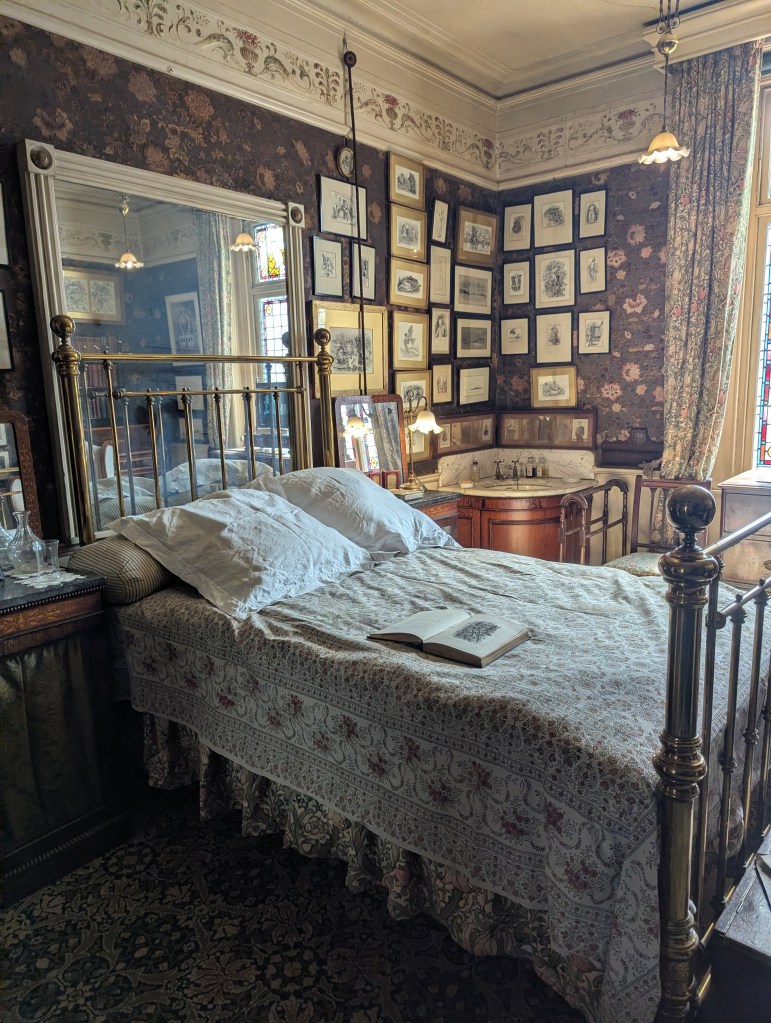
Beds have come to seem so normal but for most people in time and space, the kinds of mattresses we think of as standard in the UK just aren’t. Sleeping on bare earth – or at least, earth covered with grass and herbs to provide some kind of matting for people to walk around and sleep on. Hammocks and boxes, benches and coffin-like beds. Mattresses made of linen, feathers or straw, beds have been through lots of iterations.

My bed, I’m so happy and lucky to say, is very much not like sleeping on bare earth. It is so comfortable and either explicitly or implicitly I register that each time I get in. A daily joy and privilege. It’s quite firm but not too firm. There’s some give in it but it doesn’t feel squashed or like I’m suffocating or being swallowed up by the bed.

Yet I wonder what it would feel like for people who are used to sleeping on rolled up plant materials if they were to magically be able to try out my bed. Whether they would lie down on it and be blown away by the comfort levels, see their own situation differently. Wish for something else. Or whether it would just feel too uncomfortable. Too much. Or perhaps too little. Missing that connection with the ground. Feeling a bit unmoored from their life and homesick for something that felt more natural, rather than being on some complicated set-up.

Shove suggests that so much of what we experience as comfort is set by wider expectations. With the availability of technologies which allow us to control the temperature in rooms and buildings more easily there was a need for designers to have an understanding of what temperature range they should be aiming for. This has led to the development of a norm around temperatures in buildings which then creates a feedback loop, or ratchet as Shove describes it, which leads to increases in usage more widely. Somewhat terrifyingly, Walker, Simcock and Day found the temperatures people prefer in their bedrooms are generally lower than the 18 degrees recommended by the energy sector. This guidance can help to reset expectations and could lead to further increases in energy consumption.

So perhaps those mythical time travellers who get to test my bed might not like it if they just gave it a one-time try. Their expectations would still be with their own beds and perhaps mine wouldn’t feel right for them.

A really big shift, perhaps bigger than the actual bed technology, is the one from sleeping being a more communal activity to sleep as something private. There is a wider move to more privacy at home, and beds are just part of that. Until around the Victorian times in the UK, sleep was a much more shared experience. It used to be common for all the members of a household to bed down together. Halls were multi-purpose rooms where people would eat, work, hang out and sleep. Servants and masters, young and old sharing beds or a room. Hard to imagine that being the norm for most people in space and time, yet there was considered to be an intimacy to sharing that space. For many members of the nobility, inviting people into their bedchamber was considered to be offering or getting a huge privilege. A much more communal existence than most people have now.

This shift by the Victorians was driven partly by increased concerns around the moral implications of people sharing beds, and partly because of hygiene considerations. There became more awareness of how infectious diseases could be spread, and therefore more of a drive for people to have their own space to try and reduce that risk.

That seems impossible for most of us to imagine. A tangible way in which people from previous generations lived lives that are very different to our own.

Of course, there are now hundreds of thousands of people around the country, one of the richest in the world, for whom imagining that is easy because it is their reality today too. Families or groups of individuals sharing one room. That room becoming like the Hall of old – with one room also becoming the living, working and eating space. Sometimes the room they have to use for cooking too. Living rooms in rental places increasingly getting used as living rooms, either by the people renting having to make that decision to be able to afford the space, or landlords making that decision for people.

As with other changing expectations, the gap between expectation and reality means what once might have made a home feel communal and normal, now feels like a lack of care or respect. This creates a sense of emotional discomfort which can be just as unpleasant to live with, and in, as physical discomfort can be. Much has changed with beds and how we sleep but until we have more of a shared agreement, and actions to match, we’ll continue to have people living amongst us who have beds and sleeping arrangements that seem like time travel to most of us.

In plain sight

Always really humbling and hopefully helpful to see things hiding in plain sight that have been taken for granted that don’t quite work.

The definition of fuel poverty has changed a lot over time. Broadly speaking it’s about finding different ways to express the fact that people don’t have enough money to be able to heat their homes to a suitable temperature. There’s a separate debate about the term, and it’s not one that many people would recognise for themselves but still, those are not really for today.

There are all kinds of subtleties to that though. People’s circumstances can change for various reasons, all of which affect their ability to pay. From changes in their income – which is the main reason people move into or out of fuel poverty, to changes in the household – increases or decreases, or someone becomes unwell. There are plenty of other reasons besides but they give a sense of the fact this isn’t an absolute number that can be used as the benchmark to assess a household’s situation.

Yet when we look at fuel poverty, we look at the energy costs. This includes costs to heat the home and typically heating is the largest part of the cost. It’s not the only part of the cost. Even just looking at gas costs doesn’t allow you to separate out the heating costs, as people also use gas for hot water and potentially for cooking too.

Somewhere along the way those different aspects – assessing fuel poverty on the basis of ability to heat the home, and looking at energy costs in the round, got joined together.

Perhaps it wouldn’t matter. As many, including Druckman and Jackson suggest, energy costs for heating are more variable than electricity costs. Heating costs are more dependent upon the energy efficiency of the home and the need for different levels of comfort. So perhaps it’s a pragmatic proxy that avoids making life even more complicated.

Nonetheless, that sense of being shown by Walker, Simcock & Day how those two different considerations have been joined together in a way which isn’t articulated clearly was astonishing.

A reminder of how often there can be shared blind spots. Unspoken understandings and misunderstandings which then block opportunities or set parameters unnecessarily.

Things fall apart

It’s easy not to pay attention to the different parts of our home when they are working well. Not the things that we were already wanting to change but those taken for granted parts of home. Switching on a light or a plug socket. Flushing the toilet. The buttons, dials and levers do as we instruct them. The magic happens. Home as a machine for life.

When it works it works and we don’t tend to give thanks each time we use something. The intricacies of the technology are, for most of us, something unfathomable. An accumulation of knowledge, trial and error, insights and experimentation moulded into tools which make our lives easier. Untold hours, unexpected inspiration and dedication of people who’ve come before us turned into an easier way to make tea or clean your clothes.

Modern life has then done a pretty good job of making the technology invisible. When the Victorians put in the sewer they were so proud of the technology and what it meant, they made sewage pipes visible so people could see the marvel. They built Crossness Pumping Station – a veritable cathedral with jokes in the ironwork. Now though, underneath and through the home the wires, cables and pipes are usually hidden away. Interior design magazines often edit out wires and cables to make the place look tidier, a crisper look, more aspirational.

Putnam describes those hidden sewers, cables and utility mains as forms of material life support. Home then becomes, in their view, not just a place which holds memories, or a space for socialising but a support service.

A sign of how modern, or post-modern, homes have become that these technologies are just part of how we live now. Putnam sees this shift as the second of two successive transformations of contemporary living from the traditional 19th Century models. The first shift they identify was the emergence of the modern home between c.1920-1950 when the domestic space was designed around the technical core of those underpinning material supports. They describe the second shift in the 1960s when the technical, and they suggest the economic and political, structures of modernity became part of the background for modern home life. With this shift, where basic aspects of how we are fortunate enough to live become taken for granted, ‘home becomes the supreme domain for personalization and, by consequence, of endless negotiations’.

Moving up Maslow’s hierarchy of needs when we no longer need to think about the basics of shelter and care for ourselves. Those supports are woven into the fabric of our homes and the expectations of our lucky days.

Then when something doesn’t work, well, it’s then that we notice them. We feel the knock-on impacts of that on our behaviour. Things get glitchy. We have to run errands to try and get something to fix it ourselves, or to try and deal with the impacts of the thing being broken. Searching for different approaches to fix things, or just to understand what the issue is. The hope when we try a new thing. Looking for signs that it is working. Tossing aside the new when it hasn’t worked. More and more time and money getting spent trying to fix something.

Things feeling a bit more fragile and off – that this isn’t how it’s supposed to be. We bump back down to the bottom of Maslow’s hierarchy. The home shifts from the background, supportive and magical, into the foreground of problems, mess and frustration. We notice when things don’t work, we feel our luck when dealing with the loss.